Samādhi occupies a prominent role in the early Buddhist texts. It is the final factor of the noble eightfold path to which the higher achievements of wisdom, or of knowledge and vision of things as they are (yathā-bhūta-ñāṇa-dassana) are attributed. It is a profound state of serenity, differentiated into the four jhānas, through which the mind becomes progressively stilled and centered, various cognitive faculties are silenced, and complete ease and equanimity are attained.
Etymologically, samādhi is derived from sam ‘together’ + ādhi ‘put,’ and so has to do with gathering or collecting something together. Samādhi is most commonly translated as ‘concentration,’ implying a narrowing or focusing of attention. However, as we will see, concentration is one of two dimensions that characterize samādhi; the other is the progressive “curtailment” of various cognitive faculties as we progress through the jhānas. At every stage samādhi establishes an orderly array of mental faculties, and this (consistent with its etymology) recommends a translation as ‘collectedness’ or ‘composure.’ I will, for the most part, simply leave samādhi and jhāna untranslated to avoid confusion.
Etymologically, jhāna is the gerund of the verb jhāyati, apparently in use before the Buddha’s time to denote almost any contemplative or meditative activity. The Buddha sometimes uses this term in its common meaning, but alongside the technical sense of the “four jhānas,” which seems to have been novel at the time of his teachings. In its technical sense the Buddha equates the fourfold jhāna with samādhi, such that there is no samādhi independent of the four jhānas in the early texts.
Unfortunately, samādhi has become a controversial topic within the Theravāda tradition, where much confusion seems to have resulted historically, first from a redefining of samādhi, then from an attempt to reconcile contrasting frameworks that don’t in principle cohere. The debate persists even among the adherents to the authority of the early Buddhist texts, where contrasting evidence is cited for “hard” or “soft” jhānas (respectively difficult and easy-ish to attain), and where there is still no consensus about how Dhammic insight is even possible in jhāna.
In this chapter, I develop an account of what samādhi is and how it works according to the early Buddhist texts. I will point out some common, but widely neglected, passages concerning the ubiquitousness and spontaneous nature of samādhi, and about the fruits of samādhi. I will also examine some details of how samādhi is claimed to integrate in practice with other factors. I hope thereby to contribute to a fuller illumination of this remarkable multifaceted culminating factor of the noble eightfold path.
. . .
How samādhi arises
. . .
Samādhi as concentration
. . .
The jhānas
. . .
The fruits of samādhi
. . .
The miracle of samādhi, the pdf (2025)
I thought the readers of this blog could use a scholarly explanation of what the earliest texts, and therefore presumably the Buddha, have to say about samādhi and jhāna, that is about meditative states. This is a chapter from my recent book Satipaṭṭhāna Rethought.
Celsa: There is a group of monks walking for peace to Washington DC right now. Is this in agreement with Buddhism principles? Is this a Buddhist way to do things?
NOTE: Let’s back up for a moment to my last post, “Bodhidharma’s Witnesses.” The dialog between Emperor Wu and Master Bodhidharma should read like this:
Wu: “I have built pagodas and funded monasteries in my kingdom. What merit have I gained?”
Bodhidharma: “No merit!”
Wu: “What are the essential principles of Buddhism?”
Bodhidharma: “Vast emptiness. Nothing holy.”
Wu: “Who is it who faces me?”
Bodhidharma: “I don’t know.”
This dialog was truncated in the email that went out to subscribers (apparently my email manager mismanages quote blocks). Now the post will make sense, if you go back and read it.
BC (in reply to Celsa):
I don’t think the Buddha ever mentioned this specific kind of political expression, but let’s look at what the Buddha said about political expression for monastics and for householders, and at currently accepted manners of political expression.
The Buddha himself seems to have intervened on two occasions to prevent a military invasion, leveraging the high regard the offending king had for him. On the first occasion he succeeded, on the second he failed. In general, the Buddha was not directly politically engaged (unlike Jesus), but had a lot to say about society (see cintita.org > Study&Practice > Society), and the qualities of the ideal ruler (the “wheel-turning king”). One point stands out in this regard: He recommends that a good ruler seek the council of “brahmins and ascetics”). This would include, but not be limited to the Buddhist Sangha of his time, and in any case would have been a far cry more beneficial than modern rulers’ current reliance on corporate lobbyists. We can infer that the Sangha should play an influential role in the ethics of political decision making.
Walking for peace would be a means for fulfilling that role. Because monastics are so highly venerated in Buddhist cultures, this influence can be huge. Monastics even enjoy a degree of respect in general American culture, and certainly curiosity. Mainstream media tends to ignore the peace movement, but curiosity may sway even them to give the monks some coverage. Let me draw a comparison to the so-called Saffron Revolution in Burma in 2007 against the military government, in which monks emerged en masse to walk the streets chanting suttas about mettā, but were violently suppressed by the military government. There is a movie about this, Burma VJ, that can be found on Youtube (https://www.youtube.com/watch?v=mH6SrlZvdUM). I highly recommend it.
In Myanmar, and certainly in many other Buddhist countries, there is an expectation that monks will not engage directly in politics. In fact, in Myanmar monks are not permitted to vote. (However, in Sri Lanka there are monks that are members of parliament.) I agree with the Burmese position, as long as it does not exclude making an ethical point, addressed toward policy or behavior rather than particular parties. I think this is what our peace walkers and doing, as I understand it. Simply bearing witness to make an ethical point.
The problem with partisan politics is that it divides people. A monk should ideally be able to befriend anyone (yes, him included, and even that guy). We are all faulty, and we are all trying to do the best we can with what we’ve been given (really). Some of us happen to break the fault-o-meter. However, if a monk or nun is willing to talk to the person they find most agreeable, but not to the person least agreeable, they’ve lost half of the people they might offer ethical advice to. The least agreeable is the least likely to listen, but also has potentially the most to gain. Mettā practice is about learning to befriend everybody.
Alongside political engagement is social engagement in providing health services, alleviating poverty, improving infrastructure, education and other things like that. Monastic communities in Asia are commonly so involved. In Myanmar public education is very poor; the best schools are founded and run by monks and nuns, who also tend to be better educated than most. Monks and nuns also run orphanages, appeal for donations to infrastructure projects, and even found hospitals. It should be noted that the scope of these projects has grown through the invaluable model of Christian charity witnessed during the colonial period. Modern “engaged Buddhism” (a term coined by Thich Nhat Hanh) has taken some very creative directions, to my mind very much in accord with ancient Buddhist principles.
It is commonly known that Buddhism seldom proselytizes, but its practice of “reverse proselytizing” is not so widely appreciated. Here is the idea:
Bodhidharma was a mythical or half-mythical monk who lived in the fifth to sixth century. He is known for bringing Chan Buddhism from Central Asia to China. Fierce in appearance and demeanor, he is said to have had red hair and beard. Upon learning of Bodhidharma’s appearance in his kingdom, Emperor Wu, a great promoter of Buddhism in China, summoned the venerable to his court. Their conversation went something like this.
Wu: “I have built pagodas and funded monasteries in my kingdom. What merit have I gained?”
Bodhidharma: “No merit!”
Wu: “What are the essential principles of Buddhism?”
Bodhidharma: “Vast emptiness. Nothing holy.”
Wu: “Who is it who faces me?”
Bodhidharma: “I don’t know.”
Bodhidharma had challenged Emperor Wu’s tightly held preconceptions. Years ago I considered getting a group together and walking door to door carrying Bodhidharma’s message. We would call ourselves “Bodhidharma’s Witnesses.” After all, his attitude seems to have had some success in China, producing a thriving Chan movement that spread from China to Korea, to Japan (where ‘Chan’ was mispronounced as ‘Zen’) and to Vietnam, and that is alive in many more lands to this day.
In the forests and mountains of ancient China, if a young man was intent on leaving home to join the Chan monastic community, he would approach a monastery, knock on the gate, and request permission to enter. However, he would routinely be denied admittance, rather being told either that they could see that he not worthy of admittance, or that the monastery was already fully occupied. He should go home.
Determined, the young man would sit cross-legged at the monastery gate in meditation position and endure the challenging wait for the monks within to change their mind. The monks meanwhile would insult the foolish aspirant and throw rotten vegetables at him. But the young man would persist for as long as it took. Fortunately, an empathetic cook would come out once a day and offer food and water. This would go on for days, until the monks within were convinced of the young man’s conviction. They would then relent, shave his head, give him monastic garb and floor space on which to meditate and sleep.
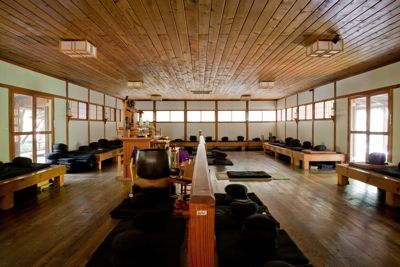
This challenging tradition continues to this day, but is often formalized. In Japan, the process is called tangaryo. In January 2002, I arrived for a three-month practice period at Tassajara Zen Mountain Monastery deep in the cold coastal mountain range of California, inland from Monterey. Any monk (men and women are both called ‘monks’ at Tassajara) who arrives for a first practice period at Tassajara must undergo tangaryo. At Tassajara tangaryo consistently lasts five days and nights, the aspirant sits in the zendo, receives meals in the zendo, but is given a real bed elsewhere to sleep on from 9:00 at night to 3:50 the next morning. Otherwise the aspiring monk has to be on their allocated cushion (standing also allowed as long as they are standing on their cushion), facing the wall, except to use the restroom, never bathing or shaving. Meanwhile other, established monks come and go freely into and out of the zendo, to sit zazen, to perform services, to learn the chants and how to ring bells and to clean the zendo, as if the tangaryans were not there. These others did so a little too cheerfully for my taste. There is generally a small group of tangaryans at the beginning of any practice period. There were about fifteen of us in January 2002, the women sitting on one side of the zendo, the men on the other.
meditation hall at Tassajara
Tangaryo is perhaps the most challenging thing I have ever done on purpose. It was impossible to actually sit zazen in the strictest sense the whole time; apparently nobody ever does. I would start off OK for a few hours, then would have to relax and think about something, remember favorite songs, daydream. When my mind would wander too far beyond control, I would induce some rigor into my practice to bring it back:
“If you find that your mind has drifted away from the daydream, just let go gently of whatever distraction has arisen, and return to the natural course of the daydream.”
Later I would return to actual zazen for a couple of more hours, then try to recall my most interesting distraction thus far. With the meal that was brought to my cushion I would drink as much liquid as I could so that I would have to go to the restroom more often, and then drink as much water as I could on the way back to the zendo. On my way back to my seat, I would furtively glance at the women tangaryans facing the wall in their baggy robes, the greatest external thrill I could squeeze out of the day, except for lunch. The women seemed much stiller to me than the men I was sitting next to, certainly than myself.
Finally, just short of one hundred and twenty hours of this, a disembodied voice manifested in each of our little worlds, congratulated us, asked us to walk up the hill to the hot springs, bathe, to put on clean robes and to join the practice period as full-fledged participants. All fifteen of us had successfully met the challenge, and sat it out. I would learn of would-be monks of the past who had given up and gone home in a huff and with a sigh. “No practice period for you.”
The tangaryo monks were additionally given an early morning duty for the remainder of our first practice period that we were to take turns performing: We were to light all of the kerosene lamps that illuminate the many paths monks use in the predawn hours, most especially to get to the zendo before four thirty zazen. This arduous task entailed getting up at 2:50 to fumble around with wicks and matches, a miner’s lamp strapped to the head, trying to protect feeble flames from the wiles of the wind.
Why would anyone want to discourage practice in this way, to reverse the easy entry into practice that proselytizing might have achieved, and to deny practice for those deemed “not worthy”? Come to think of it, denial for the unworthy is common in many walks of life. College admission often requires worthy SAT or GRE scores. Fraternity admission requires enduring some kind of hazing process to establish one’s worth. It’s a cinch that joining a street gang, especially the worst of the worst like the Sharks or the Jets, requires proving one’s worth by performing a ghastly misdeed, such as stealing a police officer’s badge or getting an ill-advised tattoo.
So, why not let anyone who can navigate the mountainside-hugging road to Tassajara stay there and practice, anyone who can find an apartment near campus attend classes in Ethnographic Research Methods and such, and any kid in the neighborhood join the local gang? I think the answer is that requiring aspirants to make that challenging initial investment promotes excellence. Having made that investment the aspirant will not forget their commitment, nor doubt their ability to fulfill that commitment. Moreover, they will also have joined a community of aspirants who can say the same thing—like-minded, mutually inspiring and mutually supportive individuals. Together they have created an environment in which practice can thrive in excellence if not in numbers. But as an excellent community they will inspire new aspirants to make that same initial investment.