
The wise one established in virtue,
Developing composure and wisdom,
That ardent and prudent monk,
It is he who disentangles this tangle. (SN 7.6)
Wisdom
home > study & practice > wisdom
Virtue (sīla, or visuddhi) and Wisdom (paññā) are intertwined. Caught in lust or hatred, we become stupid. Ignorant, our ethical choices go awry. If Timmy and the cookie jar both come crashing down from atop the fridge, we will be equally likely to inquire about his impassioned behavior (“What got into you?”), and about his faulty apprehension (“What were you thinking?”). Sometimes we distinguish the two. If Timmy had been trying to prepare a snack for his mother and a visiting guest, the guest is likely to exclaim, “Well, at least he meant well,” absolving him of unethical behavior, but not of foolishness. On the other hand, we also say that “the road to hell is paved with good intentions.” The Buddha simplifies things: For the Buddha, both vice and ignorance are simply unskillful kamma, for kamma can be of body, speech, or mind. Likewise for the Buddha, developing virtue and wisdom are like two hands, one washing the other. In the end, virtue is our primary purpose, but ignorance underlies vice, and so virtue cannot be perfected without the perfection of wisdom.
The wisdom teachings and their practice belong to right view and right attitude. The bulk of these teachings are pointers to factors of verifiable human experience, and give particular weight to their mental component as they appear in awareness. This gives Dhamma its psychological, and empirical qualities. The practice of wisdom is contemplative, and focuses primarily on Dhamma investigation (dhamma-vicaya), which is close investigation, familiarization, and internalization of the these teachings in our own observable experience, placed under the microscope of composure (samādhi). The result is knowledge and vision of things as they are, a deep insight into the mechanisms of cognition that fabricate our experience of the world, so that we might experience otherwise, in a healthier way. Right attitude adds an experiential overlay on the world more directly, through seeing things beyond attachment, ill-will, or harm.
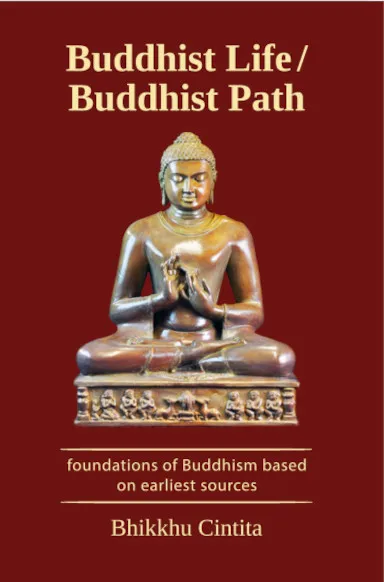
Bhikkhu Cintita, 2025, Buddhist Life/Buddhist Path: foundations of Buddhism based on earliest sources.
The wisdom teachings are discussed in chapters 7, 8 and 11.
1. Knowledge and vision of things as they are
The culmination of wisdom practice is the attainment of knowledge and vision of things as they are (yathā-bhutā-ñāṇa-dassanā). From the get-go it should be made clear that this is not insight into objective reality, that is, of what would still be true in the world “out there” even if we were not there to be aware of it. It is rather insight into subjective reality, in particular, of how our own cognitive mechanisms come to experience things as true “out there.” In short, knowledge and vision are epistemic insight, rather than ontological or objective insight. In fact, knowledge and vision end the hubris that we can reliably say anything ontologically substantial about the world “out there.” We learn to experience that world as empty. This is a hugely important point, if one is to understand the early wisdom teachings.
We generally begin Buddhist practice foolishly entangled (as in the opening verse above) in layers of faulty presumptions: fixed personal views, conventional ways of conceptualizing the world, clever ways of justifying our own actions as well-intentioned, all the way down to what we think exists from its own side, independently of what we think. The Buddha, ever skeptical, questions it all. For instance, most of us are convinced that we contact “reality” directly. We show up and there it is: physical reality all around us, and it would be there even if we didn’t show up. There is “me,” able to perceive that world from my own side, but also able to be physically present as an agent in that world. That “me” is right at the center of the Buddha’s critique of a substantial reality.
For the Buddha, the important question is “How do we come to presume what we are convinced is true?” The Buddha describes the key to acquiring wisdom in a concise simile in the Phena Sutta:
“Suppose, bhikkhus, that a magician or a magician’s apprentice would display a magical illusion at a crossroads. A man with good sight would inspect it, ponder it, and carefully investigate it, and it would appear to him to be empty, hollow, insubstantial. For what substance could there be in a magical illusion? So too, bhikkhus, whatever kind of consciousness there is, whether past, future, or present, internal or external, gross or subtle, inferior or superior, far or near: a bhikkhu inspects it, ponders it, and carefully investigates it, and it would appear to him to be empty, hollow, insubstantial. For what substance could there be in consciousness?”
The Buddha likens consciousness to a “magical illusion.” A magical illusion presents a convincing “reality” to an audience. Consciousness likewise presents a convincing reality to the common worldling. However, a skeptical viewer of the magic show might slip behind stage, gain an alternative perspective, and see how the magician conjures up this “reality” with the aid of various props and slight of hand. They would experience the situation otherwise. The practitioner intent on wisdom gains a contemplative perspective on consciousness, and sees how consciousness conjures up a convincing “reality” with the aid of various cognitive factors that play a conditioning role in consciousness. Pondering and investigating consciousness itself is how we gain wisdom. The “reality” that we think is “out there” turns out to be, from its own side, empty, for it is never independent of the mental phenomenon of consciousness needed to observe it. We learn to experience the world otherwise, once we see that the mind is making it up. In fact, for the Buddha, “the world” is entirely the world as we experience it, not some independent reality “out there.”
“In this fathom-long living body, along with its perceptions and thoughts, lies the world, the arising of the world, and the cessation of the world.” (AN 4.45)
Wisdom is to see how we make things up. We gain wisdom by direct observation the cognitive mechanisms as they fabricate the reality we experience as true, then cause us problems as we attempt to live and act in that reality. Unfortunately, this principle is not widely recognized among teachers and scholars. It is unfortunate, because without understanding this key principle, the Buddha’s wisdom teachings are unlikely to make sense. With an understanding of this principle comes the full realization that we are free to experience the world otherwise, in a less problematic, more skillful way.
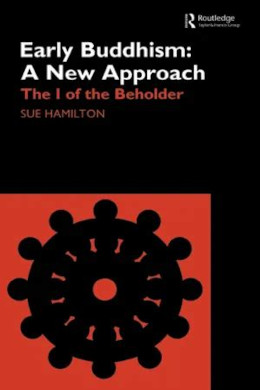
Sue Hamilton, 2000, Early Buddhism: a new approach, Routledge.
This is perhaps the clearest exposition of the epistemic basis of knowledge and vision of things as they are. It makes the point that the focus of the Buddha’s investigations were subjective, rather than objective. The Buddha discovered that the “object world” dependently originated in subjectively observable cognitive processes.
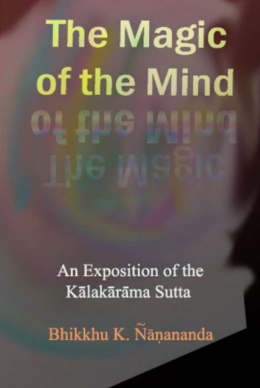
Kaṭukurunde Ñāṇananda, 2019 [1974], The Magic of the Mind: an exposition of the Kālakārāma Sutta, seeingthroughthenet.net
This is a very short, very insightful discussion of the magic show simile discussed above, which also illustrates the epistemic basis of the Buddha’s wisdom teachings. Venerable Ñānananda was a Sri Lankan scholar-monk who has had a profound influence on my own understanding of the Dhamma. See additional works below.
2. Teachings and their observables
The Buddha gives us a large set of individual teachings, many akin to thought experiments that, when subject to Dhamma investigation, open up options to experience the world otherwise, less presumptively.. Examples of such teachings are impermanence, non-self, the aggregates, the sense spheres, and dependent co-arising. Such teachings are not abstract, sweeping, philosophical proclamations. Quite the contrary, they are quite observable, and therefore verifiable in our own subjective experience if we look carefully. This direct empirical quality is characteristic of Dhamma.
The Dhamma is well expounded by the Illustrious One, directly visible, immediate, inviting one to come and see, applicable, to be personally experienced by the wise. (AN 11.11)
Dhamma investigation depends critically on our ability break a particular teaching down into its observables in our experiential world. These are the various factors mentioned in its descriptions in the early texts.
Let’s take the five aggregates as an example. The five aggregates are form, impression, perception, fabrication, and consciousness. An aggregate (khanda) is a group or heap of elements of some kind. These elements are the observables, categorized into five groups. Each group reflects some form of awareness. Let’s look at the elements of the perception group as an example. A perception element is an event whereby something arises spontaneously in experience as recognizable and typically nameable, maybe a bluebird, or the face of a friend. The observable is not the bird or the face, but rather the perceptual event itself (which refers to the bird or face as a component part). In this way, we gain insight a particular inner working of human cognition, generally involved in constructing a world “out there” piece by piece. In addition to noticing such small awareness events, we notice how they condition each other. The perception of the face of a friend will bring up a wealth of thoughts; there are fabrications. Conditional relations among observables are commonly among the observables in the descriptions of the teachings. Notice the epistemic perspective here in constructing an “objective” reality.
Dependent coarising is the most comprehensive early wisdom teaching in early Buddhism. The Buddha tells us that to understand this particular teaching is to understand the Dhamma. Dependent coarising traces—through a complex network of conditionality—the fabrication of a world of experience that keeps us locked in samsāric suffering, and at the same time identifies the opportunities for escape. It shows how that world is fabricated in moments of consciousness aided by a consortium of cognitive processes to produce a conviction of an external reality “out there” as the object of the self’s consciousness and agency. It then explains how this grand delusion underlies the unskillful intentions manifest in craving that drive our unethical behavior in the world, as well as the congealment of this dynamic into a formidable personal identity that is able to outlive us.
Dependent coarising includes a large number of conditionally entangled factors, but is organized by highlighting (generally) twelve primary factors, and a linear chain of conditional relations that bind these together, to wit,
ignorance → fabrications → consciousness → name and form→ sixfold sphere → contact → impression → craving → appropriation → becoming →birth → this mass of suffering.
This teaching is for the most part subject to Dhamma investigation. By highlighting this particular chain of conditional relations running through very complex dynamics, it also identifies critical points at which those dynamics can be disrupted through the practice of the noble eightfold path. Unfortunately parts of this teaching are widely misunderstood by teachers and scholars.

Eviatar Shulman, 2014, Rethinking the Buddha: early Buddhist philosophy as meditative perception, Cambridge University Press.
Shulman makes the case for the nuts-and-bolts-ness (my term, not his) of early Buddhist philosophy (his term; I am reluctant to call it philosophy). This is by way of explaining how complex wisdom teachings can be sustained in meditative contemplation. It also demonstrates that even within the early Buddhist period there was a tendency to reformulate initially nuts-and-bolts teachings into sweeping abstractions.
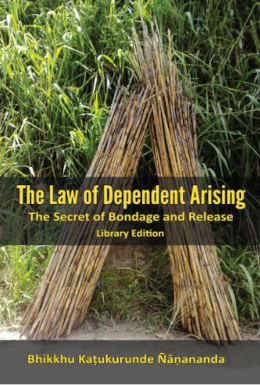
Kaṭukurunde Ñāṇananda, 2016, The Law of Dependent Arising: the secret of bondage and release, seeingthroughthenet.net.
This is a transcript of a series of Dhamma talks by the venerable on this topic. The author is very critical of the neglect of serious contemplation on this critical topic the Buddha claimed to comprehend all of the Dhamma. His penetration of its early meaning is a turning point for modern scholarship. This is not an easy book to read for the reader not already immersed in the study of the early teachings.

Bhikkhu Cintita, 2021, Dependent Coarising: meaning construction in the twelve links.
My own book on this topic started out as an effort to make Ñāṇananda’s insightful interpretation available to a wider audience. I’ve provided additional details and explanations as a result of devoting an equal amount of space to each of the twelve links. A new revision of this text is in preparation.
3. Contemplative practice
We should notice initially that we do not succeed in wisdom without being established in ethics. The citation at the top of this page tells us that. The reason seems to be that our unskillful behavior reinforces the misapprehensions with which it is associated. For instance, one who behaves habitually in a self-centered manner, will have difficulty experiencing a world devoid of self.
The overall process of wisdom practice is described as the five stages of liberation. We begin by studying and pondering the Buddha’s individual wisdom teachings, some of which are described in the last section. In other words, each of these is approached initially in its conceptual form, much as we might study a topic in a university class. But then in the subsequent stages we continue this practice through verification of its details in actual experience. This is the contemplative practice of Dhamma investigation (dhamma-vicaya), which serves to develop, cultivate, and internalize the teaching, to the extent that it becomes a way we experience the world automatically, at an intuitive, non-conceptual level.
Dhamma investigation is conducted typically on the cushion. The seven awakening factors describe the process of subjecting a Dhamma teaching to investigation, after which a series of affective states bring the mind into composure and into the fourth jhāna. Composure (samādhi) is the meditative state taught by the Buddha in progressively deeper stages, called (even in English) the four jhānas.

The Buddha’s meditation teachings
In this way wisdom practice works together with composure, without which it is not possible to fulfill its purpose. The Dhammapada tells us,
“There is no jhāna for one with no wisdom, no wisdom for one without jhāna. But one with both jhāna and wisdom, he’s on the verge of nibbāna.”
This is why this process is described as in terms of “awakening factors.” Dhamma investigation in the context of the other awakening factors produces knowledge and vision of things as they are.
Dhamma investigation depends on our ability to recognize the various factors mentioned in the individual wisdom teachings as observables in our experiential world. For instance, one of the five aggregates is perception. In Dhamma investigation we should be able to observe individual instances of perception as they arise and fall in our own experience. At this level we see directly the inner workings of human cognition, noting as well how a perception can lead to the fabrication of additional forms of awareness: instances of impression, fabrication, and so on. The stillness and focus of composure acts much like a magnifying glass in this process. In this way we learn to apprehend our presumptive patterns of thinking, and to experience the world otherwise, directly and non-conceptually. We see its impermanence, the absence of a self, the pervasiveness of suffering, and undermine the tendency to presume things as substantial, and orbiting around “me.”
The detailed method for engaging in Dhamma investigation is most commonly referred to with a Pali term that is poorly translated into English as “the foundations of mindfulness.” This method has evolved into modern vipassanā or “insight meditation.” Satipaṭṭhāna literally translates as ‘recollection-attentiveness’ in reference to bringing Dhamma teachings to mind while attending to its observable counterparts in the practitioner’s experience. The well-studied Satipaṭṭhāna Sutta is a tutorial that brings specific Dhamma teachings, organized into four realms of observable experience, under investigation.
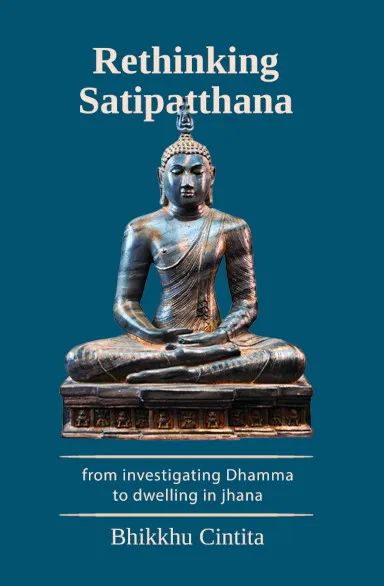
Bhikkhu Cintita, 2026, Rethinking Satipṭṭhāna: from investigating Dhamma to dwelling in Jhāna.
This is a detailed and original scholarly exposition of the teachings of Dhamma investigation, or satipaṭṭhāna practice found in the early texts. I consider existing interpretations of many of the details, find many of them wanting, and provide and motivate alternatives. This book is as much about samādhi and jhāna as it is about the contemplative practice of satipaṭṭhāna itself, with the same attention to detail. Unique in this book is reference to modern studies of human cognition that corroborate many of its conclusions.
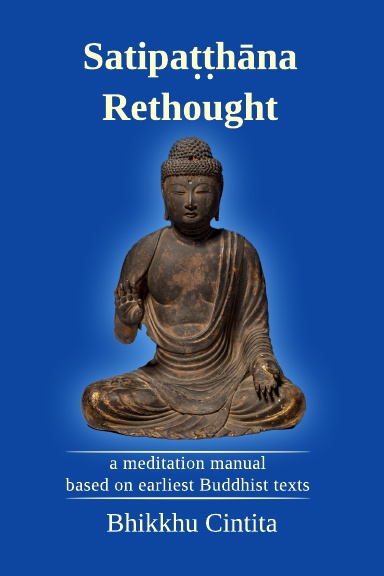
Bhikkhu Cintita, 2024, Satipṭṭhāna Rethought: a meditation manual based on earliest Buddhist texts.
This is a practitioner’s handbook for satipaṭṭhāna practice, based on the conclusions of Rethinking Satipaṭṭhāna. Non-scholarly in presentation, it covers the same ground as the tutorial Satipaṭṭhāna Sutta, but in modern terms. It gives step-by-step instructions for the 21 exercises of the Sutta and their common refrain.