
Refraining from every evil,
Accomplishing good,
Purifying the mind,
This is the teaching of buddhas. (Dhp 183)
Ethics
home > study & practice > ethics
Some decades ago, a Thai meditation master was invited for the first time to lead a retreat in the USA. I’m recounting this from memory. Shortly after the retreat had begun, the master told his American assistant, “There is something wrong with the practitioners: they all look so grim. In Thailand, when I lead a retreat, everyone is happy.” The master was determined to find out what was going on, and had the opportunity to investigate through the conventional interviews he would conduct with each of the students during the retreat through an English interpreter. At the end of the retreat he had reached a conclusion: “They’ve never learned ethics!”
The conclusion we can draw is that if our meditation is to succeed, we must first give attention to ethics. Although this advice runs counter to the strong tendency of modern meditators to regard meditation as sufficient in itself, this conclusion is precisely what the Buddha tells us in no uncertain terms. In fact, meditation, along with all wisdom practices, might be regarded in early Buddhism as properly an extension of the practice of ethics. Unfortunately, even acknowledging the central role of ethics in Buddhism seems to be challenging for many modern people, for the reason that its role in modern culture has become so marginal.
1. The deficits of modern ethics
Ethics is largely neglected, if not distrusted in modern culture. Often ethics is viewed as an arbitrary imposition of judgment on otherwise free-thinking individuals, as commandments from a God (whose presence is no longer felt as strongly as it once was), or as a futile intellectual attempt to derive an “ought” from an “is.” From a practical viewpoint we make choices all the time that produce benefit or harm, or that allocate benefit and harm one way or another. Most commonly we choose in our own favor, then justify our choices quite adeptly cherry picking among the suite of ethical criteria available to us in historical memory: individual rights, property rights, family values, personal responsibility, liberty, being true to our inner selves, being deserving, being undeserving, being to blame, retribution, forgiveness, God’s will, the natural order, respect, patriotism, loyalty, the power of a free market to resolve ethical issues, or whatever works to prove, “I’m right, and you are wrong.” What is odd about all this is that almost everybody is compelled to justify their own actions as ethical, and go to great lengths to do so, even in the absence of a consensus about what the standards for doing so are, and even while the individual’s standards shift freely in their justifications. Ethics in western culture has been in a state of crisis, some philosophers of ethics say at least since the eighteenth century.
Modern ethics is the product of an older, uniquely western cultural, religious and intellectual history, a history in which Buddhist lands did not participate, until the imposition of European colonial rule. Might Buddhist ethics rescue us from this crisis? I am convinced it can, to the extent that Buddhism achieves some degree of meaningful influence in modern culture. In fact, there are certain points of appeal to modern ways of thinking. First, Buddhist practice is not directed from on high. For the Buddha, the human dilemma is a human problem, something humans do to themselves, and something human can undo. It does not depend on a higher power. Second, although the Buddha respected social conventions and etiquette, he also recognized that they varied from place to place, and the Buddha’s system of ethics is surprisingly free of the imprint of his own culture, appearing relevant to modern people today. Most importantly, the Buddha-to-be discovered a grounding for ethics in human nature, suggestive of its universal applicability.
2. The kamma system
The recognition of a natural basis for ethics seems to have occurred in the months immediately before the Buddha’s awakening, through introspective observations concerning “intentionality.” He discovered that the intentions that guide not only our behavior, but also the way we apprehend the world fall into two discreet categories, which he called “skillful” and “unskillful” (kusala, and akusala), and that the categories can be described in psychological terms: While skillful intentions are rooted in renunciation, kindness, or wisdom, unskillful intentions are rooted in neediness, aversion, or ignorance. Skillful intentions are observably in themselves experienced as pleasing, while unskillful intentions are experienced as painful, the latter manifesting in stress, or anxiety, if not remorse. Neediness and aversion are forms of “craving,” which (according to the second noble truth) gives rise to “suffering.” Socially, as we act out of skillful intentions, benefits for others tend to result, and as we act out of unskillful intentions, harm for others tends to result. Skillful intentions are in this sense “pro-social” and feel good, while unskillful intentions seek personal advantage, yet are distressing at some level.
The Buddha used the word kamma (Sanskrit, karma) to refer to an intentional action, or to the intention itself behind the action. Practice in ethics is fundamentally the project of monitoring, developing, and cultivating skillful kamma, and discouraging unskillful kamma. Kamma is at the heart of Buddhist ethics. Human behavior is, for the common worldling driven by a complex of both skillful and unskillful intentions, but it is not generally not easy to recognize what our intentions are without training. Since we perform a stream of actions throughout every day, the quality of our kamma is constantly present and fundamental factor in a Buddhist life. Kamma is also at the heart of Buddhist wisdom. Notice that when a child’s action goes askew, we respond by asking either, “What got into you?”— pertaining to an intrusion of greed or aversion—, or “What were you thinking”—pertaining to an intrusion of ignorance. Wisdom is what keeps our good (ethically skillful) intentions from paving a way to hell (a life poorly lived).
Ultimately this practice develops ethical dispositions into a quality of character, called “purity of mind” by the Buddha, but for which the western term “virtue” also applies. There is likely a barely explored affinity here with Aristotelian and Thomist “virtue ethics,” largely eclipsed in modernity. In acquiring virtue, we become a different kind of person. Kindness, compassion, and beneficial action become second nature. Remarkably, this not only feels good for the Buddhist, it brings a sense of satisfaction and fulfillment, a joy that dwarfs simple sensual pleasures, and ultimately makes lives meaningful. Meditation is integral to the path toward developing both virtue and wisdom. This is explains why practitioners in Thailand are happy when they attend meditation retreats.
3. Virtue
It is no exaggeration to say that developing and perfecting virtue is the central concern of Dhamma practice. In fact, refraining from evil and accomplishing good—aside from their immediate benefits—each serve as trainings to purify the mind, until virtue is internalized into intrinsic and spontaneous inclinations of character, and in its pure form subsumes the functions of the other two practices.
Let me draw an analogy. Mastering a musical instrument requires years of training. Learning the mechaninics of scales and cords might be compared to following precepts. Leaning to produce the aesthetic and entertaining qualities that the listener enjoys might be compared to practicing generosity. The virtuoso has perfectly internalized their skill and simply watches the music arise. Charlie Parker once said, “You don’t play the saxophone, it plays you.” Just as the virtuoso improvises without thought in response to the unfolding needs of the musical context, the one who has perfected virtue responds without thought to the unfolding needs of the (primarily social) environment.
In our culture, it is common to think of ethics as largely a matter of balancing self-interest against the interest of others. More for that guy means less for me. In fact, modern rational thought repeatedly tells us that the homo economicus is narrowly self-centered, but the “free market” makes it OK. For the Buddha this is entirely backwards: to benefit others is to benefit oneself, and to benefit oneself is to benefit others. This gives meaning to our choices. Spread over a lifetime, this is verifiably true.
Whereas virtue is not a reliable source of mundane or immediate sensual gratification, it leads to a life of meaning, fulfillment, and satisfaction, a life well-lived. These are supramundane pleasures, of a different quality, much deeper, and more persistent than mundane pleasures. Virtue is often envisaged in Buddhism through the metaphor of rebirth in a heavenly realm. The Buddha’s teachings in this regard seem to be close to what is known as virtue ethics in western thought, generally associated with Aristotle and Thomas Aquinas.
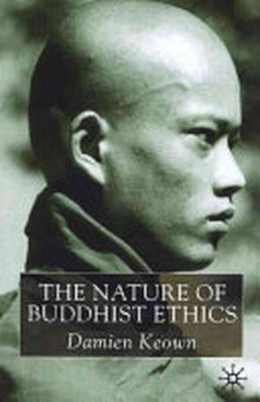
Damien Keown, 1992, The Nature of Buddhist Ethics, Palgrave.
In this early work, Keown discusses in the most detail the close resemblance of early Buddhist ethics to Aristotelian virtue ethics, and the primacy of virtue over wisdom in Buddhist practice. For Aristotle, virtue is the natural function of the human being. Recent evolutionary theory seems to explain the way in which that is true.
4. Early ethical practices
The Dhammapada tells us:
Refraining from every evil,
Accomplishing good,
Purifying the mind,
This is the teaching of buddhas.
However, refraining from every evil, and accomplishing good are both limited in scope: Precepts are rigid and porous. Beyond a certain horizon, the full range of consequences of our actions are impossible to foresee. Moreover, it is possible in principle to practice these first two facets even with unskillful intentions; maybe we are trying to raise our social status, or we are being paid or threatened to undertake the harmless or beneficial action. Perhaps we just want to impress our Buddhist teacher who has told us, “If a spider has built a web in your room, let it be,” or “If you see a turtle stuck on its back, turn it over,” but we don’t beyond that care one bit about the fate of the spider, nor of the turtle.
“Purifying the mind” is this very monitoring, developing, and cultivation of skillful intentions. It is at the center, and most characteristic of Buddhist ethics. Acknowledging this, we see that refraining from evil and accomplishing good are excellent ways as a matter of training to purifying the mind. The Buddha even calls precepts “training steps” (sikkhapada). We cannot long practice these without feeling kindness toward the spider, or the turtle. In fact, we find ourselves talking to them: “Good morning, Crawly!” “[Flip] There you go, little guy.” We discover that our acts of kindness or restraint feel really good; they make us glow inside.
The Buddha discovered that there are “supramundane pleasures,” of a different quality, much deeper, and more persistent than the mundane pleasures experienced in satisfying sensual desires. Once we are hooked on these, our practice will be super-charged. The further we develop dispositions toward skillful kamma, the more pervasive our supra-mundane pleasure will be. We will even carry it with us into meditation retreats.
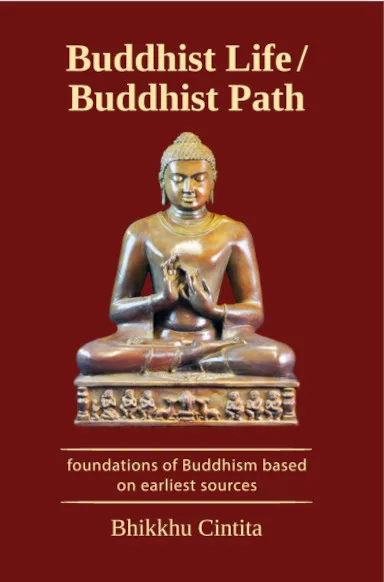
Bhikkhu Cintita, 2025, Buddhist Life/Buddhist Path: foundations of Buddhism based on earliest sources.
Early Buddhist ethics is discussed chapters 2. Generosity, 3. Harmlessness, 4, Purity, 5. Harmony, and 9. Perfecting virtue. Ch. 4 deals discusses the psychological basis of kamma and the fruits of kamma, and integrates these into the development and cultivation of virtue as a primary purpose of Buddhist practice. Ch. 9 in the new addition will deepen this understanding and compare Buddhist ethics to Aristotelian and Thomist virtue ethics.