
Go your way, monks, for the benefit of the many
For the happiness of the many,
Out of compassion for the world,
For the welfare, the benefit,
The happiness of gods and men. (Mv i 32)
Society
home > study & practice > society
We generally think of Buddhist practice as an individual endeavor. Isn’t it “me” who learns Dhamma, who follows precepts, who makes merit, who sits on the cushion? Isn’t it “me” who develops and cultivates virtue and wisdom, and who aspires to attain awakening? In modernity, many of us do practice almost entirely alone, read books, listen to podcasts, but don’t interact with other Buddhists. I remember that for me joining a Zen sitting group in the 90s was initially an afterthought. Nonetheless, it is only through integration into a certain kind of a cultural context that strong engagement in Buddhist practice occurs, and becomes meaningful. Communities are capable of sustaining a culture of awakening, and that is where our individual practice finds a home. Unfortunately, such communities are relatively rare in ethnically western society, not only because Buddhism has yet to fully arrive in the western world, but because much of modernity is hostile to very idea of a culture of awakening, … as being too religious.
Moreover, if a modern person interested in Buddhism walks into an ethnically Asian temple in the US, they are often faced with peculiarity and anomaly in the practices and beliefs of the adherents, the garb of the clerics, the style of the liturgy, the presence of unfamiliar figures in temple statuary, unfamiliar rites at temple altars, unknown scriptures on temple bookshelves, and hocus pocus all around. These modern aspirants just want to learn more about Dhamma, and to learn to meditate. To their mind, what is offered here is not the “authentic” Buddhism found in the books they have read, so they conclude that what is going on here has been corrupted by too much cultural baggage. They throw their hands up in despair, and perhaps entertain the hope that Baha’i or Sufism might have an easier onramp. Nonetheless, what they’ve encountered might well be the locus of a perfectly sound culture of awakening based firmly in that very Dhamma.

Bhikkhu Cintita, 2014, A Culture of Awakening: the life and times of the Buddha-sasana.
This book examines the living Dhamma in its cultural, social, and historic dimensions set in motion with the Buddha’s establishment of the monastic Saṅgha. It looks at its relatively tolerance of an inauthentic “folk Buddhism,” and suggests that this enabled the emergence of Buddhism as the first world religion.
1. Modern attitudes about society and religion
I worry much more about modern cultural baggage than I do about Asian cultural. To begin with, it concerns me that Buddhism is so often so poorly understood by modern teachers, many of whom teach a Buddhism that is almost entirely of western origin, or more American Transcendentalist than Buddhist. Next, as hyper-individualists, we commonly view society and culture with suspicion. Society is declared to repress free expression, creativity and spirituality, and to prevent us from being our true selves. With the dominant influence of neo-liberalism in the past decades, we are expected to not organize ourselves socially at all beyond family, and the dictates of a “free market.” Finally, there is a strong current of anti-religious sentiment in modernity.
Much of this modern cultural baggage will seem like common sense to many readers. However it arose in a context in western history that had no counterpart in Asia prior to modernity. The pivotal historical movement that drew western culture in this direction seems to be the Protestant Reformation, which responded to the corruption of the social excesses of the Catholic Church by rejecting its rituals, priests, and other signs of “religiosity,” then rethinking the essence of religion as the individual’s private relationship with God, unmediated by the church, and unmediated by society. The individual became the locus of spirituality (as opposed to religiosity), creativity, rationality, and ambition, along with an obligation to be true to our inner selves. Once established, this movement would have been internalized by people generation after generation at such a young age that they have gone largely unquestioned. That is the nature of common sense: it’s a form of blind faith that has been acquired under the radar before we were old enough to discern otherwise. These features are peculiarities hardly recognized outside of modernity.
One way the anti-religious sentiment of modernity manifests is in the attempt to exclude from Buddhism anything that falls under the rubric of “religiosity.” This includes rites, rituals, institutions, and distinguished roles (priests, monks, etc) and garb (archaic clothing, usually robes), basically everything I embody as a monk. Buddhism traditionally has all of these. But many secular spheres of modern life have all of these as well: courtrooms, birthday parties, sports events, academic institutions, the military, receiving wine at a high-scale restaurant. Isn’t it peculiar that “religiosity” is objectionable only when associated with religion, but not with secular life? Such is modern cultural baggage.
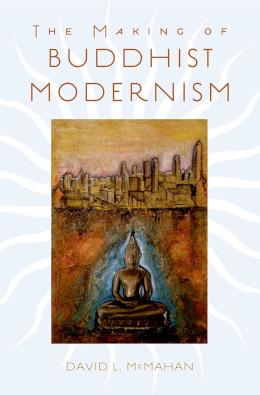
David McMahan, 2008, The Making of Buddhist Modernism, Oxford.
This is a thorough study of the absorption of modern preconceptions into the content of what is taught as Buddhism in modern Buddhism. Its method is to trace the sources of individual modern Dhamma teachings, either in some Asian Buddhist tradition, or in some western cultural/religious/intellectual tradition. The results are surprising. I highly recommend this book.
2. Buddhist communities
Buddhism in its social, cultural, and historical dimensions is called the sāsana in Pali, which means ‘teaching,’ in the sense not of Dhamma, but of the activity of imparting Dhamma. Traditionally, the sāsana has lived in communities, persisted in communities and spread from one community to another. Most westerners tend to connect with the sāsana individually through books, movies, and social media, but may then be lucky to find a living community within driving distance.
Buddhist communities are moral communities. A moral community in sociology lives in a culture that orients the lives of its members through a set of shared standards—values, ideals, responsibilities, proper behaviors, and a symbolically determined system that constitutes social reality—which lead the community toward greater harmony, better communication, stronger bonds and more effective cooperation. Typically the community accepts one or more particular central objects, persons, notions, or principles as definitive, virtually inviolable, typically sacred—the Nation, a protective or discerning God, Celebrities, the King. Some have suggested that Free Market plays this role in much of modern society, that which works with an invisible hand, is omniscient and guides human affairs flawlessly without government intervention. Such standards differ from culture to culture, but the existence of shared standards within any given society seems intrinsic to human social cognition. The absence of solid communal standards results in anomie, that is, social instability, which is experienced by individuals as alienation and meaninglessness.
In Buddhist communities something rather unique is assigned this central foundational role in the life of the community: the triple gem. A gem would have been considered a place of refuge or safety in early Indian culture. Its three facets are the Buddha, the Dhamma, and the Saṅgha, all sources of Buddhist knowledge and skill. The Dhamma is the master guide to a life of practice, through which virtue and wisdom may be developed and cultivated as qualities of individual character that benefit the larger community. The Buddha, the original source of Dhamma, is present in the community in art, lore, and imagination as representing the perfection we seek in committed Dhammic life. The Saṅgha has been throughout history the most immediately present facet of the triple gem in a Buddhist community. The monastic counterculture that has already gone off the deep end of Dhamma practice exerts enormous influence on the ways of the prevailing culture.
We will discuss the Saṅgha in some detail, since that is where the Buddha’s social teachings are primarily found. In early Buddhist terminology, the word Saṅgha refers almost always to the monastic community of monks and nuns. The Pali term that designates the whole Buddhist community, including householders, is purisā. The use of the word Saṅgha in the sense of purisā seems to be entirely a modern development. The Buddha advised, but never organized the householder community. The design of the Saṅgha is another example of his genius.
The founding charter of the Saṅgha, the Vinaya (‘discipline’), lays out the detailed standards of its radical life style. The Vinaya is the most widespread and unifying scripture in the Buddhist world to this day (albeit in a number of variants that suggest that not all of it is early). Historically the sāsana has spread with the migration of monks from place to place, extending the influence of the Saṅgha to new householder communities. The sāsana seems never to have long survived in the absence of the Saṅgha. Remarkably, the Buddhist Saṅgha is also possibly the oldest human institution on the planet that has remained in continual existence substantially unchanged. It just keeps going.
The Buddha founded the monastic Sangha, charged it with imparting Dhamma, with exemplifying Dhamma in their own lives, and with inspiring others to bring the Dhamma into their lives so that the Dhamma does not remain as a curiosity on some bookshelf. The typical householder witnesses in the Saṅgha constant breathing examples of what it is to live a purely Buddhist life. I think of us as walking science experiments, demonstrating with every word and gesture what happens when one renounces everything that common sense says is necessary for happiness, and dedicates oneself to the Buddha’s way 24/7. And, as it turns out, the local monastics are typically the most joyfully contented people in the village.
As a counterculture, a radical one at that, the Saṅgha stands as a corrective to what ails the wider culture. Moreover, unlike most countercultures— Bohemians, beatniks, hippies, goths, punks, etc.—the Saṅgha is highly revered as the third gem. Aside from study and meditation practice, the Saṅgha is typically engaged in community services, as admiral friends who inspire others in taking up serious practice, as educators, as advisors, sometimes as organizers of community projects. It asks for nothing in return, yet relies on the generosity of others to meet its modest material needs. The Saṅgha also offers the opportunity to join their ranks to those householders ready to jump off the deep end of Dhamma practice.

Trevor Ling, 2013 [1973], The Buddha: social-revolutionary potential of Buddhism, Pariyatti.
Trevor Ling shows the ways the Buddhism does not make sense without understanding its profound social dimension. He examines the early history of Buddhist communities, the role of the Saṅgha as the center from which pro-social values spread, and Buddhist practice as a means of breaking down the autonomous individual.
3. The economy of gifts
Generosity is the lifeblood of the Buddhist community, and the interchange between householders and monastics its beating heart. The Saṅgha and the householders engage each other in an economic arrangement that is a teaching in itself. It has been called an economy of gifts. The Saṅgha has no livelihood, accepts no compensation for any of its services, and is not even allowed to grow its own food, nor cook. For all of its material needs it depends on the generosity of householders, from whom it is allowed to accept, but not request gifts. Monks and nuns historically and currently in many Buddhist lands accept food typically simply by walking past every house in the village with their alms bowls. This offers the opportunity for others to offer to the Saṅgha. The monks and nuns also walk without preference for houses most likely make abundant offering, even for the house of the village French chef. The economy of gifts becomes a daily affair, as does the interaction between the Saṅgha and householders.
Accepting the generosity of householders graciously, having no resources at all of one’s own that are not donated makes monastics like house pets for householders who undertake their care: helpless on their own, dependent on the kind hand that feeds them, but at the same time cute, and of therapeutic value to that same hand. This puts the monastic in an uncommon frame of reference, but does the same for the household donor as well. Remarkably, every time the monastic accepts something, the lay donor receives a gift. This is paradoxical at first to the modern observer, but if you look again, you cannot mistake the sugar plums dancing in the donor’s eyes. By the same token, every time the lay person accepts a teaching or benefits from a social or pastoral service, the monastic receives a gift. This “economy of gifts” has a significant spiritual meaning.
Householders tend to like us to be helpless a kittens in mundane affairs; it gives them a valuable opportunity to donate. Sometime, when the monks are busy cleaning, doing laundry, and such, a lay family will drop by. For us it is, “Here comes the boss. Look idle.” Shortly after my ordination in Myanmar, I was at a large monastery where a large number of monks had just consumed our lunch offering. There were several sinks in the back where householders could wash pots and pans from the kitchen, and where monks could wash their bowls. A woman at the sink next to mine was washing a lot of dishes from the kitchen, but she gestured that she would wash my bowl for me. I naively waved her away in consideration of how much she already had yet to wash. Her face immediately turned to disappointment bordering on pain. I then and there learned never ever to do that again.
4. Inside the Sangha
As the Buddha’s creation, the Saṅgha can be viewed as the Buddha’s ideal society writ small. ‘The Saṅgha’ refers to the entire Buddhist monastic community past, present, and future. ‘A saṅgha,’ on the other hand, refers to a group of four or more monks, or of four or more nuns living and convening in a designated area at a given time, typically in a monastery (vihāra). Individual monastics are often itinerant, moving from saṅgha to saṅgha, or oftimes dwelling alone. The Buddha envisioned no centralized authority, such as a pope and bishops, only the guidance of the Vinaya to regulate the life of each local saṅgha. In contrast to the dominant culture in which the Buddha lived, the Saṅgha observes no class distinctions, and an exemplary level of gender equality.
The Vinaya provides remarkably effective mechanisms to avoid interpersonal conflict, and to maintain harmony within a saṅgha, so that monastics “mix like milk and water,” and “view each other with kindly eyes.” In the various activities and social contexts I’ve experienced in the different stages of my long and varied life, it is only within the Saṅgha that I have witnessed almost total harmony. In 2008 I spent a few days at Abhayagiri in Northern California practicing with its saṅgha of western monks in the Thai forest tradition. It was the harmony of this saṅgha (and also that these were westerners like me), and the mutual respect and affection the monks had for each other that most impressed me. It was palpable. It was in the air. It was there and then that I decided to ordain in the Theravada tradition, which I did in Myanmar a few months later. I’ve likewise dwelt consistently harmoniously with my (mostly Asian) brothers in Dhamma ever since.
Where policy decisions are necessary for a local saṅgha, these are determined by consensus. There is minimally hierarchy beyond teacher-student arrangements, beyond the authority of elected officers to oversee practical affairs of the local Saṅgha, such as how to distribute donated robes, and beyond a degree of symbolic deference to those who have been ordained longer than oneself. Adherence to the monastic code is primarily based on an honor system. Serious transgressions may entail sanctions at different levels, the greatest of which is expulsion from the local community through consensus of the other monastics.
A monastic lives a simple life, needs and possesses little, and avoids entanglement in worldly life. They are deliberate renunciates with a lifestyle and a code that leaves almost no channels for the pursuit of sensual pleasures, the accumulation of stuff, the quest for personal advantage, nor the intractable issues that accompany these. They are permitted to do almost nothing for their own benefit, but almost anything for the benefit of others.
Though venerated by those who take refuge in the triple gem, the life of the Saṅgha is at the same time closely interwoven into the daily lives of devotees. This was accomplished by making the Saṅgha totally dependent on householders for their material needs. Since monastics are renunciates, and are limited in what they can possess, monastics should not be a significant burden on householders. The Buddha not only made daily receipt of alms food mandatory but then redoubled this dependence by prohibiting monastics from growing or cooking their own food, and by limiting the monastic’s right to retain offerings of food, for which ownership expires at noon on the day it is offered. Monastics are not allowed compensation for the benefits they bestow, nor to otherwise engage in the exchange economy. This provides a high degree of insularity from the concerns and influences of the outside world, including from the need for livelihood, ensuring among other things that the Dhamma will not become a commercial product, tweaked for popular appeal.

Bhikkhu Ariyesako, 1999, The Bhikkhus’ Rules: a Guide for Householders, pdf at AccesstoInsight.org.
This short book gives an overview of the precepts found in the Vinaya, the monastic code. These precepts have been followed by the Saṅgha continuously since the time of the Buddha until today throughout most of the Buddhist world. This book is a clear introduction intended for lay readers.
5. Authority within the Buddhist community
Immediately after my ordination in Myanmar in 2009 I was astonished to find myself treated with the same veneration everywhere I went that I already knew was accorded to the robed. If I stood long enough on a street corner, someone would spot me, run across the street, and, without a word, prostrate three times at my feet, then walk away. Wealthy, poor, it didn’t matter. I knew I had not gone through a miraculous change simply by donning the robes, nor had I earned such veneration. I needed a metaphor. As far as a plaster Buddha statue is concerned, it is just a piece of plaster. But people behaved in a symbolically reverential way before it that would surprise that piece of plaster if it had eyes. It doesn’t know that it happens to be in the shape of the Buddha. I happened now to be in a shape that symbolized the Buddha’s Saṅgha, an institution that had endured 100 generations, that has certainly had many fully awakened members over the centuries (doubtlessly along with dawdlers), and without which the Buddha-sāsana would not long have endured. Having practiced for many years, I was now challenged to become even more representative of what I now symbolized. A nation of devout Buddhists now expected it. It was remarkable how strongly they believed in what I had just recently decided to do with my life.
The authority of the Saṅgha is of a kind that derives from veneration. Veneration and authority are often misunderstood in modernity as something involving power dynamics, and ego, doubtlessly because of our individualistic perspective. Veneration of the kind I’m describing here might be thought of as a ritually charged contract that obligates the two parties involved to become their respective roles in a special relationship. It belongs to social, rather than individual cognition. The relationship seems most typically to be that of teacher-student. One becomes a teacher by being venerated as such, and only afterwards attaining the necessary qualities. One becomes fully a student by venerating one’s teachers, and then opening one’s heart and mind to what they offer. Similarly for the relationship of parent-child, elder-youth, and Saṅgha-householder. In modernity coercion is often a necessary resort to to reproduce this kind of cooperation in a cruder form.
A passage of Vinaya gives the Saṅgha an almost modern-looking mission statement. Its various bullet points, in a nutshell, charge the Saṅgha with working toward its own awakening, with retaining the integrity of the Vinaya and Dhamma for future generations, and with promoting Dhamma and inspiring practice within the wider community. Through the generous support of householders, the Saṅgha has the privilege of study and practice (which includes serving needs of householders) 24/7. The Buddha once said that as long as the Saṅgha conducts itself according to Vinaya, there will be awakened ones in the world. Through the challenge of being venerated, the Saṅgha is all the more moved to to bring diligence into these endeavors. The intimacy gained in the economy of gifts alongside their veneration of the Saṅgha open the householders’ hearts and minds to receiving the Dhamma. This gives the Saṅgha great authority through which it shapes householder as well as monastic lives, ways of thinking, a culture bent in either case in the direction of awakening.
The consequences of the presence of a saṅgha for the individual householder vary greatly. There will be those who are greatly inspired, free from mundane responsibilities and attachments, dedicated to practice, and with the time and energy to learn. These are excellent candidates for donning the robes and joining the Saṅgha, thereby to enjoy optimal conditions for progress in practice. However, even those who choose to remain as householders are capable of great attainment. While Saṅgha generally meant a monastic community (bhikkhu-saṅgha), the Buddha sometimes opened up the term to all those who had attained stream entry, the noble Saṅgha (ariya-saṅgha), whether monastic or householder, ‘noble’ in reference to having attained at least the first stage of awakening.
However, most householders—busy with children, cattle, fields, trade, festivals, romance, and drink, and less connected to the centers of Buddhist life—learn Buddhist values primarily by osmosis. Like their neighbors, they venerate the triple gem, are generous, try to follow the five precepts, and emulate to some degree the behaviors of the most devout, but relatively few seriously encounter the Dhamma in all its depth and sophistication. It is a full-time life-long project to master Dhamma. As a result a hotbed of folk misunderstandings is likely to emerge as Buddhist ideas intermingle with local folk culture. For instance, in Myanmar a naive understanding of the fruits of kamma has given rise to the notion that one can ceremonially transfer one’s own accrued good kamma to deceased relatives, wherever they have been reborn, and that one can give oneself an immediate kammic boost by donating to the Saṅgha prior to surgery, childbirth, or exam, in order to increase the odds of a good outcome.
Any field of adept knowledge will be accompanied by erroneous folk beliefs. Many sometimes outrageous folk notions about science, for instance, circulate in modern society, such as that the phases of the moon happen when the sun’s shadow moves across the moon’s surface, that there is no gravity in space, or that snow makes it cold outside in winter. However, scientists are pretty much unaffected by such notions, and those possessors of folk notions who also have faith in science are willing to be corrected through the authority of scientists. Similarly, the adept understanding of the Saṅgha is generally (not always) unaffected by folk notions. Through the authority of the Saṅgha folk notions are vulnerable to correction. If controversy or doubts arise about folk understandings, Buddhists know where to go for edification. We would expect a long-standing folk Buddhism not to oppose the most basic Dhammic principles; there doesn’t seem to be a folk Buddhist cult, for instance, that practices animal sacrifice.
So far we’ve been discussing the higher authority granted to the Saṅgha in order for it to fulfill its mission successfully. However, it must be pointed out that the Saṅgha has no coercive power whatever over householders. There is, for instance, nothing like excommunication. Monastics are not even allowed to directly request material things (requests might otherwise feasibly be construed as implicitly coercive). On the other hand, householders have significant coercive power over the Saṅgha through the Saṅgha’s material dependence of them, and have sometimes used it: If the behavior of the local saṅgha disappoints the veneration of the householders—by engaging in worldly amusements, engaging in business, engaging with others in anger, etc.—the householders might withdraw the material support and put the wayward monks or nuns out of business very quickly.

Bhikkhu Bodhi, (translator), 2016, The Buddha’s Teachings on Social and Communal Harmony: An Anthology of Discourses from the Pali Canon, Wisdom Publications.
This book provided early Buddhist advice about how to live communally, how to live harmoniously, mixing like milk and water, and how to settle disputes, viewing each other with kind eyes. This book is relevant even in non-Buddhist communities.