Category: samadhi

  • The miracle of samādhi

    Samādhi occupies a prominent role in the early Buddhist texts. It is the final factor of the noble eightfold path to which the higher achievements of wisdom, or of knowledge and vision of things as they are (yathā-bhūta-ñāṇa-dassana) are attributed. It is a profound state of serenity, differentiated into the four jhānas, through which the mind becomes progressively stilled and centered, various cognitive faculties are silenced, and complete ease and equanimity are attained.

    Etymologically, samādhi is derived from sam ‘together’ + ādhi ‘put,’ and so has to do with gathering or collecting something together. Samādhi is most commonly translated as ‘concentration,’ implying a narrowing or focusing of attention. However, as we will see, concentration is one of two dimensions that characterize samādhi; the other is the progressive “curtailment” of various cognitive faculties as we progress through the jhānas. At every stage samādhi establishes an orderly array of mental faculties, and this (consistent with its etymology) recommends a translation as ‘collectedness’ or ‘composure.’ I will, for the most part, simply leave samādhi and jhāna untranslated to avoid confusion.

    Etymologically, jhāna is the gerund of the verb jhāyati, apparently in use before the Buddha’s time to denote almost any contemplative or meditative activity. The Buddha sometimes uses this term in its common meaning, but alongside the technical sense of the “four jhānas,” which seems to have been novel at the time of his teachings. In its technical sense the Buddha equates the fourfold jhāna with samādhi, such that there is no samādhi independent of the four jhānas in the early texts.

    Unfortunately, samādhi has become a controversial topic within the Theravāda tradition, where much confusion seems to have resulted historically, first from a redefining of samādhi, then from an attempt to reconcile contrasting frameworks that don’t in principle cohere. The debate persists even among the adherents to the authority of the early Buddhist texts, where contrasting evidence is cited for “hard” or “soft” jhānas (respectively difficult and easy-ish to attain), and where there is still no consensus about how Dhammic insight is even possible in jhāna.

    In this chapter, I develop an account of what samādhi is and how it works according to the early Buddhist texts. I will point out some common, but widely neglected, passages concerning the ubiquitousness and spontaneous nature of samādhi, and about the fruits of samādhi. I will also examine some details of how samādhi is claimed to integrate in practice with other factors. I hope thereby to contribute to a fuller illumination of this remarkable multifaceted culminating factor of the noble eightfold path.

    . . .

    How samādhi arises

    . . .

    Samādhi as concentration

    . . .

    The jhānas

    . . .

    The fruits of samādhi

    . . .

    The miracle of samādhi, the pdf (2025)

    I thought the readers of this blog could us a scholarly explanation of what the earliest texts, and therefore presumably the Buddha, have to say about samādhi and jhāna, that is about meditative states. This is a chapter from my recent book Satipaṭṭhāna Rethought.

    pdf

  • Q&A w/BC: Moments of insight

    Anne:

    Can you describe in writing one of your most powerful experiences during meditation?

    BC:

    There is a tendency for modern practitioners to seek after dramatic, unanticipated, immediately life-altering experiences, to which they can attribute either awakening itself, a glimpse of awakening, or a less defined but nonetheless “mystical” experience. Some practitioners are obsessed with achieving such experiences. That might be what you are expecting me to have had, Anne. Seeking such experiences is craving, and certainly detrimental to practice. Accordingly, I try to discourage attributing too much importance to the wonder of such experiences. Though they will occur, the Buddha seems to have had little no or interest in the drama of such experiences, while giving attention to the growing sense of well-being that comes with successful practice to surpass mundane pleasure. We do not practice in order to have dramatic experiences, we practice in order to develop wisdom (as a support for virtue). In the process, however, we do come to see the world in radically different ways. Sometimes we cannot help but be astonished by what we see.

    The experiences I’m referring to are sudden moments of insight associated with wisdom contemplation, in which something that was previously unclear becomes clear. Within the early Buddhist context, they occur particularly in Dhamma investigation (satipaṭṭhāna, vipassanā) within a meditative state (jhāna or samādhi). My book Rethinking Satipaṭṭhāna describes the mechanics of this practice, including what I am about to relate. Outside of the Buddhist context, insight experiences can also arise spontaneously, I suspect especially in children, where they can be disorienting and frightening in the absence of any preparation. In any case, they come suddenly, like a spark but occasionally like a lightning strike. They seem to bubble up from the unconscious mind, then make us want to shout, “Aha!” “Aha” experiences also come with with a conviction, almost a certainty, that one has seen into some deep truth.

    However, the insight experience is typically at best poorly explained in conceptual terms. It is a product of intuition. Concepts generally do not do justice to the experience itself. Tejaniya Sayadaw, a Burmese meditation teacher, gives an example of an insight he once had as a meditation student. The best he could describe it conceptually was, “You can smell only with the nose.” Excited, he told other monks about this great insight, but they all laughed at him. He finally went to his teacher, who acknowledged the depth of this insight, but advised, “When you have an insight, don’t tell the other monks about it. They will think you are crazy.”

    Common broad themes in these experiences are impermanence, non-self, the falling away of the distinction between subjective and objective experience, the nature and depth of suffering, and the mental constructedness of what we presume to be an independent reality“ out there.” The Buddha takes great pains to prime us for insights into such realms through his various Dhamma teachings. Being bound to language, he does this in conceptual terms. Many teachers and scholars accordingly take these conceptual teachings as philosophy, valuable in themselves. In fact, the Buddha’s concern seems to be limited to inducing the practitioner to be able to experience these teachings directly and non-conceptually. He expresses this achievement as “dwelling, having touched X with the body.” We do this through contemplation (in jhāna!) and discovering what the Buddha is talking about in our own experience, making it our own. Aha!

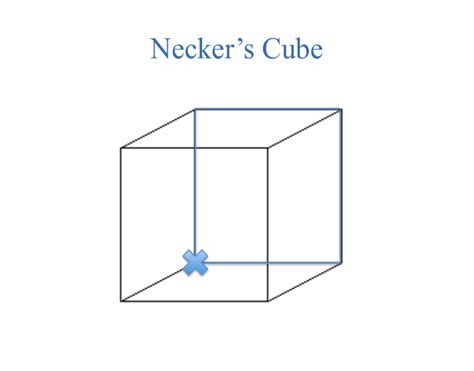
    The closest simple and readily available analogy I’ve found in the mundane world is “Magic Eye” images, 2D patterns that when stared at suddenly (aha) reveal content that appears in 3D. I recommend that beginning practitioners play around with these (I’ve acquired a couple of books of such images for both our Austin and Minnesota libraries). A similar, even simpler effect is found in staring at a Neker’s cube:

    Is the marked corner the closest to you, or the furthest from you? Once the mind has snapped into one interpretation, most people have difficulty snapping into the alternative interpretation. Discovering the alternative is then bound to produce an “aha” experience. One would think that the more firmly the mind is fixed on one interpretation, the more dramatic the discovery of the other will be. One might furthermore even conclude that the more open-minded one is, the more astonishing their insight experiences will be, if and when they eventually do occur.

    One of my favorite wisdom practices is contemplation of the five aggregates, a teaching that leads to insight into the inseparability of mind from the objective, independent world “out there.” Effectively, it teaches the constructedness of reality. (Modern quantum physics seems to have become a precisely focused continuation of this exercise, beginning with the split beam experiment.) Once over twenty years ago I was sitting zazen many hours each day at Tassajara Zen Mountain Monastery in the California coastal mountains, where I lived for almost a year and a half. One is unlikely to learn the five aggregates in Zen, since one is given only vague ideas of what to look for in meditation, most importantly “emptiness” and “non-duality,” with little explanation. Zen takes pride in being a tradition “beyond words and letters,” which in my experience seems to have the effect that insights are few and far between, but it is a whopper if and when one happens to occur.

    I must have had a very fixed idea at this time about the reality of an objective, independent world “out there,” for on this occasion something seemed to snap. I left the meditation hall and felt the world had shifted. I looked up at the tall mountains all around and saw clearly that I was in them and they were in me. There was no separation. I took a walk up the hill up to Suzuki Roshi’s burial sight and spent some time dwelling there in what I had touched. Then suddenly, after about 4 or 5 hours, I snapped back, and couldn’t recover my new interpretation of the world, only a vivid memory of it. I knew I should label the experience “non-duality,” but the label seemed meaningless in view the depth of the experience itself. It was only years later, when I was grounded in the Buddha’s teachings, that I could understand the various experiential facets of this little drama, and even begin explain it conceptually, to the satisfaction of philosophers, but inadequately from the perspective of practitioners. If I had started with the Buddha’s more detailed teachings, I think the drama would have been distributed over many smaller moments of insight.

  • Rethinking the Satipaṭṭhāna

    buddha

    A podcast series on
    the Establishment of Mindfulness
    Bhukkhu Cintita
    starts Friday, March 18

    Find it HERE

  • How did mindfulness become “bare, non-judgmental, present-moment awareness”?

    256px-Cartoon_Meditating_Man.svg“Mindfulness” in modern discourse – whether among meditation teachers or clinicians – is defined in various ways, but generally circle around “bare, non-judgmental, present-moment awareness.” Nonetheless, although mindfulness (in Pali, sati) is one of the most fundamental concepts in the Early Buddhists Texts (EBT), one would be hard-pressed to find a definition or description of mindfulness there that remotely resembles such circulations. In this essay I will try to account for our modern definitions of mindfulness and how they might be reconciled with the EBT.

    My intention is not to delegitimize these modern definitions; words come to be used differently with time and, hey, “What’s in a name? That which we call a rose, By any other word would smell as sweet!” The modern definitions have clearly proved useful and resonate with modern meditative and clinical experience. My intention is to explore what the shift in the meaning of mindfulness tells us about the shift from early Buddhist concerns to modern concerns as we pursue “mindfulness,” and then to ask the important question, What might we have left behind?

    MORE …


  • Dhammānupassanā

    Seeing through the eyes of the Buddha

    Samādhi (concentration) is the dominant factor of the higher training toward awakening in the early Buddhist texts (EBT), and yet it is lamentably misunderstood. It folds all of the energies of the previous seven path factors into a unified whole:

    There are right view, right intention, right speech, right action, right livelihood, right effort and right mindfulness. The unification of mind equipped with these seven factors is called noble right concentration with its supports and accessories. (SN 45.28)

    It then provides the incubator for that liberating knowledge that may burst forth into awakening.

    Bhikkhus, develop concentration. A monk with concentrat­ion under­stands in accordance with reality. (SN 22.5)

    Yet many have doubts that samādhi can possibly fulfill these functions. The problem seems to be that the tight integration of (1) Dhamma, of the contemplative disciplines of (2) mindfulness and (3) samādhi, and of (4) liberating knowledge, as put forward in the EBT, seems to have come apart, for many maintain that the Dhamma cannot reach the stillness of samādhi and that samādhi does not have the cognitive strength to produce liberating knowledge with any kind of meaningful content.

    Dhammānupassanā (watching or observing of phenomena) is at the center of this issue. It is the practice of examining phenomenal experience in accordance with the categories of Dhamma – in this sense, seeing through the eyes of the Buddha – articulated most prominently as the fourth establishment of mindfulness (satipaṭṭhāna). But, as we will see, it functions almost entirely in samādhi, and leads to an array of liberating insights. It is here where the full integration of Dhamma, mindfulness, samādhi and liberating knowledge is realized.

    MORE (pdf)


  • Buddha’s Meditation and its Variants 19

    New Moon Uposatha Day , March 22, 2012
          index to series

    Conclusion

    With this posting I conclude this longer than originally anticipated weekly series on meditation.

    In episode #1 I expressed concern for the bewilderment, doubt and contention resulting from the daunting plethora meditation methods, along with differing reported experiences and lack of uniformity of vocabulary used to talk about meditation. Although I have discussed only a few of the methods I hope to have provided a basis for sorting these out so that potential gaps or special features of any particular method can be recognized and communication can be normalized.

    Mostly I hope this is reassuring to the general practitioner that the method they are following is probably A-OK even if it has undergone a long historical evolution from the Buddha’s original teachings on meditation. This is because of the self-corrective nature of meditation techniques when they are applied and transmitted by sincere practicing yogis over many years.

    The first several posts Buddha’s meditation, the natural standard for comparing and evaluating meditation techniques. My view, not shared by all, is that we have a very clear basis for understanding what the Buddha’s meditation was.

    First, we have the scriptural sources in the Suttas and the Agamas, which though not perfectly are pretty darn reliable.

    Second, we can piece together from these sources something that makes functional sense. In fact a coherent and comprehensive system emerges that is fully an expression of the remarkable genius of the Buddha that serves to gather and focus the rays of the entirety of Buddhist practice, in its conceptual, ethical and affective dimensions, and turn them ineluctably toward Nirvana.

    Third, we have the direct experience of living breathing yogis to verify the efficacy of the many individual aspects of this system.

    The fourth support for our understanding of what the Buddha taught I did not mention at the beginning of this series because it would not have made much sense at that time. This is to use a plausible historical account of the variants to affirm the correctness what we think the original is. For instance, in my exposition I described the Buddha’s method then tracing its historical evolution from that point I could account for the Zen variant as a simple adaptation of the Buddha’s meditation to Chinese cultural influences. And I could at the same time account for modern Vipassana in terms of an historical intrusion of a non-Buddhist technique. The simplicity of such accounts serves to affirm that the original description of Buddha’s method was correct.

    I acknowledge that I have not developed any one of these four supports in as rigorous or insightful a way as some scholar-practitioners would be able to do, but I propose that even in my shaky hands the convergence of these supports in a single description of Buddha’s meditation means that we have at hand a very clear understanding indeed of the Buddha’s original system.

    A rough outline of Buddha’s system is as follows (details were provided in the course of this series):

    • Buddha’s meditation that arises has Centered Samadhi at its core.
    • This samadhi arises from the combined application of Right Effort and Right Mindfulness, which jointly restrain the mind enough to induce the experience of samadhi.
    • Right Effort also serves to weave the strand of Virtue into meditation.
    • Right Mindfulness also serves to weave the strand of Wisdom.
    • Wisdom and Virtue will have been developed as prerequisites through exposure to the Dhamma and through following Precepts, practicing generosity and so on, primarily at the level of reason and action in accordance with the first five steps in the Noble Eightfold Path.
    • In samadhi virtue and wisdom, initially developed at a coarse level. are developed at a much more subtle level. This is where the qualities of samatha and vipassana come forth, and investigation continues in the furnace in which wisdom and virtue are melded, and the mind is able to attain its greatest purity, defilements are pacified and insight is achieved.

    Right Samadhi is a resultant quality of mind, serene and keenly aware, that is, relaxed, calm, open, sensitive to, but unperturbed by, whatever arises. It is not fixed concentration or absorption in the meditation object, which could not sustain all of these functions.

    Whatever meditation method you use does not have to look like Buddha’s meditation in its details. I propose that meditation is like language or like living organisms: They can evolve, yet retain their functionality. I hope to have demonstrated this in the cases of Zen meditation and Vipassana. The reason is that direct experience of living breathing yogis tends to correct whatever in the method may have been misunderstood or incorrectly transmitted.

    Nonetheless, Buddha’s meditation can usefully serve to assess whatever meditation method you use. Does it have this logical structure? Is something missing? Is something extra? This may entail some investigation, since if something appears to be missing it may be made up for in some other way, and if something seems to be extra, it may still serve a useful purpose. For instance, one method may investigate impermanence, another emptiness. One method may make some use of fixed concentration to prepare the mind for centered concentration. This is OK.

    At this critical juncture as Buddhism is being transmitted to the West this assessment is particularly pertinent because there is much opportunity for misinterpretation and mistransmission, often helped along by poorly qualified teachers, or qualified Asian teachers who do not understand the presuppositions of the culture they are transmitting from nor the peculiarities of the culture they are transmitting to. The student who is not cognizant of the role of meditation in the broader Buddhist Path might not have a sufficient basis for detecting errors in her own experience for many years.

    Should you decide that whatever meditation method you are using is deficient, don’t despair: you probably have not been wasting your time; whatever training of the mind you have acquired will probably translate into a more efficacious method. For instance, if you have simply been following a fixed meditation regime, with no attention to threading wisdom or virtue into your samadhi, then yes, your method is deficient from a Buddhist perspective, but it will have provided you with a sound basis for developing quickly as a centered concentrator. (In fact this was my history; I spent almost eighteen years in fixed concentration before discovering Buddhist meditation, but have never regretted it.)

    Let me conclude with the words of Twelfth Century Zen Master Hong Zhi:

    “When silent illumination is fulfilled, the lotus blossoms, the dreamer awakens, A hundred streams flow into the ocean, a thousand ranges face the highest peak.”

  • Buddha’s Meditation and its Variants 18

    For more current writings on this topic
    by the same author,
    please visit the project page
    for Rethinking the Satipaṭṭhāna. (4/8/2023)

    Theravada Meditation: Vipassana Jhanas
    Last Quarter Moon Uposatha Day
    , March 15, 2012
          index to series

    Last Quarter Moon Uposatha Day index to series

    The Twentieth Century and perhaps late Nineteenth Century saw the arising of a new plethora of meditation techniques in the Theravada world, most notably the methods of “Vipassana Meditation” that developed in Burma. These generally take the Visuddhimagga (which we discussed last week) as a primary influence, and particularly make use of the terminology of the Visuddhimagga, but whereas the Visuddhimagga presents two methods, Samatha and Vipassana meditation, the Vipassana schools highlight Vipassana (hence their name).

    The most influential method in many Theravada countries and in America is that developed in Burma by Ven. Mahasi Sayadaw. I would like to focus specifically on this method today but only enough to compare it to Buddha’s meditation.

    Prerequisites of Mahasi School Medititation.

    Wisdom and Virtue. As for Buddha’s meditation, and in the Visuddhimagga.

    Everyday Mindfulness. The basic method of noting, described below is recommended for all the yogi’s waking hours.

    Methods of Mahasi School Meditation.

    Removal of the hindrances. As in Buddha’s meditation.

    Undistracted reflection on themes conducive to insight. Some vipassana methods use samatha practice to settle the mind to a certain point before undertaking vipassana per se. The Mahasi method is purely vipassana, that is, it does not make use of any preparatory samatha practice or fixed concentration.

    The Mahasi method is a practice of noting which entails moment to moment awareness of impermanence. Noting here means mentally naming what has just arisen, “lifting, swallowing, listening, thinking, touching, intending.” Noting itself is an innovation not found as a continuous practice in Buddha’s meditation, but is much in his spirit of clear comprehension of whatever arises.

    The Mahasi method, like Visuddhimagga, uses five aggregates of grasping (form, feeling, perception, formations and consciousness) as themes of meditation, and optionally makes use of following the breath as part of contemplation of body, with recommended focus on the feeling of the breath in the abdomen. For each theme of contemplation the qualities of impermanence, suffering and non-self are to be observed. The method differs only in details from the Buddha’s meditation.

    The Experience of Mahasi School Meditation.

    In Buddha’s meditation, samadhi (S-samadhi, Sutta-samadhi or S-jhana) is a primary experience of meditation. In the Visuddhimagga this experience is called “momentary concentration,” about which little is said. However, since the method in either case is close to the Buddha’s method we would expect the emergent experience to be similar.

    Concentration is centered, not fixed. Mahasi Sayadaw describes the concentration (samadhi) that occurs during vipassana meditation in terms of the observing consciousness not wandering away from the task of noting whatever arises. This momentary concentration deepens as follows.

    there arises tranquility of mind and along with it appears mental agility, etc. … body and mind are agile in functioning swiftly, they are pliant in being able to attend to any object desired for any length of time desired. … Insight penetrates objects with ease.

    Clearly samatha (serenity) arises in vipassana. Mahasi Sayadaw’s disciple, Pandita Sayadaw describes this concentration experience that arises from the Mahasi method “vipassana jhana,” in contrast to “samatha jhana” (VM-jhana, Visuddhimagga-jhana) as follows:

    Vipassana jhana allows the mind to move freely from object to object, staying focused on the characteristics of impermanence, suffering and absence of self that are common in all objects. … Rather than the tranquility and absorption which are the goal of samatha jhana practitioners, the most important results of vipassana jhana are insight and wisdom.

    Pandita Sayadaw in fact analyzes vipassana jhana in precise Sutta terms, correlating this concentration with the specific factors and jhana stages described in the Suttas. Actually, we can anticipate this correlation since the method that gives rise to vipassana jhanas is close to the Buddha’s method that gives rise to S-jhanas.

    Investigation continues in samadhi. VM-vipassana includes S-mindfulness and S-vipassana, all of which involve investigation. Vipassana jhanas arise from these and there is no indication that this samadhi shuts down investigation; investigation continues with a more subtle mind (which is S-vipassana). This is fully in accord with Buddha’s description of jhana.

    The main conclusions in looking at Mahasi’s method are that it is largely equivalent to the Buddha’s method and results in the same kind of experience. The differences are largely terminological, but even this is corrected with the term vipassana jhana, related to the Buddha’s and Visuddhimagga’s terms as follows.

    Vipassana jhana (= VM-momentary concentration) is S-jhana (= S-samadhi).

    That is, vipassana jhana is the jhana or samadhi the Buddha had been talking about all along! Although samatha jhana doubtless arises in fixed concentration, and I speculate that it was something the Buddha was intimately familiar with from his early training, there is no indication at all that the Buddha was interested in teaching samatha jhana.

    The lesson to be learned from the “discovery” of vipassana jhanas is that made at the beginning of the series on Buddha’s meditation and its variants, that meditative experience has a corrective influence on the textual tradition and its interpretation. The yogi’s practice is not based on texts alone, but also on the experiences that arise through practice. Given enough hints from the texts and an understanding of the goal of meditative practice in Buddhism the integrity of the teachings will be maintained or tend to be restored in practical terms if they have gone astray. (I speculate that where understanding goes astray is generally through a intellectual understanding not backed by practice. There is a curious natural pun in the Pali language: the word “ajjhayaka” has two meanings (1) non-meditator and (2) scholar.)

    The Visuddhimagga does not contradict the Buddha’s method once the terminological correspondences are understood. However it does fail grievously to highlight and extoll the relevant sense of jhana or samadhi the way the Buddha does, in fact it marginalizes it. Although jhana is an emergent experience that arises through the method, highlighting it as something we return to over and over, as a place we dwell, does inspire us to think about practice in a particular way. Keep in mind that samadhi, equated with jhana, is one of the eight folds of the Noble Path. Recall also the many ways the Buddha extolls jhana/samadhi. (and clearly not samatha).

    Sit jhana, bhikkhus!

    When right samadhi does not exist, for one failing right samadhi, the proximate cause is destroyed for knowledge and vision of things as they really are. – A.V.4.9-11.

    Bhikkhus, develop samadhi. A monk with samadhi understands in accordance with reality. – SN 22.5

    The knowledges are for one with samadhi, not for one without samadhi. – AN 6.64

    A monk who develops and makes much of the four jhanas slopes, flows and inclines toward Nibbana.

    There is no jhana for one with no wisdom, no wisdom for one without jhana. But one with both jhana and discernment, he’s on the verge of nibbana. – Dhp 372

    I say, bhikkhus, that the knowledge and vision of things as they really are too has a proximate cause; it does not lack a proximate cause. And what is the proximate cause for the knowledge and vision of things as they really are? It should be said: samadhi. – SN 12.23

    You will probably find that if you substitute “momentary concentration” or “vipassana jhana” for each reference to “samadhi” or “jhana” above, the result is completely comprehensible, but nonetheless lacks sparkle and weight.

  • Buddha’s Meditation and its Variants 17

    Theravada Meditation: Visuddhimagga Vipassana
    Full Moon Uposatha Day
    , March 7, 2012
          index to series

    Last week I began discussing the Visuddhimagga, a massive meditation manual compiled almost a thousand years after the Buddha (and 1500 years before us), that itself claims to accurately represent the Buddha’s intention in the Suttas. The Visuddhimagga, though seldom followed exactly in the modern Theravada tradition, has had a great influence on it, and particularly, I hope to show, in creating the terminology used to talk about meditation.

    Buddha – 4 Foundations Guy

    As mentioned last week, Visuddhimagga provides two rather distinct methods of meditation, serenity (samatha) and insight (vipassana), where the Buddha presents a single method, albeit with a number of parts. Last week I used our handy template to compare samatha meditation to the Buddha’s meditation, and we found very limited correspondence. In particular the Visuddhimagga‘s application of fixed concentration seems to have no counterpart in the Buddha’s meditation. This week I undertake to compare vipassana meditation as presented in the Visuddhimagga using the same handy template with the Buddha’s meditation. Here the correspondence will turn out to be very close.

    Last week I introduced the annoying prefixes “VM-” and “S-” and attached each to the term “jhana.” Quite simply, the word “jhana” as used in the Visuddhimagga does not have the same meaning as the word “jhana” as used by the Buddha. This is the first shift in meaning. “VM-jhana” refers to how the Visuddhimagga understands jhana, roughly as fixed concentration or absorption. “S-jhana” refers to how the Buddha understands jhana in the Suttas, roughly as centered concentration, unabsorbed but openly aware. I will extend the use of these prefixes today, particularly for the word “vipassana.”

    Prerequisites of Visuddhimagga Vipassana Medititation.

    The Visuddhimaga sees practice in stages, in which one stage feeds into the next. Vipassana meditation follows samatha meditation and therefore at least the same prerequisites are statisfied that I described last week, particularly the prerequisite virtue is described in great detail. Before Vipassana occurs also the intellectual understanding of wisdom. So both wisdom and virtue are woven into vipassana meditation, as in the Buddha’s meditation.

    However samatha meditation, and with it VM-jhana, is itself is now an optional prerequisite for VM-vipassana. The serenity vehicle guy (samatha-yankika) is instructed to leave VM-jhana in order to pursue VM-vipassana meditation, thus keeping both methods distinct. VM-jhana is thereby only indirectly applicable to VM-vipassana meditation but is said to support it. However, peculiarity of samatha as a (optional) prerequisite to vipassana is that vipassana, as we will see momentarily, is generally identified with mindfulness practice and in the Buddha’s framework mindfulness precedes samadhi; consider for instance the traditional order of the Noble Eightfold Path. Also there is nothing in the Suttas about leaving jhana before practicing vipassana.

    Methods of Visuddhimagga Vipassana Medititation.

    Removal of the hindrances. These are much as in Buddha’s meditation.

    Undistracted reflection on themes conducive to insight. These are differently formulated, but are largely equivalent to the themes discussed in the Four Foundations of Mindfulness. These themes are organized primarily around the khandhas (skandhas or aggregates): materiality, feeling, perception, volition and consciousness, whereas the Four Foundations of Mindfulness are body (materiality), feeling, consciousness and everything else. The technique is to examine a chose theme in particuar with regard to impermanence, suffering and insubstantiality. The method of Vipassana meditation does not seem to differ much from Right Mindfulness.

    The Experience of Visuddhimagga Vipassana Medititation.

    Pa Auk Sayadaw – Samatha Guy

    Concentration is centered, not fixed. The Visuddhimagga refers to momentary concentration (khanika-samadhi) as a necessary component of penetration, that is of the arrival of insight. Unfortunately it says very little about momentary concentration. As its name suggests concentration fixes for at least a moment on a single thing, but otherwise is free to move about. These moments of concentration can form a continuity such that the term khanika-ekaggata, unification or centeredness of momentary concentration, is possible. The Paramathamanjusa, the Pali commentary to the Vissudhimagga, apparently makes an interesting observation, that the force of khanika-samadhi can be equivalent to full absorption in the jhanas.

    Investigation continues in samadhi. Yes, or at least with momentary concentration. Given that momentary concentration in vipassana is the counterpart of S-jhana in the Buddha’s framework, it is surprising that Visuddhimagga gives so little attention to momentary concentration, Whereas the Buddha describes S-jhana in detail and then extols its virtues, admonishing practioners to abide in jhana, to return to it over and over, the Vissuddhamagga almost trivializes it, or its counterpart. This is not a difference in method or experience, but one in the way practice is inspired.

    The upshot is that VM-Vipassana meditation seems to correspond to the Buddha’s meditation closely, differing in smaller details. This conclusion should be reassuring to the many modern vipassana practioners. However, a realignment of terminology seems to have occurred in the Visuddhimagga, plus the Visuddhimagga devotes considerable, in fact most, space and effort to the description of a method (VM-samatha) that has no counterpart in Buddha’s meditation.

    Here is the way the terminology has been realigned:

    VM-Samatha corresponds to nothing in the Suttas

    VM-jhana (= VM-fixed concentration, uppana-samadhi) corresponds to nothing in the Suttas

    VM-access concentration (upacara-samadhi) corresponds to nothing in the Suttas

    VM-Vipassana encompasses S-mindfulness and S-vipassana

    VM-momentary concentration corresponds to S-jhana (= S-samadhi)

    VM-samadhi includes S-samadhi (S-jhana), but is much broader.

    No wonder people talk past one another when they use any of the terms samatha, vipassana, jhana or samadhi in Theravada circles, which has widely adopted Visuddhimagga terminology alongside that of the Suttas.

    Mahasi Sayadaw – Vipassana Guy

    I speculate that this shift in terminology began historically — we have no way of knowing when — with the meaning of “jhana.” The Buddha seems to have appropriated this word and given it a specific role in his framework as S-jhana, much like he appropriated “kamma” (“karma”) with a specifically Buddhist definition. But just as Buddhists in the West have to defend the word “karma” against the intrusion of a more widely known Hindu understanding, the same word, “jhana” may have been similarly challenged in the early days. My speculation is that the defense was unsuccessful at some place and time in the tradition that produced the Visuddhimagga and that “jhana” lost the meaning the Buddha had given it as centered concentration,.

    Once this happened “samatha” and especially “vipassana,” which were for the Buddha aspects of jhana, became free agents and broadened their meanings. However, in sustaining the Buddha’s framework in practice it was necessary to acknowledge types of concentration that were not fixed, and therefore the new terms “access concentration” and “momentary concentration” were introduced.

    To do Visuddhimagga justice, I should stress that the entire practice of Buddha’s meditation seems to be upheld in the Visuddhimagga framework, in fact in Vipassana meditation alone, in spite of the realignment of terminology. An important question is how useful the rest of what the Vissuddhimagga offers is, namely samatha meditation. The Visuddhimagga certainly develops samatha meditation as a highly refined and sophisticated technique. It is perhaps telling that in modern Theravada, samatha meditation is an historical innovation that has for the most part been ignored or marginalized. However in recent years samatha meditation has been successfully reintroduced into the daunting plethora of meditation techniques by Pa Auk Sayadaw in Burma and abroad and has a growing number of strong practitioner-advocates. I will not pursue usefulness of samatha meditation beyond this within this series.

    Also, given that the terminology used to describe meditation has shifted in the Theravada tradition from the Buddha’s usage, a practical question arises, Should we try to shift it back? Actually to do so might cause even more confusion, at least for a time. For instance, what is now commonly referred to as “Vipassana” meditation would more properly be called “Jhana” meditation! (“Go sit jhana, oh bhikkus.”). But in fact this is what the Zen people have always called what is in its essential details the same thing: “zazen,” “sitting jhana.”

    Next week I will talk about modern Vipassana meditation and how it accords with the Buddha’s meditation, and thus will end this series on the Buddha’s Meditation and its Variants.

  • Buddha’s Meditation and its Variants 16

    Theravada Meditation: Visuddhimagga Jhanas
    First Quarter Moon Uposatha Day
    , February 29, 2012
          index to series

    In the Fifth Century AD in Sri Lanka, the Visuddhimagga (Path of Purification), was compiled by Ven. Buddhaghosa from previously existing materials and would prove to have lasting influence on the meditation methods of Theravada school of Buddhism. A number of things must have been striking to any new reader familiar with the Buddha’s meditation method described in the Suttas but encountering this huge, very detailed meditation manual for the first time. Primary among these is that the Visuddhimagga describes not one but two distinct methods of meditation, each to be cultivated independently for distinct purposes. These are called samatha- (serenity) and vipassana- (insight) meditation. Now the astute reader will recognize both terms, samatha and vipassana, from the previous discussions of Buddha’s meditation and its Zen variant, but in each of those cases these were aspects of of a single method that were brought into balance but worked together.

    In order to compare the Visuddhimagga’s approach to the Buddha’s I will make use of the template we used to make the same comparison for Zen, however since we are now dealing with two methods I will apply it twice, this week for samatha meditation, and next week for vipassana.

    Prerequisites of Visuddhimagga Samatha Medititation.

    These are things cultivated prior to meditation, over years or minutes.

    Wisdom and Virtue. Virtue and aesthetic practices are prerequisites to meditation. The latter, endorsed but not strongly by the Buddha, are intended to “cleanse” virtue by developing fewness of wishes and contentment. What differs from the Buddha’s program, following the Eightfold Noble Path is that samatha meditation is developed prior to the development of wisdom as a conceptual pursuit.

    Methods of Visuddhimagga Samatha Medititation.

    These are the mental actions that give rise to meditative experiences or allow them to be steered once they have arisen.

    Removal of the hindrances. This is roughly as in Buddha’s meditation.

    Undistracted reflection on themes conducive to insight? Forty alternative objects or themes of meditation are enumerated that substantially overlaps with the different themes of the buddha’s Four Foundations of Mindfulness which are not represented in the Suttas. Most remarkable is the inclusion of ten different kasinas, or artificial disks as meditation objects. Otherwise objects are included that one one expect to be, as in Buddha’s method, intended to support the investigating impermanence, suffering, insubstantiality and unattractiveness. However the experience of samatha meditation described below actually precludes their use in this way once jhana is attained. The choice of meditation object seems intended to match the meditator’s personality type rather than the development of a particular kind of meditation.

    In general the method is to fix the mind on the object of meditation and as the mind settles a counterpoint sign (patibhaga nimitta) will arise, which is an idealized mental image, unblemished and unchanging, of the object itself in the mind’s eye. The mind fixes instead on the counterpoint image when this arises. Fixing on an image in this way is not mentioned in the Buddha’s meditation.

    Encouragement of active factors. In the preparatory stages of meditation all of the jhana factors and the early factors of enlightenment including mindfulness, investigation, energy, delight and happiness are encouraged, much as in the Buddha’s meditation.

    The Experience of Visuddhimagga Samatha Medititation.

    As in Buddha’s meditation the experience of samatha meditation is concentration at varying levels. The Visuddhimagga describes a level of concentration called samadhi but actually prior to jhana, which the Suttas do not mention: Access concentration is close to jhana, is possible only when the hindrances are suppressed, involves clear undistracted awareness and a full range of mental experiences.

    Concentration is centered, not fixed? In the Visuddhimagga jhana, also called fixed concentration, is so fixed on the counterpart sign that this is the entirety of experience. This means that all senses and awareness of the body are completely cut off. The jhana factors that define the different jhanas and that we are familiar with from Buddha’s meditation — thought and discourse, delight, pleasure and one-pointedness — are present, but they are functions for directing and maintaining concentration, awareness of these individual factors is possible only before and after leaving jhana.

    We have seen that in the Buddha’s meditation concentration is centered, not fixed, there is broad awareness, particularly of the body and of many mental factors in every jhana, including the five jhana factors. Clearly jhana in the Visuddhimagga is a different experience than in the Suttas. Just to be clear, when I need to disambiguate these two kinds of jhana I will call them respectively VM-jhana and S-jhana, or Visuddhimagga-jhana and Sutta-jhana. Notice that S-jhana has more in common with access concentration than it does with VM-jhana.

    Investigation continues in samadhi? No investigation or insight can occur in VM-jhana. This is clearly stated in the Visuddhimagga itself and must be the case because the counterpart sign is the entirety of experience and it is experienced as unchanging, without blemish. VM-jhana in this respect is quite distinct from S-jhana, which we have seen forms not only a basis, but the essential basis, for vipassana.

    So, if samatha meditation is not a direct basis for insight, what is it used for? First, it provides a blissful abiding. Second, it provides a indirect support for insight meditation by developing qualities of mind that carry over after leaving jhana. Third it allows the development of supermundane powers such as walking through walls or touching the sun. Fourth, it can lead to rebirth in the Brahma World. Fifth, it provides the cessation of Nirvana here and now … temporarily.

    The pre-jhanic access concentration can be used a a direct basis for insight. But insight is actually developed in vipassana meditation, not in samatha meditation. And in fact according to the Visuddhimagga VM-jhana is not even a necessary condition for the development of at all insight; it is optional. Vipassana does not require VM-jhana. A practioner who makes use of VM-jhanas is even specifically referred to as a samatha-yanika, a serenity vehicle guy. This contrasts with the suddha-vipassana-yanika, a pure vipassana vehicle guy, or a sukkha-vipassaka, a dry vipassana guy.

    It should be clear that VM-jhana is quite different from S-jhana. First, the Buddha provides in the Suttas no comparable method to that of the Visuddhimagga to lead to jhana and no fixing on an object of concentration is described and the intermediary role of the nimittas in fixing concentration is completely absent. Second, the description of jhana in the Suttas reflect something in which many mental factors are active, for instance, in MN 111 the Buddha takes Sariputta as a model and says of him,

    Whatever qualities there are in the first jhāna … he ferrets them out one by one. Known to him they remain, known to him they subside…

    He then makes exactly the same statement but with regard to the “second jhana,” the “third jhana” and the “fourth jhana.” This and the next passage describe things that would not be possible in VM-jhana.

    A monk in each jhana regards whatever phenomena connected with form, feelings, perceptions, fabrications and consciousness as inconstant, stressful, a disease, a cancer, an arrow, painful, an afflection, alian, a disintegration, a void, non-self … – AN 9.36

    Third, jhana is described as necessary for insight in the Suttas, not optional. For instance:

    There is no jhana for one with no wisdom, no wisdom for one without jhana. But one with both jhana and discernment, he’s on the verge of nibbana. – Dhp 372

    In fact the idea that samadhi would be optional as a full fold of the Noble Eightfold Path seems on the surface absurd.

    Fourth, there is no reference in the Suttas to coming out of jhana in order to practice insight, which is what is required for VM-jhanas. I have come across only one instance in the large number of suttas dealing with jhana and insight of coming out of jhana to practice insight, but it is the exception that proves the rule: In M.I.435.26 the meditator comes out of jhana in order to observe the impermanence of jhana itself. Bhante Gunaratana has written an paper available on line on this issue in which he concludes:

    It is virtually impossible to find evidence in the Suttas that one should come out of jhana to practice vipassana.”

    In summary, in the Visuddhimagga VM-jhana serves functions primarily different from the highest goal of final liberation, which requires insight, and for which jhana is helpful but optional. It only incidentally supports the development of insight. This is OK, since the Visuddhimagga provides a second form of meditation, which we will look at and assess next week.

    What is a bit troubling is that the Visuddhimagga co-opts the Buddha’s terminology, “jhana” and “samadhi,” for its own ends. The Buddha had already co-opted “jhana” for his own ends, but it seems that in the Visuddhimagga it has reverted to what might have been its original non-Buddhist usage to refer to fixed concentration. What is a bit puzzling is the amount of attention given to VM-jhana, since it is not only optional for the highest goal and in fact rather outside of the logic of the Buddha’s system, but is also considered to be something few can actually attain. If any readers more familiar with the Visuddhimagga than I can explain away this trouble and puzzle I would appreciate it.
     

  • Buddha’s Meditation and its Variants 15

    Theravada Meditation
    New Moon Uposatha Day , February 21, 2012
          index to series

    Buddhism spread from its home in Northern India in all directions, north, east and west. We have considered some of what happened to Buddhism in China and the rest of East Asia. Some two hundred years before reaching China Buddhism is purported to have arrived in Sri Lanka during the Second Century BC reign of Emperor Ashoka, possessor of the political will that made Buddhism perhaps the first world religion, that is, propelled Buddhism well beyond its boundaries from the land and culture of its origin. The traditional account has Emperor Ashoka’s son Ven. Mahinda, a Buddhist monk, first brought Buddhism to this southern island, along with a branch from which a Bodhi tree could be planted. Though Sri Lanka was isolated by water it was not so distant culturally as China for its culture and language were Indoeuropean.

    Over the first centuries different schools of Buddhism came and went in Sri Lanka, but what emerged dominant is what we now know as the Theravada school, which would spread to Burma, Thailand, Cambodia and Laos, where it lives today. The Theravada school is often called the most orthodox school, or even “original Buddhism.” Indeed it is the one still existing school that does not fall into the reformist Mahayana camp. And indeed it has served more than any other school as the guardian of the original teachings, the Dharmavinaya, preserved in the Pali language as the early Suttas (discourses) and as the Vinaya (book of discipline).

    Now, Theravada is not the only school to have inherited the Dharmavinaya — the Chinese have it too and the Tibetans most of it — but they are the primary guardians in at least two senses: First, the Theravada tradition preserves the Dharmavinaya in something close to the Buddha’s language or languages rather than in an unrelated language from with the original texts have been translated. For instance, if you wanted to find out in detail what the Christian Bible said about some esoteric point, you would prefer to look in the original Greek rather than the King James version. A similar higher degree of reliability falls to the Pali rather than to the Chinese. Second, the Theravada has devoted much more energy to the study of those texts than anyone else. These texts are chanted repeatedly in their original Pali. Pali scholars have discussed the meanings of words and phrases for centuries. These texts are actually read and even memorized.

    I began this series by describing the Buddha’s meditation, based on the discourses. Although I relied almost exclusively on the Pali Suttas preserved in the Pali tradition, this does not mean that I was describing exclusively Theravada meditation. The Chinese Agamas seem, as far as I know, to say the same thing and outside of the last minute translation from Sanskrit to Chinese have as solid a pedigree as the Pali Suttas. What I presented seems to have been a part of the Buddha’s teaching in Northern India that defined the starting point for the evolution of each of the Buddhist schools, each of which introduced its own innovations. Buddha’s meditation is the root of both Zen meditation and of Theravada meditation, even though the Thervadins have the key right there on the shelf to unlock what the Buddha’s meditation was. In fact even as the primary guardian of these original teachings, the Theravada school underwent its own evolution, and was fully codified in Sri Lanka only in the Fifth Century AD in what is known as the Commentaries. This is a great body of texts that analyze the earlier canonical scriptures. Even though there is much debate about the reliability of the commentaries in every instance, the commentaries largely define the center of gravity in Theravada Buddhism. They are particularly highly regarded in Burma.

    We will in fact be forced to plunge right into the Sutta/Commentary debate here, because it seems that meditation is handled quite differently in the Commentaries than in the Suttas. The commentarial Visuddhimagga (Path of Purification) is a huge, very detailed and very influential meditation manual from the Fifth Century AD, compiled by Ven. Buddhaghosa about the same time Tian-tai Master Zhiyi Zhi was writing his voluminous meditation manual, the Mohe Zhiguan (Great Serenity and Insight) in China (which I mentioned a couple of weeks ago).

    For an ardent student of the Suttas, or failing that, for an ardent reader of the early part of this series on the Buddha’s meditation, a number of common claims about Theravada, particularly what is called Vipassana, meditation have to raise eyebrows through the roof:

    “The Buddha taught two kinds of meditation: Samatha and Vipassana.”

    “The Buddha taught following your breath where it touches your upper lip but otherwise there is no teaching from the Buddha on how to do samadhi.”

    “Jhana is the mental absorption in a ‘counterpart image’ [nimitta].”

    “Thinking stops and the senses shut down in jhana.”

    “You have to come out of jhana to do vipassana.”

    “Jhana/samadhi is not necessary for insight,” or “… for higher attainments, … for Liberation.”

    None of these claims seems to have any support in the Suttas at all and many seem to flatly contradict the Suttas, what I have presented as Buddha’s meditation. Less importantly, none of these claims has any semblance whatever of Zen meditation.

    What gives? Has Theravada meditation gone woefully astray, or did it decide at some point to abandon the old ways for a method more adequate than the Buddha’s method? It turns out, I think, that neither of these is true. This is what I will discuss in the next couple of weeks.