Category: Uncategorized

  • Where did these images come from?

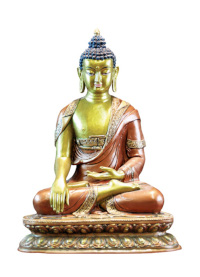
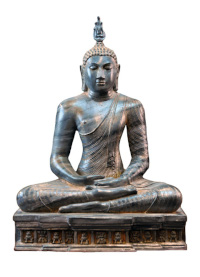
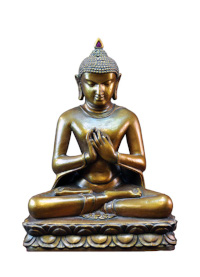
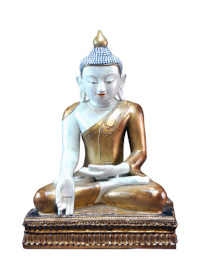
    The images used in this site are based on photographs of a collection of twenty four two-foot-high statues that can be found at the Burmese monastery in Austin, TX. If you click on “Credits” in the footer below, you can read about the interesting history behind these images.

  • The miracle of samādhi

    Samādhi occupies a prominent role in the early Buddhist texts. It is the final factor of the noble eightfold path to which the higher achievements of wisdom, or of knowledge and vision of things as they are (yathā-bhūta-ñāṇa-dassana) are attributed. It is a profound state of serenity, differentiated into the four jhānas, through which the mind becomes progressively stilled and centered, various cognitive faculties are silenced, and complete ease and equanimity are attained.

    Etymologically, samādhi is derived from sam ‘together’ + ādhi ‘put,’ and so has to do with gathering or collecting something together. Samādhi is most commonly translated as ‘concentration,’ implying a narrowing or focusing of attention. However, as we will see, concentration is one of two dimensions that characterize samādhi; the other is the progressive “curtailment” of various cognitive faculties as we progress through the jhānas. At every stage samādhi establishes an orderly array of mental faculties, and this (consistent with its etymology) recommends a translation as ‘collectedness’ or ‘composure.’ I will, for the most part, simply leave samādhi and jhāna untranslated to avoid confusion.

    Etymologically, jhāna is the gerund of the verb jhāyati, apparently in use before the Buddha’s time to denote almost any contemplative or meditative activity. The Buddha sometimes uses this term in its common meaning, but alongside the technical sense of the “four jhānas,” which seems to have been novel at the time of his teachings. In its technical sense the Buddha equates the fourfold jhāna with samādhi, such that there is no samādhi independent of the four jhānas in the early texts.

    Unfortunately, samādhi has become a controversial topic within the Theravāda tradition, where much confusion seems to have resulted historically, first from a redefining of samādhi, then from an attempt to reconcile contrasting frameworks that don’t in principle cohere. The debate persists even among the adherents to the authority of the early Buddhist texts, where contrasting evidence is cited for “hard” or “soft” jhānas (respectively difficult and easy-ish to attain), and where there is still no consensus about how Dhammic insight is even possible in jhāna.

    In this chapter, I develop an account of what samādhi is and how it works according to the early Buddhist texts. I will point out some common, but widely neglected, passages concerning the ubiquitousness and spontaneous nature of samādhi, and about the fruits of samādhi. I will also examine some details of how samādhi is claimed to integrate in practice with other factors. I hope thereby to contribute to a fuller illumination of this remarkable multifaceted culminating factor of the noble eightfold path.

    . . .

    How samādhi arises

    . . .

    Samādhi as concentration

    . . .

    The jhānas

    . . .

    The fruits of samādhi

    . . .

    The miracle of samādhi, the pdf (2025)

    I thought the readers of this blog could us a scholarly explanation of what the earliest texts, and therefore presumably the Buddha, have to say about samādhi and jhāna, that is about meditative states. This is a chapter from my recent book Satipaṭṭhāna Rethought.

    pdf

  • Q&A w/BC: Walking for peace

    Celsa: There is a group of monks walking for peace to Washington DC right now. Is this in agreement with Buddhism principles? Is this a Buddhist way to do things?

    NOTE: Let’s back up for a moment to my last post, “Bodhidharma’s Witnesses.” The dialog between Emperor Wu and Master Bodhidharma should read like this:

    Wu: “I have built pagodas and funded monasteries in my kingdom. What merit have I gained?”

    Bodhidharma: “No merit!”

    Wu: “What are the essential principles of Buddhism?”

    Bodhidharma: “Vast emptiness. Nothing holy.”

    Wu: “Who is it who faces me?”

    Bodhidharma: “I don’t know.”

    This dialog was truncated in the email that went out to subscribers (apparently my email manager mismanages quote blocks). Now the post will make sense, if you go back and read it.

    BC (in reply to Celsa):

    I don’t think the Buddha ever mentioned this specific kind of political expression, but let’s look at what the Buddha said about political expression for monastics and for householders, and at currently accepted manners of political expression.

    The Buddha himself seems to have intervened on two occasions to prevent a military invasion, leveraging the high regard the offending king had for him. On the first occasion he succeeded, on the second he failed. In general, the Buddha was not directly politically engaged (unlike Jesus), but had a lot to say about society (see cintita.org > Study&Practice > Society), and the qualities of the ideal ruler (the “wheel-turning king”). One point stands out in this regard: He recommends that a good ruler seek the council of “brahmins and ascetics”). This would include, but not be limited to the Buddhist Sangha of his time, and in any case would have been a far cry more beneficial than modern rulers’ current reliance on corporate lobbyists. We can infer that the Sangha should play an influential role in the ethics of political decision making.

    Walking for peace would be a means for fulfilling that role. Because monastics are so highly venerated in Buddhist cultures, this influence can be huge. Monastics even enjoy a degree of respect in general American culture, and certainly curiosity. Mainstream media tends to ignore the peace movement, but curiosity may sway even them to give the monks some coverage. Let me draw a comparison to the so-called Saffron Revolution in Burma in 2007 against the military government, in which monks emerged en masse to walk the streets chanting suttas about mettā, but were violently suppressed by the military government. There is a movie about this, Burma VJ, that can be found on Youtube (https://www.youtube.com/watch?v=mH6SrlZvdUM). I highly recommend it.

    In Myanmar, and certainly in many other Buddhist countries, there is an expectation that monks will not engage directly in politics. In fact, in Myanmar monks are not permitted to vote. (However, in Sri Lanka there are monks that are members of parliament.) I agree with the Burmese position, as long as it does not exclude making an ethical point, addressed toward policy or behavior rather than particular parties. I think this is what our peace walkers and doing, as I understand it. Simply bearing witness to make an ethical point.

    The problem with partisan politics is that it divides people. A monk should ideally be able to befriend anyone (yes, him included, and even that guy). We are all faulty, and we are all trying to do the best we can with what we’ve been given (really). Some of us happen to break the fault-o-meter. However, if a monk or nun is willing to talk to the person they find most agreeable, but not to the person least agreeable, they’ve lost half of the people they might offer ethical advice to. The least agreeable is the least likely to listen, but also has potentially the most to gain. Mettā practice is about learning to befriend everybody.

    Alongside political engagement is social engagement in providing health services, alleviating poverty, improving infrastructure, education and other things like that. Monastic communities in Asia are commonly so involved. In Myanmar public education is very poor; the best schools are founded and run by monks and nuns, who also tend to be better educated than most. Monks and nuns also run orphanages, appeal for donations to infrastructure projects, and even found hospitals. It should be noted that the scope of these projects has grown through the invaluable model of Christian charity witnessed during the colonial period. Modern “engaged Buddhism” (a term coined by Thich Nhat Hanh) has taken some very creative directions, to my mind very much in accord with ancient Buddhist principles.

  • Bodhidharma’s Witnesses

    It is commonly known that Buddhism seldom proselytizes, but its practice of “reverse proselytizing” is not so widely appreciated. Here is the idea:

    Bodhidharma was a mythical or half-mythical monk who lived in the fifth to sixth century. He is known for bringing Chan Buddhism from Central Asia to China. Fierce in appearance and demeanor, he is said to have had red hair and beard. Upon learning of Bodhidharma’s appearance in his kingdom, Emperor Wu, a great promoter of Buddhism in China, summoned the venerable to his court. Their conversation went something like this.

    Wu: “I have built pagodas and funded monasteries in my kingdom. What merit have I gained?”

    Bodhidharma: “No merit!”

    Wu: “What are the essential principles of Buddhism?”

    Bodhidharma: “Vast emptiness. Nothing holy.”

    Wu: “Who is it who faces me?”

    Bodhidharma: “I don’t know.”

    Bodhidharma had challenged Emperor Wu’s tightly held preconceptions. Years ago I considered getting a group together and walking door to door carrying Bodhidharma’s message. We would call ourselves “Bodhidharma’s Witnesses.” After all, his attitude seems to have had some success in China, producing a thriving Chan movement that spread from China to Korea, to Japan (where ‘Chan’ was mispronounced as ‘Zen’) and to Vietnam, and that is alive in many more lands to this day.

    In the forests and mountains of ancient China, if a young man was intent on leaving home to join the Chan monastic community, he would approach a monastery, knock on the gate, and request permission to enter. However, he would routinely be denied admittance, rather being told either that they could see that he not worthy of admittance, or that the monastery was already fully occupied. He should go home.

    Determined, the young man would sit cross-legged at the monastery gate in meditation position and endure the challenging wait for the monks within to change their mind. The monks meanwhile would insult the foolish aspirant and throw rotten vegetables at him. But the young man would persist for as long as it took. Fortunately, an empathetic cook would come out once a day and offer food and water. This would go on for days, until the monks within were convinced of the young man’s conviction. They would then relent, shave his head, give him monastic garb and floor space on which to meditate and sleep.

    This challenging tradition continues to this day, but is often formalized. In Japan, the process is called tangaryo. In January 2002, I arrived for a three-month practice period at Tassajara Zen Mountain Monastery deep in the cold coastal mountain range of California, inland from Monterey. Any monk (men and women are both called ‘monks’ at Tassajara) who arrives for a first practice period at Tassajara must undergo tangaryo. At Tassajara tangaryo consistently lasts five days and nights, the aspirant sits in the zendo, receives meals in the zendo, but is given a real bed elsewhere to sleep on from 9:00 at night to 3:50 the next morning. Otherwise the aspiring monk has to be on their allocated cushion (standing also allowed as long as they are standing on their cushion), facing the wall, except to use the restroom, never bathing or shaving. Meanwhile other, established monks come and go freely into and out of the zendo, to sit zazen, to perform services, to learn the chants and how to ring bells and to clean the zendo, as if the tangaryans were not there. These others did so a little too cheerfully for my taste. There is generally a small group of tangaryans at the beginning of any practice period. There were about fifteen of us in January 2002, the women sitting on one side of the zendo, the men on the other.

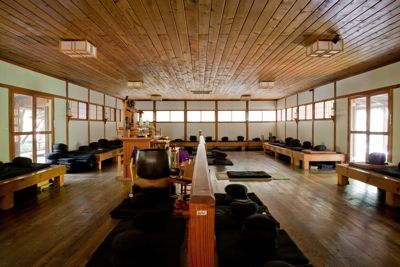
    meditation hall at Tassajara

    Tangaryo is perhaps the most challenging thing I have ever done on purpose. It was impossible to actually sit zazen in the strictest sense the whole time; apparently nobody ever does. I would start off OK for a few hours, then would have to relax and think about something, remember favorite songs, daydream. When my mind would wander too far beyond control, I would induce some rigor into my practice to bring it back:

    “If you find that your mind has drifted away from the daydream, just let go gently of whatever distraction has arisen, and return to the natural course of the daydream.”

    Later I would return to actual zazen for a couple of more hours, then try to recall my most interesting distraction thus far. With the meal that was brought to my cushion I would drink as much liquid as I could so that I would have to go to the restroom more often, and then drink as much water as I could on the way back to the zendo. On my way back to my seat, I would furtively glance at the women tangaryans facing the wall in their baggy robes, the greatest external thrill I could squeeze out of the day, except for lunch. The women seemed much stiller to me than the men I was sitting next to, certainly than myself.

    Finally, just short of one hundred and twenty hours of this, a disembodied voice manifested in each of our little worlds, congratulated us, asked us to walk up the hill to the hot springs, bathe, to put on clean robes and to join the practice period as full-fledged participants. All fifteen of us had successfully met the challenge, and sat it out. I would learn of would-be monks of the past who had given up and gone home in a huff and with a sigh. “No practice period for you.”

    The tangaryo monks were additionally given an early morning duty for the remainder of our first practice period that we were to take turns performing: We were to light all of the kerosene lamps that illuminate the many paths monks use in the predawn hours, most especially to get to the zendo before four thirty zazen. This arduous task entailed getting up at 2:50 to fumble around with wicks and matches, a miner’s lamp strapped to the head, trying to protect feeble flames from the wiles of the wind.

    Why would anyone want to discourage practice in this way, to reverse the easy entry into practice that proselytizing might have achieved, and to deny practice for those deemed “not worthy”? Come to think of it, denial for the unworthy is common in many walks of life. College admission often requires worthy SAT or GRE scores. Fraternity admission requires enduring some kind of hazing process to establish one’s worth. It’s a cinch that joining a street gang, especially the worst of the worst like the Sharks or the Jets, requires proving one’s worth by performing a ghastly misdeed, such as stealing a police officer’s badge or getting an ill-advised tattoo.

    So, why not let anyone who can navigate the mountainside-hugging road to Tassajara stay there and practice, anyone who can find an apartment near campus attend classes in Ethnographic Research Methods and such, and any kid in the neighborhood join the local gang? I think the answer is that requiring aspirants to make that challenging initial investment promotes excellence. Having made that investment the aspirant will not forget their commitment, nor doubt their ability to fulfill that commitment. Moreover, they will also have joined a community of aspirants who can say the same thing—like-minded, mutually inspiring and mutually supportive individuals. Together they have created an environment in which practice can thrive in excellence if not in numbers. But as an excellent community they will inspire new aspirants to make that same initial investment.

  • Sunday Zoom Dhamma Talks

    I have just added the following to the Events page. Please join us when you can. It is short notice, but I am giving a talk tomorrow (Sunday, December 28, 2025, 10:30 CST) on the Seven Awakening Factors.

    Sunday Jade Temple Dhamma Talks

    click on the banner for more info
    Kwan Yin Hall, Jade Buddha Temple, Houston, TX

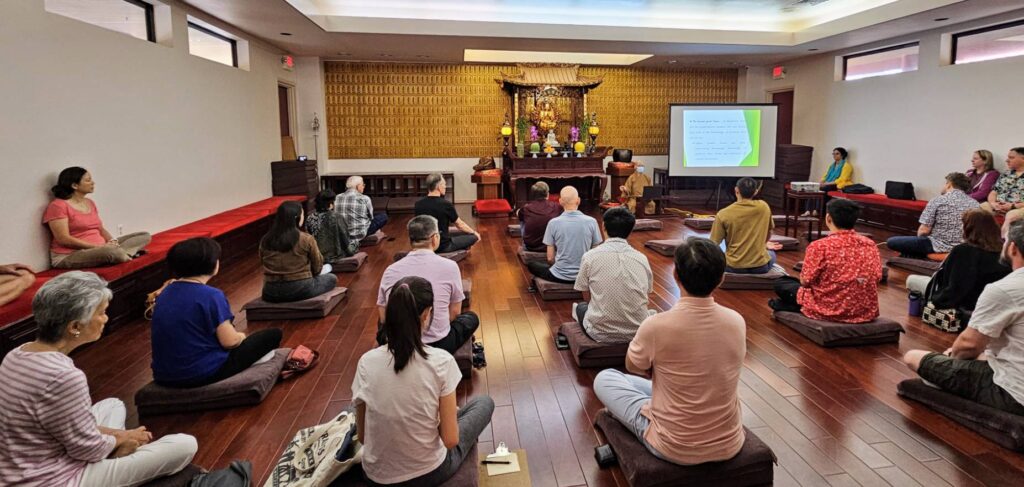
    BC offers occasional talks via Zoom for the Sunday morning program in the Kwan Yin Hall at Jade Buddha Temple in Houston, TX. Each Sunday there is a guided meditation at 10 am Central (Chicago) Time, followed by a short Dhamma Talk at 10:30 am, offered either in person or via Zoom on the big screen. BC is currently scheduled to speak on the following Sundays (subject to change).

    • December 28, 2025
    • January 11, 2026
    • February 8, 2026
    • March 8, 2026
    • April 12, 2026
    • May 10, 2026
    • June 14, 2026
    • July 12, 2026
    • August 9, 2026
    • September 13, 2026
    • October 11, 2026
    • November 8, 2026
    • December 13, 2026

    Click on the current date for the Zoom link. It should be available a day or so before the respective Sunday program.

  • Q&A w/BC: The virtuous vegetarian

    Gerry:

    Killing is another good example of a wrong interpretation of the Buddha’s teachings and intention, as well as strict vegetarianism. The rational “intent” of “no killing” (of sentient beings) as an important precept is to reinforce the wholesome concept of always “doing the right thing”, and to avoid being intentionally “cruel” to living creatures. While this sounds good, the reality is man and other “animals” have to kill to eat and survive. Big animals eat smaller animals, big fish eat smaller fish, birds eat almost anything, from fish to rodents, and pet cats. Killing and dying are “normal” aspects of life. Every living creature eventually dies, sometimes from unpleasant effects of old age, injury, or disease. Killing for food was and is perfectly natural and necessary.  In the Buddha’s time, he was influenced by many wars and needless killing. Moreover, there was, and still is, ritualistic killing in India; mass animal sacrifices to the “gods”. These issues shaped the precept of “no killing”.

    An example of the clear intent and practical need for the precept is found in western culture, particularly in Texas, where sport killing is big business, where “deer season”, and “Dove season”, pheasant and turkey hunts, quail hunts, and the “Safari Club” are viewed as imperatives.  Sport fishing is the same. This mindset is of course exploited by manufacturers as a billion dollar market for guns, ammo, clothing, boats, 4 wheel drive “super trucks”, and expensive taxidermy where some more wealthy “big game hunters” have trophy rooms with hundreds of thousands of dollars in stuffed animals; all for ego. And, as an integral part of this fantasy, heavy alcohol drinking is considered essential.

    It seems logical that a critical thinker like the Buddha, saw this type of killing as “sinful”, or promoting an unwholesome view of life, and therefore the first on his list of Precepts to follow for a better life.  Not killing to live. If this logic for a misinterpretation of “no killing” weren’t enough, the Dali Lama, the Spiritual Leader of Tibetan Buddhism, and realistically the “face” of modern Buddhism in general, eats meat!!!!  (Not something they broadcast).

    Killing to eat, or killing “pests” like mosquitoes, or ants, is practical and logical, just like killing a form of bacteria. It is not detrimental to finding the enlightenment of integrity and wisdom. If we are to spread Buddhism to “westerners” we need to repackage its purpose, and the specific practice to transform our distorted minds.

    BC:

    I’m going to say that the dilemma of not killing is common to all precepts, commandments, or ethical rules. There is no way for any ethical system to provide a fool-proof guide to telling what is right or wrong in all circumstances. This is true of Buddhist precepts as well. But let me first clear up just what the Buddha said about eating meat.

    There is no across-the-board requirement or even recommendation of vegetarianism in early Buddhism. The first of the five standard precepts prohibits attack or killing of “breathing things,” which a butcher (or worker in a slaughterhouse), hunter or fisherman would certainly violate regularly. However, many people eat meat without ever killing. Even though doing so is implicated in killing by others, it is not explicitly prohibited in the early texts. However, a general prohibition against eating meat is observed in East Asia. It is listed among the “Bodhisattva Precepts” in the Brahmajala Sutra. Although this text has a Sanskrit name, scholars have determined it is actually of Chinese origin. Modern Zen centers in America are invariably, at least in my experience, vegetarian.

    The Buddha was, nonetheless, sensitive to implication in killing, rather than killing itself, in a couple of contexts. He significantly restricted meat consumption for the Sangha, whose diet depended on what food was offered to them by householders. Here two principles came into conflict: On the one hand, monks and nuns are expected to accept graciously whatever is offered (effectively, beggars should not be choosers). On the other, he apparently seems to have felt that monks and nuns should not be implicated in killing by consuming meat. He therefore established a compromise: A monk or nun can in general accept and consume meat if it is offered, for instance, from what the family is eating at home in any case. However, they cannot accept or consume meat if they have any reason to suspect that the meat was killed explicitly in order to feed monks or nuns. This is a rule in the Vinaya, the monastic code.

    When I was in Myanmar in 2009, shortly before my ordination, I traveled with my teacher (Ashin Ariyadhamma, abbot of our monastery in Austin, TX) throughout Myanmar, staying primarily in monasteries. At each monastery we visited, U Ariya introduced me to the abbot, and I offered the three traditional bows at his feet. Each time U Ariya would explain in Burmese that I was priest in a Mahayana tradition, but was about to ordain as a Theravada bhikkhu. In every single case the local abbot offered me some advice, generally based on his misunderstanding of some aspect of Mahayana that he felt I needed to rid myself of. But on one occasion I was surprised that the abbot offered the following advice,

    “Don’t eat meat!”

    Already a vegetarian, and aware of the typical Theravada provision about accepting whatever is offered, I chose to play devil’s advocate, “What if a layperson offers it to me, shouldn’t I accept it graciously?”

    “If a layperson offered you a glass of whiskey, would you drink it?”

    “No.”

    “Don’t eat meat!”

    Parenthetically, on another occasion we visited a very prominent 94-year old abbot. In his case, upon hearing U Ariya’s explanation of my desire to change traditions, rather than offering advice, he looked very confused, then said to me in perfect English,

    “Mahayana is perfectly good Buddhism.”

    Another example in which behavior falling short of killing is restricted applies to householders as part of right livelihood. A wrong livelihood is one that is not conducive to practice. One’s livelihood compels one to repeat actions over and over, that therefore have a huge influence on upholding or making progress in practice. The significance of mere implication in others’ breaking certain precepts is thereby magnified. Accordingly, the Buddha characterized professions like manufacture of weapons, raising animals for consumption, human trafficking, and involvement in the alcohol industry as wrong livelihoods.

    Garry, your points concerning the necessity and naturalness of meat consumption are well taken, as well as the important distinction between killing for food and killing for sport. I’ll even add a couple of points: There would be no Buddhism in a vegetarian Tibet. Plant-based agriculture is too meager to sustain the human population. Animals domesticated for food production have thrived historically throughout the world: chickens and cattle abound, because people eat them. However, the animals raised today on factory farms are often subject to far more cruelty that the victims of hunting for sport.

    But let’s zoom out to get an idea of the bigger picture. The ethical questions you note with respect to meat are, I think, in the nature of virtually all precepts to one degree or another. This goes for Buddhist precepts, Christian commandments, civic laws, etc. In my intro to Buddhism (BLBP) I call precepts “rigid and porous.” They are rigid in that they fail to acknowledge exceptions, or the kinds of circumstances you note, in which they become counterproductive, harmful, or non-negotiable. They are porous in that they fail to cover all the circumstances that could use a bit of ethical attention. Precepts constitute a kind of shotgun, hit-or-miss approach to ethics. If they are made less rigid (adding a clause such as, “… unless greater harm results”), people will become very creative in imagining greater harm when they simply find the precept personally inconvenient. If they are made less porous, they become so numerous that no one will remember all of them.

    The value of precepts is to offer simple rules thumb that apply relatively reliably to a wide swath of ethically charged circumstances, in which ethical choices might otherwise be overlooked or require more deliberation than available time. They produce benefit, but are not a reliable calculus that tells us what to do in every circumstance.

    Notably, there are two words for precepts in Pali. One is sīlāni, which simply means ‘behaviors.’ The other is more interesting: sikkhapada, which means ‘training step.’ We follow the precepts partly because most of the time they provide beneficial results, but primarily we use precepts to train multple levels of ethical sensibilities. In Buddhist practice, a precept gives us an opportunity to consider our own motives and needs, the consequences of our alternative choices (especially for others), how alternative actions might make us feel (glowing with compassion, remorseful for what we’ve done?). We thereby learn to engage in our ethical choices more conscienciously.

    Just a couple of days ago I was in a store chatting about the weather with a friendly cashier. She said that she had gone pheasant hunting with her dad earlier that sunny day. I asked if she knew how to prepare pheasant for eating, and was surprised to hear that she didn’t even know if they were going to eat the ones they had bagged. If she had the precept about killing firmly in her mind, she would have raised questions that in fact not not occurred to her. Likewise, an ethically equipped person who wants to rid their house of pests is less likely to undertake extreme measures, like destroying an entire ant colony, and more likely to find clever ways of eliminating the problem, such as finding and plugging the entrance by which ants find their way into the house with a bit of putty. Like other matters of Dhamma, we take precepts seriously, but hold them loosely.

    For the Buddha, every action (kamma) we undertake, every choice we make, has a potential ethical value. Ethics is an art, something we train in until our choices becomes second nature, internalized to the extent that we find ourselves making beneficial and satisfying ethical choices spontaneously and intuitively, without recourse to rules, or even thought. For the Buddha, ethics already has a firm basis in human psychology: what is skillful (kusala) or unskillful (akusala) is defined in these terms. Advanced practice is centered around perfecting this art by putting it to use in our lives under the guidance of Dhamma. “Training steps” are simple Dhammic nuggets of wisdom that provide some direction in many situations that tend to cause thorny problems. Other things we must pay close attention to are how the consequences of our choices play out, what intentions (personal motivations) underlie our choices, how our choices or its consequences make us feel (good? remorseful? cringy?). Ultimately we must also take up wisdom practices in order to discover how our habituated but faulty ways of framing the world (for instance as revolving around a fixed self) affects our behavioral choices. All of these factors become integrated as we advance in practice and become a beacon of virtue.

    In the modern world, excellence is an important concept. We produce virtuoso musicians, excellent actors and athletes, brilliant scientists, martial artists, navy seals, snipers, perfect empoyees that know how to compete in the neoliberal marketplace. The contribution of mindfulness has even played an important role in achieving excellence seemingly across the board. However, modern society provides few opportunities to achieve excellence in virtue. This is where Buddhism has its greatest potential.

  • Q&A w/BC What would you do?

    Colleen Kastenek has has an interesting Q, but rather than adding an A, it is appropriate that I let you readers do that. Please comment below with your answers, and I will summarize the results.

    Colleen

    Just throwing this out there, and I hope a lot of people respond because I am curious: If a Buddhist monk or nun knocked on your door and asked for a few minutes of your time to explain Buddhism, what would you do?

  • This is a test

    Some subscribers (including me) seem not to be receiving blog posts by email from my new site. I’m sending this out as a test. Please excuse the disruption.

  • The Case of the Missing Sangha

    a selective review of Stephen Batchelor’s After Buddhism: Rethinking the Dharma for a Secular Age, 2017, Yale University Press.

    pdf_24x18Other reviews of this work have missed what I think is the main arc of this book, its thoughts on the nature of the Buddhist community, on the fourfold assembly, on monasticism, on Buddhist institutions and on what a modern “secular” Buddhist community will look like. The scope of the book is, however, much broader: “truth” and “belief” and their relation to practice, the Buddha’s understanding of emptiness, ethics as the basis of Buddhist practice, the ins and outs of Buddhist psychology, and much more. Much of this discussion is worthwhile, particularly his discussion of the practical basis of Buddhist doctrine as opposed to view of it as a belief-system,[1] and his strong emphasis on ethics as foundational for Buddhist practice and understanding.

    I will, in this review, focus on what he writes about the Buddhist community, which I find is also the weakest part of his exposition. For Batchelor, “after Buddhism” is achieved by going back to the early teachings of the Buddha, that is, “before Buddhism,” whose ancient teachings, astonishingly, resonate with modern ways of thinking. As Batchelor puts it,

    “Paradoxically, to imagine what might emerge after Buddhism, we need to go back to the time before Buddhism began” (p.28).

    In Batchelor’s account of early Buddhism he attempts to show that there was no organized monastic community within the Sāsana during the life of the Buddha. If this were true, it would remove the tag “organized religion” from “before Buddhism,” and place it on the doorstep of “Buddhism.” It would also removing the imperative from “after Buddhism” of establishing a modern organized monastic community.

    The reliability of early Buddhist texts (EBT). His position on this issue forms the framework of Batchelor’s entire discussion of early Buddhism, so let’s begin here. Batchelor writes,

    “The early canonical texts are a complex tapestry of linguistic and rhetorical styles, shot through with conflicting ideas, doctrines and images, all assembled and elaborated orally over about three or four centuries before being committed to writing. Given the chorus of voices, how are we to distinguish between what is likely to have been the Buddha’s word as opposed to a well-intentioned ‘clarification’ by a later editor or commentator? We are not yet–and may never be–at a point where such questions can be answered with certainty.”[2]

    This is quite accurate as far as it goes, but I believe the Buddha’s voice can be heard much more clearly than one is likely to infer from this statement. This is an important issue, because throwing up our hands as saying, “We really don’t know what is authentic!” is an invitation to cherry-pick evidence for any particular interpretation of the EBT that we like, declare this evidence as authentic and dismiss any counter-evidence as the product of a later editor or commentator.

    The level of authenticity of the EBT can be fairly reliably assessed because the same early corpus of texts was preserved separately from earliest times in many parallel early sects in diverse regions of the Buddhist world and in diverse languages. The Pali corpus of the early Theravada sect is the best known today, but only one of many of what constitute the EBT. Comparative studies of the existent redactions of the early Buddhist Texts give us a good tool for determining what has be altered and what is likely authentic. We find, for instance, that background stories found in the discourses can vary in details among redactions, but the words of the Buddha seem generally to be surprising close in content and remarkably uncontaminated by later doctrinal developments within the various sects. In general we can be confident – and this has been recognized since the nineteenth century – that these texts were preserved remarkably well given their complex history.[3]

    Furthermore, once the adept Buddhist practitioner becomes thoroughly familiar with, and puts substantially into practice, the EBT in any one redaction (e.g., the Pali canon), he will appreciate how systematic these texts are and realize that they must be primarily the work of a single genius. His task is like piecing together a jigsaw puzzle in which some authentic pieces are missing, and in which other inauthentic pieces have been mixed in from other jigsaw puzzles. At some point he nevertheless recognizes in the unfinished puzzle, “Oh, I get it: This is the Golden Gate Bridge!” A systematic interpretation of the whole has shone forth that he cannot easily back out of.

    Although any specific claim about the EBT cannot be proven decisively, and might still admit debate among scholars, the convergence of evidence from many sources can give the practitioner considerable confidence about what is authentic. In the long history of scholarship around these texts, I am not aware that anything fundamental that is repeated frequently in a range of texts has ever been overturned, certainly nothing as fundamental as the existence of an organized monastic community at the time of the Buddha.

    Equality in the Buddhist community. One of Batchelor’s more puzzling statements is critical for the conclusions he wants eventually to make about modern secular Buddhism. It is the following:

    “Gotama clearly envisaged a community in which all members – irrespective of their status as men or women, monastics (mendicants) or laity (adherents) – are entirely equal in the training they receive in the dharma, the practices they undertake to master and understand it, and the responsibility they have in communicating its message. Such an egalitarian community is a far cry from what is normative in many Buddhist traditions in Asia today.”[4]

    A famous EBT passage he quotes from the Parinibbāna Sutta in defense of this states that the Buddha would not be ready to attain parinirvāna until there are trained and accomplished disciples who can take on teaching responsibilities in each of four categories: male and female monastic disciples and male and female lay disciples. However, his radically egalitarian conclusion does not follow even closely from the passage he cites, which does not state all members of these four groups have all of these qualities, only that some members of each group have all of these qualities. Moreover, Batchelor’s interpretation would make no sense, because not all members can possibly possess these qualities equally, for:

    1. Not everyone has equal access to training.
    2. Not everyone chooses equally to receive such training,
    3. Not everyone chooses to undertake the same practices,
    4. Monastic disciples and lay disciples already differ, by definition, in the nature of their practices; to say they are entirely equal in practices they undertake is analogous to saying meditators and non-meditators are entirely equal in their practice.
    5. Disciples, even if they have the same training and practices, will differ in opportunity, motivation and disposition, and will exhibit a markedly wide range of practice attainments, and therefore:
    6. Disciples will differ widely in their capacity for understanding or communicating the message of the Buddha.

    Batchelor himself refers to the noble disciples as those distinguished from common members of the Buddhist community in their practice attainments. Noble disciples have reached at least the first level of awakening, called stream-entry, before which a disciple is considered, in the Buddha’s terminology, an ordinary person or a worldling (puthujjana). In short, the Buddhist community varies enormously in all the criteria Batchelor mentions.

    Although the point that many noble disciples, whether monastics or lay, whether men or women, are strong in training, practice, attainment and teaching is well taken, the egalitarian community Batchelor describes makes as much sense as lumping all baseball players together, whether major league, minor league, little league or amateur and then claiming that they are equal in entirely equal in training and practice, and equally qualified to coach a major league team. We will see how Batchelor’s uses his weak egalitarian conclusions for early Buddhism to justify elements of his vision of “after Buddhism.”

    The status of monastics. Batchelor makes another remarkable claim,[5] that no formal distinction between the monastics (bhikkhus and bhikkhunis) and the lay adherents (upāsakas and upāsikas) existed in early Buddhism. He offers no support whatever for this claim, a claim that would surprise any student or scholar even casually familiar with the early texts. Let me itemize some obvious problems with his claim:

    First, the words bhikkhu and the feminine bhikkhuni seem to have been introduced by the Buddha and was not used for ascetics of other traditions, nor applied to Buddhist householders.[6]

    Next, the Buddha’s earliest disciples, including himself, of other traditions; it was initially a movement among bhikkhus. One of the Buddha’s earliest disciples was a nobleman, Yassa, a young man who left home and showed up where the Buddha was staying, but with his father in hot pursuit. When the father arrived at the encampment, the Buddha sorted things out such that Yassa received permission from his father to become a bhikkhu and was ordained by the Buddha and remained with the Buddha as a trainee, while the father became a lay follower of the Buddha and returned home. It is clear that there is at this very early time a formal difference in the status of father and son in terms of the manner of commitment each has made, the younger leaving the household life to follow the Buddha and live, like the Buddha, as a renunciate.

    Some of Yassa’s friends subsequently decided to follow his example, and are reported to have shaved their heads and beards, put on yellow robes and left home for homelessness. It is clear that the early monastic community had a “dress code” in the EBT that distinguished them from the mendicants of other schools as well as from Buddhist laity.

    Requesting and granting monastic ordination occurs frequently in the EBT. This was a first accomplished by the Buddha with the words, “Come, bhikkhu!” but involved an increasingly elaborate procedure with time. Eventually the Buddha also authorized other monks to perform ordinations so that candidates would not have to make the ofttimes long journey to see the Buddha in person. It is also said that people were prohibited from monastic ordination as a means of avoiding social responsibilities such as debt, military service or punishment for a crime.

    Throughout the discourses, new disciples most typically declare their conversion to the Buddha’s way by taking refuge in the Buddha, the dhamma and the bhikkhusangha, not simply the sangha. Clearly the bhikkhu community has a formal status even in the rite of becoming an adherent as a householder. Probably at about forty years of age, the Buddha founded the bhikkhuni-sangha, the nuns’ community, with new concerns reported around ordination.

    The Buddha produced at least the core of the Vinaya, the disciplinary code, during his lifetime expressly for bhikkhus and bhikkhunis. The life of the bhikkhus was initially taught implicitly by example, but as the bhikkhu community began to grow and vary the Buddha laid down specific standards of discipline. The result was the quite extensive Vinaya, as far as we know, an entirely novel accomplishment for that time. As Richard Gombrich put it, “… among all of the bodies of renouncers it was only the Buddhists who invented monastic life.”[7] The Vinaya is the body of teachings that define the monastic what it is to be a monastic, as distinct from a householder.

    That the Vinaya was conceived and developed – although not fully brought to its complete canonical form– during the life of the Buddha is clear in the Buddha’s frequent use of the term Vinaya in the discourses. In fact, the Buddha repeated refers to the body of his teachings as the Dhamma and Vinaya (Doctrine and Discipline), or simply as the dhamma-vinaya, highlighting the importance of the monastic code relative to the Dhamma. For instance, a Digital Pali Reader search over the four main discourse collections shows the following number of occurrences for only one of the expressions used to refer to the Doctrine and Discipline;

    dhammavinay- 274

    Moreover, all Buddhist traditions agree that the Vinaya was recited along with the discourses at the first council shortly after the Buddha’s death. Although Batchelor gives an account of the first council and of the recitation of the discourses by Ānanda, he makes no mention the recitation of the Vinaya, which was accomplished by Ven. Upāli.

    All of this evidence overlooked by Batchelor when he makes his unsubstantiated claim that the monastics had no formal status in the EBT. Together it provides overwhelmingly evidence that there was a formally distinguished bhikkhu community during the life of the Buddha.

    Following up on this claim, Batchelor maintains that designating someone as a monk or a nun would not be appropriate, in any case, until a later time in history, “when mendicants came to live apart in monasteries, functioned as priests, and depended on the laity to provide not only daily alms food but the upkeep and protection of their institutions.”[8] In fact , it is clear that most of these conditions were already in existence at the time of the Buddha. Although the Buddha continued to extol the mendicant life, there are many reports in the EBT of land being granted to the monastic community: The first was a park donated by King Bimbiasara of Magadha on the outskirts of Rājagaha shortly after the Buddha’s awakening. The best known was the Jeta grove donated by the wealth banker Anāthapindika near Sāvatthi the capital of Kosala. Often donors had residences and other structure build on the land, which the Buddha explicitly permitted monastics to accept, but not to request. Lamotte calculated twenty-nine monasteries explicitly mentioned at the time of the Buddha.[9] Monastics are reported to have built modest shelters on their own for temporary residence and the Buddha placed restrictions on how substantial these shelters could be. The Buddha also stipulated that monks and nuns should stay in residence in one place during three months of the rainy season each year. He also authorized the residents of monasteries to elect officers to handle the allocation of housing, the acceptance of robe donations to the community, etc.

    Batchelor is, however, correct in his statement that the monastics only later took up priestly functions. That the Buddha could prohibit this also speaks of the existence of a distinct disciplined monastic community for whom this stipulation would apply.

    The meaning of “sangha.” Batchelor defines the word the word sangha in a way that is poorly supported in the EBT.[10] Specifically, he defines it as the fourfold assembly of male and female, mendicants and adherents (monastics and householders). Now, in Western circles the word sangha indeed most generally refers to the entire Buddhist community, so Batchelor’s claim will make sense to the casual reader, but misleadingly so. In the EBT the fourfold assembly is almost always designated as catu-parisā in Pali, and in the Pali canon the word sangha is never used for the fourfold assembly.[11] In fact, I am unaware of any precedent for the common Western usage anywhere in pre-modern Buddhism (although I’ve noticed Thich Nhat Hanh often uses the word in this way, apparently in conformity with Western usage). Knowing that this usage is never found in current Asian Theravada Buddhism, I once asked the late scholar John McRae if sangha ever refers to the general Buddhist community anywhere in East Asian Buddhism, his area of expertise, and was told that this would be an “unusual and idiosyncratic” use of the term.

    The base meaning of sangha is “group.” However, the word was used in a specific sense prior to the Buddha to refer (as Batchelor correctly points out[12]) to the clan-based governing bodies of the Indian republics at the time of the Buddha, generally in the compound gaṇa-sangha, “assembly of equals.”[13] In the EBT two compounds are commonly formed from –sangha: sāvaka-sangha and bhikkhu-sangha. We have already seen that bhikkhu-sangha (monastic sangha) is common in the formula for going for refuge. Sāvaka-sangha (community of disciples, or “hearers”) is generally used to refer specifically to the community of ariyas or noble disciples, that is, those who have attained at least the first level of awakening, steam entry. One might expect to see the term ariya-sangha as well in the place of sāvaka-sangha; although it would seem to mean the same thing, ariya-sangha is in fact very rare in the EBT.

    So, it seems that sangha has two technical meanings in the EBT, one referring to the community of noble disciples and the other referring to the community of monks and nuns. Running the Digital Pali Reader on the four main collections of discourses yields the following numbers of occurrences:

    bhikkhusangh- 270,
    sāvakasangh- 61,
    ariyasangh- 1.

    There are no occurrences of upāsaka-sangha in the corpus, which would be the lay sangha if one existed. Batchelor’s further claim[14] that the monastic community only later monopolized the use of the term sangha is therefore belied by the EBT, in which the term refers almost always either to the monastics or to the noble disciples, with the monastic reference seeming to be more common.

    Moreover, we are justified in inferring that the meaning of sangha in reference to the monastics is primary meaning of sangha in the Buddhist context, because of the origin of the term as the assembly of equals in the republics. First, as we will see, the early monastic sangha as described in the Vinaya was a non-hierarchical, non-autocratic democratic institution like the republican councils. Second, neither the lay community, nor the community of noble disciples was organized at all by the Buddha institutionally.[15] Finally, in a famous series of similes, the Buddha drew an explicit seven point-by-point comparison between the basis of welfare in the Vijjian Republic and the monastic Sangha,[16] suggestive of the close kinship of the monastic organization to the republican.

    Moreover, taking the monastic community as the primary meaning of sangha explains the use of sāvaka-sangha as a derivative meaning. Whereas almost all of the early monastics quickly became noble disciples (ariyas) – in fact the first sixty are reported to have become arahants – as the number of householders began to grow, many lay disciples soon achieved high levels of attainment resembling expected monastic levels of attainment. Therefore, we can see how meaning of sangha in reference to noble disciples might easily arise as a way of grouping such householders with the monastics as adept upholders of the Dhamma. The term sāvaka-sangha (disciple, or “not necessarily a monk or nun,” sangha) thus makes sense, suggesting an extension of the bhikkhu-sangha. Ariya-sangha would be more precise, suggesting a group that only intersects with the bhikkhu-sangha, but appears not to be preferred in the EBT.

    In summary, Batchelor seems to be falsely and without evidence projecting an apparently uniquely modern usage of the word sangha onto early Buddhism. The base technical meaning of sangha in the EBT is an organized monastic community, the secondary meaning is the community of noble disciples, and a meaning that includes the entire lay community is unknown. As far as I can determine, this has consistently been the usage in Asia until modern times.[17]

    Batchelor’s origin story. Batchelor, in fact, attributes the creation of the monastic order to the senior monk Mahākassapa. Now, Kassapa is remembered in every Buddhist tradition for taking the lead in arranging the first Buddhist council shortly after the Buddha’s death, at which a group of arahants heard a recitation of the complete corpus of the Dharma-Vinaya to make sure that they were all on the same page. The Zen tradition would later compose the story about him in which the Buddha holds up a flower and Kassapa smiles, and then assign him second place after the Buddha in the fabricated early Zen lineage. Batchelor creates his own speculative tale about Kassapa that casts him in a less favorable light. This is apparently by way of attributing the monastic institution to the later “Buddhism” period under his guidance.

    Batchelor’s is a tale of good monk/bad monk, in which Ānanda represents the former and Kassapa the latter. Batchelor describes Kassapa at the time at which he arrived at Kusināra to witness the Buddha’s funeral as,

    “… a stern, intimidating ascetic who immediately imposes his authority on the proceedings. He seems to embody everything that Gotama warned against as he lay dying. He is ‘chief among those who expound the ascetic practices’ and does not hesitate to declare how enlightened he is and that he is the Buddha’s appointed successor. He is the very antithesis of Ānanda, but Ānanda seems powerless to resist him.”[18]

    He states that Kassapa’s arrival at Kusināra marks the beginning of a struggle to determine the nature of orthodoxy and ecclesiastical authority.[19] He even calls Kassapa an “insufferable prig” at one point, suggests that the Buddha was trying to get away from Kassapa in traveling to Kusināra and smears him through a vague association with the evil monk Devadatta through a connection to King Ajātusattu of Magadha, who agreed to sponsor the first council.[20]

    Let’s compare this with what we find in the EBT. First, there is nothing about Kassapa imposing his authority of the funeral proceedings. Anaruddha, the Buddha’s cousin and Ānanda’s half-brother, seems to have taken on a leadership role in this regard before Kassapa’s arrival. What is reported is that deities who were present, visible only to Anaruddha, would not allow the Buddha’s pyre to be lit until after Kassapa and his party of monks had arrived and paid respects, after which the pyre spontaneously burst into flames. This is clearly a later embellishment that attributes no active role to Kassapa at all, other than paying proper respect to the deceased Buddha.

    Second, the Buddha is consistently reported to have had the highest regard for Kassapa, and in fact for his observance of very strict discipline, for his very simple contemplative life-style and for being content with whatever was offered to him. This is why the Buddha named him “chief among those who expound the ascetic practices.” There is no indication that the Buddha warned anybody about monks like Kassapa; quite the contrary.

    Next, there is indeed a bit of evidence in the EBT that a tiff arose between Ānanda and Kassapa during this period. Apparently after the Buddha’s death and before the First Council, Kassapa admonished Ānanda for allowing a group of young bhikkhus, students of Ānanda, to run around in an undisciplined manner and called Ānanda a “youngster.”[21] There are parallels to this discourse in the Chinese canon, but I understand that none of them mention this tiff, which makes its authenticity suspect. Even if Kassapa did in fact call Ānanda a youngster, this actually makes sense as a means of admonishing Ānanda for behaving like a youngster in running around with undisciplined youngsters; monks are expected, according to the Vinaya, to admonish and accept admonition for infractions of discipline. The passage, if authentic at all, admits to even more alternative interpretations. For all we know, Kassapa and Ānanda were the best of friends and were in the habit of exchanging friendly barbs. Or, Kassapa, the arahant, was trying to shock Ānanda, the steam enterer, into taking his practice more seriously. In fact, the Zen tradition maintains that Kassapa became the teacher of Ānanda and succeeded in bringing him to full awakening where the Buddha had failed. In the Pali, Ānanda is said to have attained awakening just prior to the first council. In short, it is easy to read too much into a tiff.

    Next, “does not hesitate to declare how enlightened he is” refers, apparently, to a (single) incident in which a bhikkhunii, Thullatissā, well known as a trouble-maker in the Vinaya, accuses Kassapa of being unqualified to teach bhikkhunīs. Kassapa, though of greater attainment, was apparently a less talented teacher than Ānanda, and had initially resisted Ānanda’s invitation to teach on this occasion. Kassapa defends himself from Thullatissā’s attack by recounting a circumstance in which the Buddha praised him rather effusively.[22] Although the phrasing of this discourse indeed makes Kassapa sound like something of a braggart to the modern reader, this kind of language is common in the discourses; in many passages the Buddha sounds like a braggart as well when he extols his own qualities. I suspect this impression is the product of a natural tendency toward embellishment during the generations of recitations of these texts, and toward normalizing the wording of similar passages taken from different contexts.

    Finally, there is no mention in EBT of a “struggle to determine the nature of orthodoxy and ecclesiastical authority.” Batchelor does not tell us what the specific issue or result of this struggle might be, though he seems to suggest it was the creation of the monastic order, which, as we have already seen, occurred at an earlier time. He mentions[23] Kassapa’s vision of a top-down hierarchy, which is nowhere mentioned in the texts and which would be hard to reconcile with Kassapa’s personal dedication to a pure and simple ascetic lifestyle, or with the decidedly non-hierarchical structure of the early sangha as it is described in the early Vinaya and carried forth in the centuries after Kassapa.

    What is reported in the EBT about Kassapa’s role during this period is very limited. The Buddha had just died. He as well as everyone else involved would clearly have been concerned about the survival of the Sāsana, including the integrity of the Dharma and the discipline of the monks. Since monks had undoubtedly been meeting for recitations of earlier discourses for many years to keep them in memory, it would have been quite natural to convene a group of very highly regarded, senior and therefore influential monks for however many months it would take to recite the Dhamma and the Vinaya in their entirety, in order to make sure that they remembered these accurately at this critical juncture and could each teach them to others accordingly. Ānanda was invited to recite the discourses, for he was renowned for his great memory and had been the Buddha’s constant companion for the last twenty-five years. Then Upāli was invited to recite the Vinaya. After a couple of disciplinary issues, the monks went on their way, and that was that.

    Batchelor’s account is otherwise a fantasy. At no point is Kassapa known to have declared himself the successor of the Buddha. What might actually have happened at the council to trigger “Buddhism” is left entirely unclear in Batchelor’s account.

    The need to organize Buddhism. Like-minded people tend to organize things at a social level. A group of stamp collectors are likely to organize a stamp club, with a regular venue and regular meeting times where people can get together to talk about stamps, or even organize stamp expositions or a local stamp convention. In the case of religion, at what point does such a thing become a problem? When I lived at the Austin Zen Center I would often point out to my grown daughter events that she might like to attend, to which she would generally say, “I don’t like organized religion.” However, if we held a potluck or anything involving food she would eagerly attend, even though, as I would point out, someone had to organize that. Why must the spiritual but not religious eschew organizing, if wine tasters, star gazers and tango dancers don’t?

    This makes one curious about why Batchelor is so intent in arguing that the Buddha did not create the monastic institution. One of the great weaknesses of secular Buddhism as it has developed so far in the West is that it is seldom self-reflective with respect to its own orthodoxy. What it generally takes as common sense often has, in fact, a relatively recently history in Western thought, a history not shared in the early roots of Buddhism. Secularization for many, beginning with John Locke, who wrote in the wake of the Protestant Reformation, meant that religion became a private concern without an institutional presence in society, sometimes now described as being “spiritual but not religious.” For many, the role of God in the following centuries faded, particularly with the ascent of science. With the marginalization of God, particularly in European romanticism and psychotherapy, and among the hippies, some inner core within each of us became the source of spiritual energy as well as creativity, under constant threat by social convention and institutions. A product of all this has been a general suspicion of organized religion.[24] What does this have to do with Buddhism? Absolutely nothing, and that is the point. The Buddha would have hesitated to engage in organizing no more than star gazers or boomer singles.

    Batchelor takes up what religion means early in the book,[25] distinguishing two primary definitions. First, religion is the “ultimate concern,” as Paul Tillich defined it. This is, in fact, the only reasonable definition I know of religion that would include Buddhism. Indeed, we might characterize both Buddhism and Christianity as the ultimate concern for their adherents. Second, religion is the “formal means” that enact these ultimate concerns. He lists as examples sacred texts, submission to the authority of monastics or priests, rites, rituals and spiritual retreats. “Formal means” is a bit vague –when I sit by myself to meditate, is that a formal means? – but the examples he provides suggests that by “formal means” he means “public means.” He points out that one can be religious in either sense without being religious in the other. He then states that a secular person can be religious in the first sense, which I would take to mean that a secular person cannot be religious in the second sense. Although this is all very orthodox from a secular point of view, a couple of pages later he promises not to fully expunge all of “religiosity” from his vision of modern secular Buddhism.

    One would think he has a clear problem with institutionalization, but it is unclear to what extent. In Confessions of a Buddhist Atheist he writes,

    “To reject organized religion in favor of a nebulous and eclectic ‘spirituality’ is not a satisfactory solution either. … As social animals we invariably organize ourselves into groups and communities.”[26]

    In any case, as organizations go, the monastic sangha of the Vinaya is completely benign. Batchelor writes about hierarchy, power structures and uses terms like “ecclesiastical” evocative of the Catholic church in reference to whatever came after the Buddha, beginning with Kassapa. In fact, the early monastic sangha was not a church. It had no hierarchy nor individual power whatever. and provided no opportunities for consolidation of power. It was democratic and highly decentralized, upholding the standards the “assembly of equals” of the early Indian republics on which it was based.

    Sociologists of religion generally distinguish two kinds of institutions, at least within Christianity, but this is also helpful here: churches and sects. Whereas churches tend to large and hierarchical, sects tend to be democratic meetings of like-minded people. Whereas a church generally aims at growth and political influence in the wider society, a sect generally tends to focus on the purity, spiritual growth and common values of its members as its primary concern. A sect represents a kind of counter-culture, a refuge away from the perceived depravity of the wider society or ofttimes of the church from which it once spun off. The Quaker Friends and the Amish are examples of long-enduring Christian sects, robust sects that have maintained their internal integrity and somewhat radical messages over a long time in spite of the perceived corrupting tendencies of the wider society. The monastic sangha is like this. It is interesting that Batchelor mentions the Quakers favorably in the context of envisioning a modern Buddhism.[27] It astonishes me that Batchelor, given his background, has so little understanding of what the traditional monastic sangha is, a sangha that persists in something remarkably close to its early form in most Buddhist countries to the present day.[28]

    Conclusion. In Batchelor’s account of early Buddhism he attempts with considerable effort to show that there was no organized monastic community during the life of the Buddha. However, much of Batchelor’s account is hugely disappointing in that it relies on faulty or simply false interpretations of many of the passages he quotes, on many rather bold and dubious claims that he presents with no evidence, on neglect of abundant, well-known and uncontested evidence against the account he proposes, and on a highly speculative narrative about the the actors involved in shaping that community. This is a misdirected attempt to rewrite the history of the early Buddhist community.

    References

    Batchelor, Stephen, 2010, Confessions of a Buddhist Atheist, Spiegel and Grau.
    Gombrich, Richard, 2006, Theravada Buddhism, Routledge.
    Ling, Trevor, 2013 [1973], The Buddha: the Social-Revolutionary Potential of Buddhism, Pariyatti.
    McMahan, David L., 2008, The Making of Buddhist Modernism, Oxford University Press.
    Sujato, Bhikkhu & Bhikkhu Brahmali, 2014, The Authenticity of the Early Buddhist Texts, supplement to Volume 5 of the Journal of the Oxford Centre for Buddhist Studies.
    Thapar, Romila, 2002, Early India: From the Origins to AD 1300, Penguin.
    Wijayaratna, Mohan, 1990, Buddhist Monastic Life, according to the texts of the Theravada tradition, Cambridge University Press.

    Footnotes

    1. See my recent essay “Take Seriously But Hold Loosely,” posted at bhikkhucintita.wordpress.org, for more on this topic and its relation to secular Buddhism.
    2. p. 21.
    3. Sujato and Brahmali (2014) provide detailed criteria for assessing the authenticity within the EBT, which justifies a high degree of confidence in the general quality of these texts.
    4. p. 12.
    5. p. 47.
    6. If anyone should know of an instance of these terms applied to ascetic of other traditions, please let me know.
    7. Gombrich (2006), p. 19.
    8. p. 47.
    9. Wijayaratna (1990), p. 23.
    10. p. 314.
    11. E.g., Wijayratna (1990, 1) gleens that in the Pali texts lay people are never included in “sangha” in this way.
    12. p. 314; see also Ling (2013), p. 68.
    13. Thapar (2002), pp. 146-50.
    14. p. 314.
    15. Ling (2013) p.152 makes the same point.
    16. DN 15.
    17. In understand that the modern Japanese school Soka Gakai uses sangha to refer to the whole community, but they do not have a monastic component.
    18. pp. 282-3.
    19. p. 284.
    20. pp. 184-6.
    21. SN 16.11.
    22. SN 16.1.
    23. p. 315.
    24. McMahan (2008) p. 220.
    25. p. 15.
    26. Batchelor (2010), pp.236-7.
    27. p. 315.
    28. This is not to say that the sangha has not also devolved in many places into church-like forms, or been embedded into (often significantly lay-based) church-like institutions.


  • Sangha

    This essay is updated from the chapter “The Buddhist Community” in my book A pdf_24x18Culture of Awakening: the life and times of the Buddha-Sasana.

    When the Buddha returned to visit his princely home after his alms-financed Awakening, he continued his rounds in the streets of Kapilavastu much to the distress of his aristocratic father. The alms round was, for the Buddha, a key feature of the monastic life. Even when food was close at hand, the alms round was not to be disregarded. For the Buddha the alms round was not simply a way to feed the monks and nuns: it had a social role to play in realigning the values of both monastic and lay.

    IMG_1240A monastic is like a house pet: helpless on his own, absolutely and vulnerably dependent on the kind hand that feeds him, but at the same time of therapeutic value to that same hand (not to mention cute as a kitten in his fluffy robes and with his bald head). Like a house pet, a monastic lives a simple life, needs and possesses little: He does not have a motorboat on the lake, nor a puppy he is working to put through college. He is a deliberate renunciate with a lifestyle that leaves almost no channels for the pursuit of sensual pleasures, the accumulation of stuff, the quest for personal advantage, nor the intractable issues that accompany these. The effect is that he settles, if the mind remains steady, into a state of quiet contentment, a fertile field of practice indeed.

    Accepting the generosity of the lay graciously, having no resources at all of one’s own that are not donated, puts the monastic in an uncommon frame of reference, but does the same for the lay donor as well. Remarkably, every time the monastic accepts something, the lay donor receives a gift. This is paradoxical to the Western observer, but if you look again, you cannot mistake the sugar plums dancing in the donor’s eyes. Every time the lay person accepts a teaching or benefits from a social or pastoral service, the monastic receives a gift. The relationship is unlike what one finds in conventional human affairs. This is an economy of gifts,[1] one that provides much of the context of the most fundamental Buddhist value and practice, that of dāna, Pali for generosity.

    The Buddha imagined a harmonious Buddhist community of laity and monastics and he brought this community to light by organizing the Monastic Sangha. His idea seems to have been that the presence of the Monastic Sangha would shape the entire community, the laity taking on its roles entirely voluntarily, in particular without formal obligations enforced by some kind of command structure or threats of excommunication.

    The Monastic Sangha

    Whereas we find the sublime in the Dharma, we find in the Buddha’s institutional teachings nuts and bolts pragmatism. The Sangha is an institution. The fundamental purpose of this institution is to produce Noble Ones now and in the years to come.[2] Its founding charter provides the optimal training conditions for the practice that produces Noble Ones, it also sustains a wholesome and inspiring influence on the broader Buddhist community, and, as we will see, it ensures the future authenticity of the Sasana.[3]

    The Sangha has striking parallels with science as an institution, the disciplined community of scientists organized largely within universities and research institutions. Each, the monastic community and the scientific community, is a complex system responsible for many things: for training its members, for authorizing its teachers, for maintaining the integrity of its tradition against many misguided and popular notions, for upholding pure standards whereby its results can be assessed, for encouraging the growth, prosperity and longevity of its functions, for rewarding patience where results are not immediately forthcoming, for maintaining harmony among its members, for nurturing a positive perception in the public eye. Just as scientific discipline is intrinsic to the practice and perpetuation of science, and science as we know it would collapse without it, Vinaya is intrinsic to the practice and perpetuation of the Buddha-Sasana, and Buddhism in all its depth would collapse without it. Both institutions are conservative, exhibiting relatively little change over the centuries, even while their products can be highly innovative. From these parallels I will draw helpful analogies to better understand the function of the Sangha in terms of the (presumably, for most readers) more familiar scientific institution.

    It is not often enough stated that the founding of the Sangha was a truly monu-mental achievement. Although there were ascetics in India before the Buddha, “… among all of the bodies of renouncers it was only the Buddhists who in-vented monastic life,”[4] that is who provided an organized institution capable of sustaining its teachings. Consider this observation:

    The Buddhist Sangha is likely the world’s oldest human organization in continual existence on the planet![5]

    What is more, the Sangha is still entirely recognizable in terms of attire, life-style, practice and function after 100 generations! It was there as great empires, the Roman, Mongolian, Arab, Lithuanian, Mayan and British, arose and grew. It was still there as each of those empires collapsed. From India it extended its civilizing reach to Ceylon and Southeast Asia and into Indonesia, into Central Asia where it followed the Silk Road eastward into China and East Asia and westward as far as the Mediterranean. In modern times it has begun to board airplanes and to sprinkle down on North America, Europe, Australia, South America and even Africa. Buddhism has never penetrated new lands nor established itself without the Sangha.

    Yet in spite of its robustness the Sangha is delicate. Without any centralized authority or substantial hierarchy, its governance is based on the consensus of local communities (sanghas) of monks and nuns, its regulations are enforced through an honor system and its support is completely entrusted to the good-will of others. The Buddha could have set up a hierarchy, with something like Pope and bishops and a range of severe punishments for transgressing authority, but he did not. Who would have thought it would last? This amazing institution is the product of one genius, who cobbled it together from diverse elements present and observed among the ascetics of his time, clearly articulated for it a mission and a charter and released it into the world. And this genius is the very same person who revealed the Dharma, among the most sophisticated and skillfully expounded products of the human mind, and the very same person who attained complete Awakening without a teacher to light the way, the threefold genius we call the Buddha.

    The Functions of the Discipline

    The Buddha most consistently called the body of his teachings not “Dharma,” not “Sasana,” and certainly not “Buddhism,” but rather “Dharma-Vinaya,” the doctrine and discipline. On his deathbed the Buddha refused to appoint a successor, saying to the surrounding monks,

    “… what I have taught and explained to you as Dharma and discipline will, at my passing, be your teacher,”[6]

    The Vinaya is fundamentally about community and about the monastic life style, the life in accord with the Dharma and thereby the most direct path to higher attainments. The Vinaya is addressed indeed to monks and nuns, but throughout it emphasizes the responsibility of the Sangha to the lay community, and the expectation of support of the Sangha by the lay community. The Buddha’s teachings on community provide the mechanism through which the light of the Buddha’s teachings burns brightly, through which it spreads to attract new adherents and through which it retains its integrity as it is passed on to new generations.

    Here is the Buddha‘s mission statement for the Sangha in ten points:[7]

    “The excellence of the Sangha,
    The comfort of the Sangha,
    The curbing of the impudent,
    The comfort of well-behaved monastics,
    The restraint of effluents related to the present life,
    The prevention of effluents related to the next life,
    The arousing of faith in the faithless,
    The increase of the faithful,
    The establishment of the true Dharma,and
    The fostering of Discipline.”

    Let’s try to understand the functions of monastic discipline point by point in terms of this mission statement, and to recognize, as a means of further elucidation, their close counterparts in the discipline of science.

    “The excellence of the Sangha”

    The Sangha must be excellent because it sustains something quite sophisticated and precious, the Dharma, the teachings of the Buddha. The nuns and monks are the designated full-time caretakers of the Dharma. The Vinaya ensures the conditions for deep practice and study and for harmony within the Sangha.

    Excellence of the Sangha entails that its membership is exclusive. This is a critical point. Although membership is an opportunity offered in principle to all, its members become exclusive through their vows, through the willingness to take on very simple lives of renunciation, a lifestyle fully in accord with Dharma but beyond the consideration of most people. Initially to become a member is quite easy, but sustained membership requires enormous trust in the Dharma, recognition of the disadvantages of samsaric life and oodles of personal discipline. In most cases it entails rigorous training in Dharma, meditation and Vinaya. Concentrated in this life among the renunciates, the Dharma burns most brightly.[8]

    By way of analogy the scientific community must be excellent because it sustains something sophisticated and productive of rapid progress in understanding the nature of our universe. Science concentrates people of exceptional training into a persistent, stimulating and highly cooperative, if not always harmonious, community. Excellence also entails that its membership be exclusive, in this case ensured through years of intense education, evaluation and training, culminating in apprenticeship under a senior research scientist to acquire the competence to conduct independent research.

    “The comfort of the Sangha”

    The Sangha appears to have been planned as the ideal society writ small. The excellence of the Sangha makes that feasible. Internally the Sangha as envisioned by the Buddha observes no class distinctions, provides an exemplary level of gender equality,[9] is regulated in a way to avoid conflicts and maintain harmony, observes procedures to negotiate disagreements should these arise, is democratic and only minimally hierarchical.

    At the same time, the Sangha is embedded in, and dependent on, a greater society, whose values may be often contrary but with which it must harmonize. Accordingly it takes care to conform, or at least provide the perception of conforming to the expectations of the wider society and certainly its standards of etiquette. It is worth noting that many, perhaps most, rules observed by Buddhist monks and nuns early on were recommended or inspired by lay people discontented in one way or another with the behavior of some monastics.[10] Some regulations seem to be symbolic and I suspect purely for public perception, that is, not necessarily reflective of the values of the ideal society (for instance, laypeople pay respects to monastics but not vice versa). The uniform appearance of the Buddhist Sangha serves to distinguish them from ascetics of other traditions who may observe other standards, and from the laity, who have a distinct role.

    As an ascetic renunciate community, monks and nuns depend completely on material support from the lay community. This affords them the leisure of practice, study and good works. Remarkably the Buddha not only makes receipt of this support mandatory (monastics cannot, for instance, grow their own food or live off their own resources) but then redoubles this dependence by limiting the monastic’s right to retain offerings, especially of food, for which ownership expires at noon on the day it is offered![11] Monastics are not allowed to engage in exchange, such as Dharma talks for food or blessings for money. This provides a high degree of insularity from the concerns and influences of the outside world, including from the need for livelihood, ensuring among other things that the Dharma will not become a commercial product, tweaked for popular appeal. It also means that monastics can engage patiently in long-term practice toward profound but long-term attainment without the pressure to produce identifiable results.

    The scientific community analogously receives material support, through professorships, research grants, etc, from the broader society, both to sustain its (much higher) living standards and to offset the costs of research equipment, publication, travel and so forth that its functions entail. This permits its members engage in nearly full-time research, training and teaching, fulfilling the functions of the community. The assumption of academic freedom and the institution of tenure gives the scientific community a high degree of insularity from the prevailing concerns of the outside world, unbiased by politics, religion, superstition, other popular notions, practical applications or benefits or profitability. It also means scientists can engage patiently in long-term research with no pressure to produce identifiable results.

    “The curbing of the impudent” / “The comfort of well-behaved monastics”

    The Sangha maintains high standards of behavior to ensure ethical conduct, conduct befitting the role of renunciate: celibacy, a nominal personal footprint, harmony of the Sangha, harmony between Sangha and laity, preservation of the reputation of the Sangha, reaching decisions as a group and restraint of self-gratifying behavior.

    Regulations are enforced primarily through simple personal acknowledgment of infractions with the intention to do better next time. The Sangha has no forms of corporal punishment and implements justice largely on an honor system. More serious matters are enforced through peer pressure, through expulsion or moving impudent members to the uneasy fringes of the community for periods of time. For a very small set of very serious offenses the wayward monk or nun is, from that very instant, no longer of the Sangha. If one manages to hide such an offense one is simply a lay person in robes who is successfully impersonating a monk or nun. Those, on the other hand, whose behavior is unblemished garner a great deal of respect, generally among Sangha and laity alike.

    Scientific communities also maintain high ethical standards, albeit in quite different realms having primarily to do with potential falsification of data and plagiarism, with disharmonious and unproductive discourse and debate, and with productive evaluation of results and theoretical proposals, scientific standards and methods by peers. Such communities are largely self-regulating, generally at the institutional level, with relatively little centralization of authority. Governance is often in a local university administration, but similar standards of professional conduct are generally recognized and enforced throughout the world scientific community. Institutions share common practices for expelling members or to move them to the fringes of communal activities through hiring, funding and tenure decisions. Pursuit of professional reputation is typically a strong determinant of the behavior of scientists, as distinct from monastics.

    “The restraint of effluents related to the present life” / “The prevention of effluents … to the next life”

    These two aims, alone among the ten, refer to the results of actual monastic practice toward Awakening. Effluents are unwholesome tendencies and views, the taints from which the human character is purified on the Path. The Sangha functions in this regard by securing for itself the life most conducive to upholding Buddhist principles, a life so barren of any opportunity for personal advantage that a self can scarcely find root, except in the mind. Into its stead flow the wisdom and compassion that, liberated from the tyranny of personal neediness, burst here and there into various stages of Awakening. In this way the Sangha, as long as it follows the discipline scrupulously, produces relatively effectively Noble Ones from among its ranks.

    Monastics are allowed by their vows to do almost nothing for themselves. They are permitted no livelihood, nor trade, and are isolated from the conventional exchange economy. Their material needs are offered entirely by the laity. Monastics are proscribed, except in exceptional circumstances, from asking for anything, that is, they do not beg, but only offer the opportunity to give. On alms rounds they are not to prefer one house (the wealthy one, or the home of the French chef) over another. They are not even allowed to endear themselves through charm and wit to families with the intent of garnering better or greater offerings, nor are they allowed to show off any special psychic powers nor talk about attainments to gain in reputation. They can build themselves a dwelling or sew robes for themselves, but if they do so these must be limited in size and quality. They also curtail frivolous speech, shows and entertainments and self-beautification, they observe limits on what they can own or store, and they do not eat after noon. Of course curtailing sexual activity is foundational to monasticism, obviating the most reliable and well-worn route to entanglement in Samsara.

    On the other hand there are almost no restrictions on what a monastic can do for others: on teaching, pastoral care, good works, advice, even physical labor, as long as it is not compensated. Interestingly, the restrictions on the monastics’ aid to others for the most part apply to traditional priestly functions, such as predicting the future, healing or appealing to the mercy of deities. The Buddha created an order of renunciates, role models and teachers, not of priests.

    Virtually all of the progress one (lay or monastic) is likely to make on the Buddhist Path will be directly correlated with what is given up, physically and/or mentally: the physical trappings of life, relations and obligations like debt and car ownership, behaviors like partying flirtatiously or imbibing liberally, needy emotions of lust, greed, envy, pride, avarice, aversive emotions of anger, hatred, fear, jealousy, denial and confusion, the distortion of self-view and having to be somebody. The Buddhist Path entails a long process of disentanglement strand by strand from soap-operatic existence, of renunciation. The power of the monastic life is in setting high standards of physical renunciation and offering virtually no channel for the practical expression of the afflictive mental factors that refuse to let go and generally assault, for a time, even the most dedicated monastic heart. Within the monastic container, meditation and study quickly develop ripe and plump fruit.

    The analogous discipline of science develops a different kind of quality in its practitioners: talent for research. It implements policies that provide very high standards for assessing its quality, for publicizing results and for allocating research funding and employment where future results prove most promising. Through continuous discourse at conferences, in published journals and in informal contexts, research results are continually refined and reevaluated cooperatively within the community to improve their quality. Peer review, and standards for hiring professors, granting tenure, awarding research grants, etc. also provide other forms of constraint and encouragement.

    “The arousing of faith in the faithless” / “The increase of the faithful”

    Where there are Noble Ones, trust will be inspired, for they display first-hand the peace and happiness, wisdom and compassion that result from complete immersion in the Buddhist life. The Noble Ones are close at hand, they teach, they inspire with their deportment, their good works and their knowledge. They inspire self-reflection concerning one’s own life, and tend to melt samsaric tendencies. They are adepts, consulted as authorities to which folk Buddhists will defer when Dharmic questions arise. They thereby constrain popular speculative views of Dharma with a firm anchor in the practice and understanding of the Noble Ones.

    Although most people do not have first-hand access to scientists, the volume and continuous production of results gives science much of its reputation and influence in the world, most particularly in the production of technology, including the wonderful gadgets that now fill our homes, cars and pockets, along with popular published outreach in the media. Scientists are popularly regarded as the experts to whom others defer, thereby countering popular speculative views of science with the solid anchor of scientific research, inhibiting the former from devolving into pure fantasy.

    “The establishment of the true Dharma”

    Buddhism has been noted as the first world religion. It has proved remarkable in its resilience, especially considering that no other religion has been able to penetrate foreign cultures without military conquest as naturally as Buddhism. This has been possible because the integrity of the authentic Dharma is preserved in an excellent community that enjoys insularity, is strong in its practice, is sustained by the laity and is actively involved in its own training. Something as refined as Buddhism might otherwise easily degrade into superstition, pop psychology or religious intolerance, even in its native culture, but the anchor of the Sangha is difficult to budge. This theme will be developed further in Chapters Six and Seven.

    The integrity of scientific results is similarly preserved in an excellent community that enjoys insularity, engages strong collaborative research, is well supported and is actively involved in its own education. Something as refined as Science might otherwise easily degrade into the superstition, magic or wild speculation from which it arose in the first place, but it doesn’t, even though the oddest notions about the domain of science are rampant outside of the firmly planted scientific community.

    “The fostering of Discipline”

    Monastic discipline is probably the most archaic element of Buddhism. While scriptures vary throughout the Buddhist world, particularly with the proliferation of the later Mahayana Sutras, the regulations of the Vinaya are nearly a constant throughout Buddhist Asia.[12] The discipline is preserved by those who maintain the discipline and who ordain nuns and monks who will maintain the discipline. As long as the discipline is maintained there will be arahants in the world, as well as the lesser Noble Ones. As long as there are Noble Ones in the world the Dharma also will not go too far astray.

    Imagine by way of illustration that the Buddhist Sangha as a whole decided that from now on the support of a monk will depend on his popularity among the laity, perhaps in terms of how many students he attracts, how many people read his books or listen to his Dharma talks, how well he avoids that most disquieting of words, “renunciation.” Such a change would compromise the comfort of the Sangha, because it would put its essential functions under outside less-than-adept influence. It would also compromise the restraint of effluents, because it would force the monk into the self-centered and perhaps competitive behavior of actively seeking approval of others as a matter of livelihood.

    Imagine additionally that members of the Sangha were self-qualified simply by hanging up their shingle, “Venerable Bo Bo,” with no commitment to the renunciate life. This would compromise the excellence of the community. It is easy to imagine how Buddhism would dissolve in a quick flash of unprecedented popularity. Influence over casual seekers would grow for a short time, but fewer and fewer people would be inspired or guided into deep practice and study of the Dharma in the long term. The fostering of discipline is critical to the resilience of the Sasana.

    The discipline of the scientific community is perhaps its most archaic element. Interestingly it is not preserved in a uniform document and not so deliberately studied as the Buddhist Vinaya is. Yet working scientists and university administrators have an implicit common sense of what discipline entails and how to regulate it, and are very sensitive to any assault on its integrity as a community. These various elements of scientific discipline are for the most part very old, implicitly understood by working scientists, and show every sign of enduring into the future.

    Imagine, for instance, that the scientific community as a whole decided that, from now on, salary and the ability to publish or fund research will depend entirely on the popularity of the researcher or his research, perhaps measured in terms of how many students he attracts or how many people read his results, with special credit for writing a best-selling book. This would compromise the comfort of the scientific community, because it would put its critical functions under less-than-adept, outside influence: popular opinion. It would also compromise the restraint of mistaken notions, because it would eliminate the guidance of peer review in favor of a much less expert process of review. It would represent a race to the bottom.

    Imagine additionally that researchers are self-qualified, simply by hanging up their shingles, “Professor Bob, BA.” This would compromise the excellence of the community. It is easy to see how serious science would dissolve in a short flash of unprecedented popularity. Scientific understanding would also be compromised when unqualified researchers publish results with little feedback from perhaps better qualified members of the scientific community, and when they ignore important aspects of research in favor of what sells. In the end science would be largely discredited. Luckily this scenario is unlikely to play itself out fully, because scientists have a sense of the discipline their community requires.

    References

    Ariyesako, Bhikkhu, 1999, “The Bhikkhus’ Rules: a Guide for Laypeople,” on-line at accesstoinsight.org.

    Cintita, Bhikkhu Dinsmore, 2012, “What Did the Buddha Think of Women?,” essay available on-line at http://bhikkhucintita.wordpress.com.

    Conze, Edward, 1959, Buddhism: its Essence and Development, Harper.

    Gombrich, Richard, 2006, Theravada Buddhism, Routledge.

    Gombrich, Richard, 2009, What the Buddha Taught, Equinox.

    Horner, I.B., 2006, Book of the Discipline, Part I, Pali Text Society: Lancaster.

    Jaffe, Richard, 2001, Neither Monk nor Layman: Clerical Marriage in Modern Japanese Buddhism, Princeton University Press.

    Thanissaro Bhikkhu, 1997, “The Economy of Gifts,” on line essay at accesstoinsight.org.

    Thanissaro Bhikkhu, 2007, The Buddhist Monastic Code I, II, Metta Forest Monastery.

    Walshe, Maurice, 1996, The Long Discourses of the Buddha (= DN), Wisdom Publications: Boston.

    Endnotes

    1. Thanissaro (1997, 2009).

    2. Noble Ones (ariya) have attained at least the first level of awakening, stream entry.

    3. The Sasana is the playing out of the Buddha’s teaching in time and space, that is, from an historical and social perspective.

    4. Gombrich (2006), p. 19.

    5. Gombrich (2009), p. 2, makes this claim.

    6. Mahāparinibbāna Sutta, DN 16, Walshe (1996), p. 260.

    7. Translation is by Thanissaro (2007), p. 5. See also Horner (2006) , pp.37-8.

    8 .Conze (1959, p. 53) writes in stronger terms that, “The monks are the Buddhist elite. They are the only Buddhists in the proper sense of the word. The life of a householder is almost incompatible with the higher levels of spiritual life. This has been a conviction common to all Buddhists at all times.”

    9 .See Cintita (2012). Historically the Sangha has often failed to uphold this ideal.

    10. The origin stories of individual rules found in the Vinaya reveal this.

    11. Ariyesako (1999) provides an accessible overview of the monastic regulations.

    12. The most notable exception is Japan, long subject to government interference. See Jaffe (2001) and the discussion in later chapters.