Category: Uncategorized

  • Comments on Awakening (yesterday’s post)

    Yesterday’s post on awakening left readers with no way to submit a comment because of the way I posted it. By posting what you are reading the normal way, you should be able to offer comments below. Sorry, I’m still learning some of the quirks of this web site.

  • The jhānas: Dhamma made easy

    The following is the final chapter of my recently revised book Rethinking Satipatthana. It can be read independently of the other chapters. It deals with the question of whether investigation of Dhamma can occur in deep jhāna, and concludes not only that it can, but that it is required in order to completely internalize Dhamma.

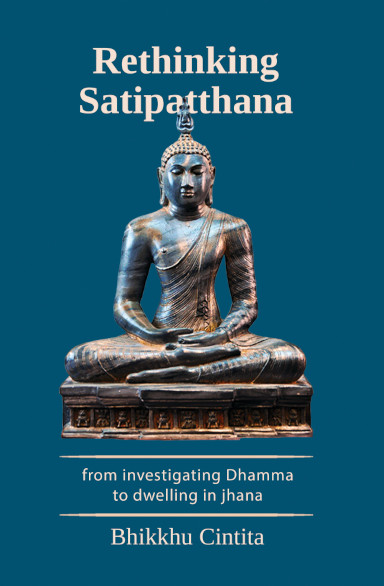
    Bhikkhu Cintita, 2026, Rethinking Satipaṭṭāna: from investigating Dhamma to dwelling in Jhāna.

    This is a thoroughgoing reevaluation of the early wisdom meditation teachings of the Buddha that lead to “knowledge and vision of things as they are.” It demonstrates the critical role of the integration of samādhi in the investigation of Dhamma.

    PDF
    Lulu

    Many centuries ago, the question of the role of samādhi in satipaṭṭhāna opened up a contentious Dhammic rift that remains with us today. The core question is: “How can the investigation or knowledge of something as complex and wise as Dhamma be experienced in the deep stillness of jhāna?” The title of this chapter suggests that an encouraging answer to this question is forthcoming. However, the almost unanimously accepted answer to this core question among scholars today is: “Investigation of Dhamma can not occur in jhāna!”

    In spite of this consensus, its adherents manage to split themselves further into two camps with regard to whether Dhamma investigation or jhāna is primary in the path to liberation. The following seems to be a rough overview of the membership of the two camps overview.1

    Contemplating Dhamma is primary. Gombrich, Conze, Rahula, Collins, Carrithers, Masefield, Lindtner, Hamilton, and also most modern Vipassanā traditions.

    Typically, Samādhi is thereby regarded as a preparation for contemplation.

    Jhāna is primary. Griffiths, Vetter, Wynne, Bronkhorst, Rhys Davids, Norman, Cousing, Gethin, Anālayo, Sujato, Kuan, Samuel, Brahmāli.

    Often deep jhāna is regarded as the (ofttimes mystical) liberating experience itself, and Dhamma as a kind of secondary, conceptual bi-product. Sometimes contemplating Dhamma is regarded as a preparation for jhāna.

    On the other hand, Shulman challenges two questionable assumptions underlying the presumed incompatibility of Dhamma investigation and jhāna. In his 2014 book Rethinking the Buddha, he argues:

    1. that Dhamma, in the very earliest texts, is not generally abstract philosophy in need of higher reasoning processes, but rather for the most part descriptive of direct experience, and
    2. that repeated Dhamma investigation itself induces a “restructuring” or “internalization” of content conducive to a more spontaneous means of apprehension.

    In chapter five I have taken his first point to heart in showing how each of the Dhamma teachings referred to in the Satipaṭṭhāna Sutta has a nuts-and-bolts interpretation in terms of direct observables. In this final chapter, I will focus on Shulman’s second point. We will learn that internalization is already intrinsic to all human skill acquisition, from learning to walk or drive a car, to weaving or to playing the accordion. In each case, it turns know-what into a progressively more spontaneous, intuitive and non-conceptual know-how, easily, with repeated practice, within the capabilities of the still mind. In fact, we will see how jhāna serves to enable the practice of investigation to reach ever greater refinement as internalization puts it out of the reach of the more deliberate reasoning processes, with remarkable results.

    It should also be appreciated by the end of this chapter that if we equate satipaṭṭhāna investigation with vipassanā, and jhāna with samatha, the Buddha’s few statements about the need to balance these in practice make sense. The Buddha said,

    Again, a bhikkhu developssamathaand vipassanā in conjunction. As he is developing samatha and vipassanā in conjunction, the path is generated. He pursues this path, develops itand cultivates it. As he is pursuing, developing and cultivating this path, the fetters are abandoned and the underlying dispositions are uprooted. (AN 4.170)

    Download full essay

  • Where did these images come from?

    The images used in this site are based on photographs of a collection of twenty four two-foot-high statues that can be found at the Burmese monastery in Austin, TX. If you click on “Credits” in the footer below, you can read about the interesting history behind these images.

  • The miracle of samādhi

    Samādhi occupies a prominent role in the early Buddhist texts. It is the final factor of the noble eightfold path to which the higher achievements of wisdom, or of knowledge and vision of things as they are (yathā-bhūta-ñāṇa-dassana) are attributed. It is a profound state of serenity, differentiated into the four jhānas, through which the mind becomes progressively stilled and centered, various cognitive faculties are silenced, and complete ease and equanimity are attained.

    Etymologically, samādhi is derived from sam ‘together’ + ādhi ‘put,’ and so has to do with gathering or collecting something together. Samādhi is most commonly translated as ‘concentration,’ implying a narrowing or focusing of attention. However, as we will see, concentration is one of two dimensions that characterize samādhi; the other is the progressive “curtailment” of various cognitive faculties as we progress through the jhānas. At every stage samādhi establishes an orderly array of mental faculties, and this (consistent with its etymology) recommends a translation as ‘collectedness’ or ‘composure.’ I will, for the most part, simply leave samādhi and jhāna untranslated to avoid confusion.

    Etymologically, jhāna is the gerund of the verb jhāyati, apparently in use before the Buddha’s time to denote almost any contemplative or meditative activity. The Buddha sometimes uses this term in its common meaning, but alongside the technical sense of the “four jhānas,” which seems to have been novel at the time of his teachings. In its technical sense the Buddha equates the fourfold jhāna with samādhi, such that there is no samādhi independent of the four jhānas in the early texts.

    Unfortunately, samādhi has become a controversial topic within the Theravāda tradition, where much confusion seems to have resulted historically, first from a redefining of samādhi, then from an attempt to reconcile contrasting frameworks that don’t in principle cohere. The debate persists even among the adherents to the authority of the early Buddhist texts, where contrasting evidence is cited for “hard” or “soft” jhānas (respectively difficult and easy-ish to attain), and where there is still no consensus about how Dhammic insight is even possible in jhāna.

    In this chapter, I develop an account of what samādhi is and how it works according to the early Buddhist texts. I will point out some common, but widely neglected, passages concerning the ubiquitousness and spontaneous nature of samādhi, and about the fruits of samādhi. I will also examine some details of how samādhi is claimed to integrate in practice with other factors. I hope thereby to contribute to a fuller illumination of this remarkable multifaceted culminating factor of the noble eightfold path.

    . . .

    How samādhi arises

    . . .

    Samādhi as concentration

    . . .

    The jhānas

    . . .

    The fruits of samādhi

    . . .

    The miracle of samādhi, the pdf (2025)

    I thought the readers of this blog could us a scholarly explanation of what the earliest texts, and therefore presumably the Buddha, have to say about samādhi and jhāna, that is about meditative states. This is a chapter from my recent book Satipaṭṭhāna Rethought.

    pdf

  • Q&A w/BC: Walking for peace

    Celsa: There is a group of monks walking for peace to Washington DC right now. Is this in agreement with Buddhism principles? Is this a Buddhist way to do things?

    NOTE: Let’s back up for a moment to my last post, “Bodhidharma’s Witnesses.” The dialog between Emperor Wu and Master Bodhidharma should read like this:

    Wu: “I have built pagodas and funded monasteries in my kingdom. What merit have I gained?”

    Bodhidharma: “No merit!”

    Wu: “What are the essential principles of Buddhism?”

    Bodhidharma: “Vast emptiness. Nothing holy.”

    Wu: “Who is it who faces me?”

    Bodhidharma: “I don’t know.”

    This dialog was truncated in the email that went out to subscribers (apparently my email manager mismanages quote blocks). Now the post will make sense, if you go back and read it.

    BC (in reply to Celsa):

    I don’t think the Buddha ever mentioned this specific kind of political expression, but let’s look at what the Buddha said about political expression for monastics and for householders, and at currently accepted manners of political expression.

    The Buddha himself seems to have intervened on two occasions to prevent a military invasion, leveraging the high regard the offending king had for him. On the first occasion he succeeded, on the second he failed. In general, the Buddha was not directly politically engaged (unlike Jesus), but had a lot to say about society (see cintita.org > Study&Practice > Society), and the qualities of the ideal ruler (the “wheel-turning king”). One point stands out in this regard: He recommends that a good ruler seek the council of “brahmins and ascetics”). This would include, but not be limited to the Buddhist Sangha of his time, and in any case would have been a far cry more beneficial than modern rulers’ current reliance on corporate lobbyists. We can infer that the Sangha should play an influential role in the ethics of political decision making.

    Walking for peace would be a means for fulfilling that role. Because monastics are so highly venerated in Buddhist cultures, this influence can be huge. Monastics even enjoy a degree of respect in general American culture, and certainly curiosity. Mainstream media tends to ignore the peace movement, but curiosity may sway even them to give the monks some coverage. Let me draw a comparison to the so-called Saffron Revolution in Burma in 2007 against the military government, in which monks emerged en masse to walk the streets chanting suttas about mettā, but were violently suppressed by the military government. There is a movie about this, Burma VJ, that can be found on Youtube (https://www.youtube.com/watch?v=mH6SrlZvdUM). I highly recommend it.

    In Myanmar, and certainly in many other Buddhist countries, there is an expectation that monks will not engage directly in politics. In fact, in Myanmar monks are not permitted to vote. (However, in Sri Lanka there are monks that are members of parliament.) I agree with the Burmese position, as long as it does not exclude making an ethical point, addressed toward policy or behavior rather than particular parties. I think this is what our peace walkers and doing, as I understand it. Simply bearing witness to make an ethical point.

    The problem with partisan politics is that it divides people. A monk should ideally be able to befriend anyone (yes, him included, and even that guy). We are all faulty, and we are all trying to do the best we can with what we’ve been given (really). Some of us happen to break the fault-o-meter. However, if a monk or nun is willing to talk to the person they find most agreeable, but not to the person least agreeable, they’ve lost half of the people they might offer ethical advice to. The least agreeable is the least likely to listen, but also has potentially the most to gain. Mettā practice is about learning to befriend everybody.

    Alongside political engagement is social engagement in providing health services, alleviating poverty, improving infrastructure, education and other things like that. Monastic communities in Asia are commonly so involved. In Myanmar public education is very poor; the best schools are founded and run by monks and nuns, who also tend to be better educated than most. Monks and nuns also run orphanages, appeal for donations to infrastructure projects, and even found hospitals. It should be noted that the scope of these projects has grown through the invaluable model of Christian charity witnessed during the colonial period. Modern “engaged Buddhism” (a term coined by Thich Nhat Hanh) has taken some very creative directions, to my mind very much in accord with ancient Buddhist principles.

  • Bodhidharma’s Witnesses

    It is commonly known that Buddhism seldom proselytizes, but its practice of “reverse proselytizing” is not so widely appreciated. Here is the idea:

    Bodhidharma was a mythical or half-mythical monk who lived in the fifth to sixth century. He is known for bringing Chan Buddhism from Central Asia to China. Fierce in appearance and demeanor, he is said to have had red hair and beard. Upon learning of Bodhidharma’s appearance in his kingdom, Emperor Wu, a great promoter of Buddhism in China, summoned the venerable to his court. Their conversation went something like this.

    Wu: “I have built pagodas and funded monasteries in my kingdom. What merit have I gained?”

    Bodhidharma: “No merit!”

    Wu: “What are the essential principles of Buddhism?”

    Bodhidharma: “Vast emptiness. Nothing holy.”

    Wu: “Who is it who faces me?”

    Bodhidharma: “I don’t know.”

    Bodhidharma had challenged Emperor Wu’s tightly held preconceptions. Years ago I considered getting a group together and walking door to door carrying Bodhidharma’s message. We would call ourselves “Bodhidharma’s Witnesses.” After all, his attitude seems to have had some success in China, producing a thriving Chan movement that spread from China to Korea, to Japan (where ‘Chan’ was mispronounced as ‘Zen’) and to Vietnam, and that is alive in many more lands to this day.

    In the forests and mountains of ancient China, if a young man was intent on leaving home to join the Chan monastic community, he would approach a monastery, knock on the gate, and request permission to enter. However, he would routinely be denied admittance, rather being told either that they could see that he not worthy of admittance, or that the monastery was already fully occupied. He should go home.

    Determined, the young man would sit cross-legged at the monastery gate in meditation position and endure the challenging wait for the monks within to change their mind. The monks meanwhile would insult the foolish aspirant and throw rotten vegetables at him. But the young man would persist for as long as it took. Fortunately, an empathetic cook would come out once a day and offer food and water. This would go on for days, until the monks within were convinced of the young man’s conviction. They would then relent, shave his head, give him monastic garb and floor space on which to meditate and sleep.

    This challenging tradition continues to this day, but is often formalized. In Japan, the process is called tangaryo. In January 2002, I arrived for a three-month practice period at Tassajara Zen Mountain Monastery deep in the cold coastal mountain range of California, inland from Monterey. Any monk (men and women are both called ‘monks’ at Tassajara) who arrives for a first practice period at Tassajara must undergo tangaryo. At Tassajara tangaryo consistently lasts five days and nights, the aspirant sits in the zendo, receives meals in the zendo, but is given a real bed elsewhere to sleep on from 9:00 at night to 3:50 the next morning. Otherwise the aspiring monk has to be on their allocated cushion (standing also allowed as long as they are standing on their cushion), facing the wall, except to use the restroom, never bathing or shaving. Meanwhile other, established monks come and go freely into and out of the zendo, to sit zazen, to perform services, to learn the chants and how to ring bells and to clean the zendo, as if the tangaryans were not there. These others did so a little too cheerfully for my taste. There is generally a small group of tangaryans at the beginning of any practice period. There were about fifteen of us in January 2002, the women sitting on one side of the zendo, the men on the other.

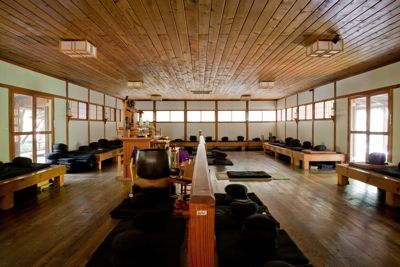
    meditation hall at Tassajara

    Tangaryo is perhaps the most challenging thing I have ever done on purpose. It was impossible to actually sit zazen in the strictest sense the whole time; apparently nobody ever does. I would start off OK for a few hours, then would have to relax and think about something, remember favorite songs, daydream. When my mind would wander too far beyond control, I would induce some rigor into my practice to bring it back:

    “If you find that your mind has drifted away from the daydream, just let go gently of whatever distraction has arisen, and return to the natural course of the daydream.”

    Later I would return to actual zazen for a couple of more hours, then try to recall my most interesting distraction thus far. With the meal that was brought to my cushion I would drink as much liquid as I could so that I would have to go to the restroom more often, and then drink as much water as I could on the way back to the zendo. On my way back to my seat, I would furtively glance at the women tangaryans facing the wall in their baggy robes, the greatest external thrill I could squeeze out of the day, except for lunch. The women seemed much stiller to me than the men I was sitting next to, certainly than myself.

    Finally, just short of one hundred and twenty hours of this, a disembodied voice manifested in each of our little worlds, congratulated us, asked us to walk up the hill to the hot springs, bathe, to put on clean robes and to join the practice period as full-fledged participants. All fifteen of us had successfully met the challenge, and sat it out. I would learn of would-be monks of the past who had given up and gone home in a huff and with a sigh. “No practice period for you.”

    The tangaryo monks were additionally given an early morning duty for the remainder of our first practice period that we were to take turns performing: We were to light all of the kerosene lamps that illuminate the many paths monks use in the predawn hours, most especially to get to the zendo before four thirty zazen. This arduous task entailed getting up at 2:50 to fumble around with wicks and matches, a miner’s lamp strapped to the head, trying to protect feeble flames from the wiles of the wind.

    Why would anyone want to discourage practice in this way, to reverse the easy entry into practice that proselytizing might have achieved, and to deny practice for those deemed “not worthy”? Come to think of it, denial for the unworthy is common in many walks of life. College admission often requires worthy SAT or GRE scores. Fraternity admission requires enduring some kind of hazing process to establish one’s worth. It’s a cinch that joining a street gang, especially the worst of the worst like the Sharks or the Jets, requires proving one’s worth by performing a ghastly misdeed, such as stealing a police officer’s badge or getting an ill-advised tattoo.

    So, why not let anyone who can navigate the mountainside-hugging road to Tassajara stay there and practice, anyone who can find an apartment near campus attend classes in Ethnographic Research Methods and such, and any kid in the neighborhood join the local gang? I think the answer is that requiring aspirants to make that challenging initial investment promotes excellence. Having made that investment the aspirant will not forget their commitment, nor doubt their ability to fulfill that commitment. Moreover, they will also have joined a community of aspirants who can say the same thing—like-minded, mutually inspiring and mutually supportive individuals. Together they have created an environment in which practice can thrive in excellence if not in numbers. But as an excellent community they will inspire new aspirants to make that same initial investment.

  • Sunday Zoom Dhamma Talks

    I have just added the following to the Events page. Please join us when you can. It is short notice, but I am giving a talk tomorrow (Sunday, December 28, 2025, 10:30 CST) on the Seven Awakening Factors.

    Sunday Jade Temple Dhamma Talks

    click on the banner for more info
    Kwan Yin Hall, Jade Buddha Temple, Houston, TX

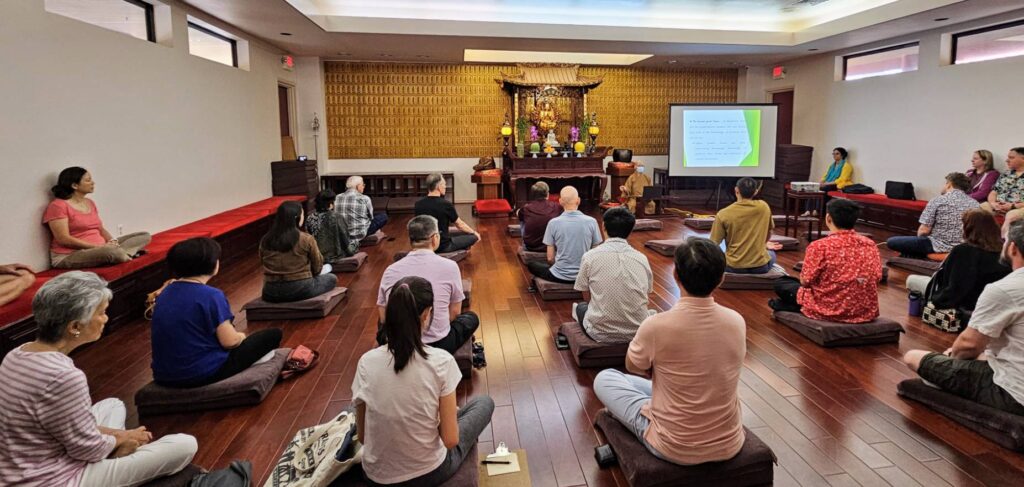
    BC offers occasional talks via Zoom for the Sunday morning program in the Kwan Yin Hall at Jade Buddha Temple in Houston, TX. Each Sunday there is a guided meditation at 10 am Central (Chicago) Time, followed by a short Dhamma Talk at 10:30 am, offered either in person or via Zoom on the big screen. BC is currently scheduled to speak on the following Sundays (subject to change).

    • December 28, 2025
    • January 11, 2026
    • February 8, 2026
    • March 8, 2026
    • April 12, 2026
    • May 10, 2026
    • June 14, 2026
    • July 12, 2026
    • August 9, 2026
    • September 13, 2026
    • October 11, 2026
    • November 8, 2026
    • December 13, 2026

    Click on the current date for the Zoom link. It should be available a day or so before the respective Sunday program.

  • Q&A w/BC: The virtuous vegetarian

    Gerry:

    Killing is another good example of a wrong interpretation of the Buddha’s teachings and intention, as well as strict vegetarianism. The rational “intent” of “no killing” (of sentient beings) as an important precept is to reinforce the wholesome concept of always “doing the right thing”, and to avoid being intentionally “cruel” to living creatures. While this sounds good, the reality is man and other “animals” have to kill to eat and survive. Big animals eat smaller animals, big fish eat smaller fish, birds eat almost anything, from fish to rodents, and pet cats. Killing and dying are “normal” aspects of life. Every living creature eventually dies, sometimes from unpleasant effects of old age, injury, or disease. Killing for food was and is perfectly natural and necessary.  In the Buddha’s time, he was influenced by many wars and needless killing. Moreover, there was, and still is, ritualistic killing in India; mass animal sacrifices to the “gods”. These issues shaped the precept of “no killing”.

    An example of the clear intent and practical need for the precept is found in western culture, particularly in Texas, where sport killing is big business, where “deer season”, and “Dove season”, pheasant and turkey hunts, quail hunts, and the “Safari Club” are viewed as imperatives.  Sport fishing is the same. This mindset is of course exploited by manufacturers as a billion dollar market for guns, ammo, clothing, boats, 4 wheel drive “super trucks”, and expensive taxidermy where some more wealthy “big game hunters” have trophy rooms with hundreds of thousands of dollars in stuffed animals; all for ego. And, as an integral part of this fantasy, heavy alcohol drinking is considered essential.

    It seems logical that a critical thinker like the Buddha, saw this type of killing as “sinful”, or promoting an unwholesome view of life, and therefore the first on his list of Precepts to follow for a better life.  Not killing to live. If this logic for a misinterpretation of “no killing” weren’t enough, the Dali Lama, the Spiritual Leader of Tibetan Buddhism, and realistically the “face” of modern Buddhism in general, eats meat!!!!  (Not something they broadcast).

    Killing to eat, or killing “pests” like mosquitoes, or ants, is practical and logical, just like killing a form of bacteria. It is not detrimental to finding the enlightenment of integrity and wisdom. If we are to spread Buddhism to “westerners” we need to repackage its purpose, and the specific practice to transform our distorted minds.

    BC:

    I’m going to say that the dilemma of not killing is common to all precepts, commandments, or ethical rules. There is no way for any ethical system to provide a fool-proof guide to telling what is right or wrong in all circumstances. This is true of Buddhist precepts as well. But let me first clear up just what the Buddha said about eating meat.

    There is no across-the-board requirement or even recommendation of vegetarianism in early Buddhism. The first of the five standard precepts prohibits attack or killing of “breathing things,” which a butcher (or worker in a slaughterhouse), hunter or fisherman would certainly violate regularly. However, many people eat meat without ever killing. Even though doing so is implicated in killing by others, it is not explicitly prohibited in the early texts. However, a general prohibition against eating meat is observed in East Asia. It is listed among the “Bodhisattva Precepts” in the Brahmajala Sutra. Although this text has a Sanskrit name, scholars have determined it is actually of Chinese origin. Modern Zen centers in America are invariably, at least in my experience, vegetarian.

    The Buddha was, nonetheless, sensitive to implication in killing, rather than killing itself, in a couple of contexts. He significantly restricted meat consumption for the Sangha, whose diet depended on what food was offered to them by householders. Here two principles came into conflict: On the one hand, monks and nuns are expected to accept graciously whatever is offered (effectively, beggars should not be choosers). On the other, he apparently seems to have felt that monks and nuns should not be implicated in killing by consuming meat. He therefore established a compromise: A monk or nun can in general accept and consume meat if it is offered, for instance, from what the family is eating at home in any case. However, they cannot accept or consume meat if they have any reason to suspect that the meat was killed explicitly in order to feed monks or nuns. This is a rule in the Vinaya, the monastic code.

    When I was in Myanmar in 2009, shortly before my ordination, I traveled with my teacher (Ashin Ariyadhamma, abbot of our monastery in Austin, TX) throughout Myanmar, staying primarily in monasteries. At each monastery we visited, U Ariya introduced me to the abbot, and I offered the three traditional bows at his feet. Each time U Ariya would explain in Burmese that I was priest in a Mahayana tradition, but was about to ordain as a Theravada bhikkhu. In every single case the local abbot offered me some advice, generally based on his misunderstanding of some aspect of Mahayana that he felt I needed to rid myself of. But on one occasion I was surprised that the abbot offered the following advice,

    “Don’t eat meat!”

    Already a vegetarian, and aware of the typical Theravada provision about accepting whatever is offered, I chose to play devil’s advocate, “What if a layperson offers it to me, shouldn’t I accept it graciously?”

    “If a layperson offered you a glass of whiskey, would you drink it?”

    “No.”

    “Don’t eat meat!”

    Parenthetically, on another occasion we visited a very prominent 94-year old abbot. In his case, upon hearing U Ariya’s explanation of my desire to change traditions, rather than offering advice, he looked very confused, then said to me in perfect English,

    “Mahayana is perfectly good Buddhism.”

    Another example in which behavior falling short of killing is restricted applies to householders as part of right livelihood. A wrong livelihood is one that is not conducive to practice. One’s livelihood compels one to repeat actions over and over, that therefore have a huge influence on upholding or making progress in practice. The significance of mere implication in others’ breaking certain precepts is thereby magnified. Accordingly, the Buddha characterized professions like manufacture of weapons, raising animals for consumption, human trafficking, and involvement in the alcohol industry as wrong livelihoods.

    Garry, your points concerning the necessity and naturalness of meat consumption are well taken, as well as the important distinction between killing for food and killing for sport. I’ll even add a couple of points: There would be no Buddhism in a vegetarian Tibet. Plant-based agriculture is too meager to sustain the human population. Animals domesticated for food production have thrived historically throughout the world: chickens and cattle abound, because people eat them. However, the animals raised today on factory farms are often subject to far more cruelty that the victims of hunting for sport.

    But let’s zoom out to get an idea of the bigger picture. The ethical questions you note with respect to meat are, I think, in the nature of virtually all precepts to one degree or another. This goes for Buddhist precepts, Christian commandments, civic laws, etc. In my intro to Buddhism (BLBP) I call precepts “rigid and porous.” They are rigid in that they fail to acknowledge exceptions, or the kinds of circumstances you note, in which they become counterproductive, harmful, or non-negotiable. They are porous in that they fail to cover all the circumstances that could use a bit of ethical attention. Precepts constitute a kind of shotgun, hit-or-miss approach to ethics. If they are made less rigid (adding a clause such as, “… unless greater harm results”), people will become very creative in imagining greater harm when they simply find the precept personally inconvenient. If they are made less porous, they become so numerous that no one will remember all of them.

    The value of precepts is to offer simple rules thumb that apply relatively reliably to a wide swath of ethically charged circumstances, in which ethical choices might otherwise be overlooked or require more deliberation than available time. They produce benefit, but are not a reliable calculus that tells us what to do in every circumstance.

    Notably, there are two words for precepts in Pali. One is sīlāni, which simply means ‘behaviors.’ The other is more interesting: sikkhapada, which means ‘training step.’ We follow the precepts partly because most of the time they provide beneficial results, but primarily we use precepts to train multple levels of ethical sensibilities. In Buddhist practice, a precept gives us an opportunity to consider our own motives and needs, the consequences of our alternative choices (especially for others), how alternative actions might make us feel (glowing with compassion, remorseful for what we’ve done?). We thereby learn to engage in our ethical choices more conscienciously.

    Just a couple of days ago I was in a store chatting about the weather with a friendly cashier. She said that she had gone pheasant hunting with her dad earlier that sunny day. I asked if she knew how to prepare pheasant for eating, and was surprised to hear that she didn’t even know if they were going to eat the ones they had bagged. If she had the precept about killing firmly in her mind, she would have raised questions that in fact not not occurred to her. Likewise, an ethically equipped person who wants to rid their house of pests is less likely to undertake extreme measures, like destroying an entire ant colony, and more likely to find clever ways of eliminating the problem, such as finding and plugging the entrance by which ants find their way into the house with a bit of putty. Like other matters of Dhamma, we take precepts seriously, but hold them loosely.

    For the Buddha, every action (kamma) we undertake, every choice we make, has a potential ethical value. Ethics is an art, something we train in until our choices becomes second nature, internalized to the extent that we find ourselves making beneficial and satisfying ethical choices spontaneously and intuitively, without recourse to rules, or even thought. For the Buddha, ethics already has a firm basis in human psychology: what is skillful (kusala) or unskillful (akusala) is defined in these terms. Advanced practice is centered around perfecting this art by putting it to use in our lives under the guidance of Dhamma. “Training steps” are simple Dhammic nuggets of wisdom that provide some direction in many situations that tend to cause thorny problems. Other things we must pay close attention to are how the consequences of our choices play out, what intentions (personal motivations) underlie our choices, how our choices or its consequences make us feel (good? remorseful? cringy?). Ultimately we must also take up wisdom practices in order to discover how our habituated but faulty ways of framing the world (for instance as revolving around a fixed self) affects our behavioral choices. All of these factors become integrated as we advance in practice and become a beacon of virtue.

    In the modern world, excellence is an important concept. We produce virtuoso musicians, excellent actors and athletes, brilliant scientists, martial artists, navy seals, snipers, perfect empoyees that know how to compete in the neoliberal marketplace. The contribution of mindfulness has even played an important role in achieving excellence seemingly across the board. However, modern society provides few opportunities to achieve excellence in virtue. This is where Buddhism has its greatest potential.

  • Q&A w/BC What would you do?

    Colleen Kastenek has has an interesting Q, but rather than adding an A, it is appropriate that I let you readers do that. Please comment below with your answers, and I will summarize the results.

    Colleen

    Just throwing this out there, and I hope a lot of people respond because I am curious: If a Buddhist monk or nun knocked on your door and asked for a few minutes of your time to explain Buddhism, what would you do?

  • This is a test

    Some subscribers (including me) seem not to be receiving blog posts by email from my new site. I’m sending this out as a test. Please excuse the disruption.