Year: 2025

  • Q&A w/BC: Is Theravada Buddhism less developed than Mahayana Buddhism?

    QUESTION from Claudia: What is the key difference(s) between Theravada and Mahayana traditions? Why is Theravada called the lesser vehicle? Someone said recently that Theravada school was less developed than the Mahayana because it did not go to advanced states of mind-developing.

    ANSWER from BC: The Buddhist world is generally divided into two major schools, the Mahayana (great vehicle), and the Hinayana (small vehicle). These terms originated with the rise of the Mahayana to distinguish them from the other school, and it has become widely considered impolite to call someone “Hinayana.” But I’ll use the terms here. Roughly 65% of Buddhists today are affiliated with Mahayana. The rest belong to the Theravada school to which I belong.

    The Mahayana was an innovative movement that grew in India in the first millennium. Before that time Buddhism had differentiated into many geographically and (as a result) somewhat doctrinally dispersed sects, which with time blended back together. Of the early sects only Theravada has kept its identity, certainly because of its early isolation in Sri Lanka, from whence it spread into SE Asia. Traditionally the doctrinally distinct Mahayana is considered to have developed from the early Mahasanghika sect in eastern India. It may have had more than a single point of origin, but Mahayana became over the centuries a pan-Buddhist movement. Within any sect, region, or monastery you might have found some Mahayanists and some Hinayanists living together and getting along happily, as pilgrims from China were surprised to find. Mahayana was even influential in the Theravada sect at one time but later died out.

    Mahayana was the innovator, and emphasized three main things that distinguished it from the older Hinayana: (1) the status of the Buddha as not as a normal human, but as a kind of cosmic being, something along the Jesus model. (2) The higher ideal by which instead of awakening to escape the cycle of rebirth, it is more praiseworthy to forego awakening in order to be reborn with all of the virtue and compassion that will have come with high practice attainments. Why squander all that virtue on awakening, when you can use it to help make the world a better place in future lifetimes? A Bodhisattva is someone who follows this path. This is why the Dalai Lama has been reborn fourteen traceable times. (3) The idea of emptiness, that nothing in the world exists from its own side, but only through human conceptualization.

    I think (1) reflects the general need of people to embellish. It’s pretty much harmless, and may encourage wholeheartedness in Buddhist practice. (2) is actually present and respected in Theravada, apparently as a remnant of the early Mahayana influence on Theravada. I think it is beautiful way to frame one’s own Buddhist practice, even for those who disbelieve in rebirth. (3) is a very significant factor in wisdom practice, and insight meditation. The Buddha taught emptiness, but predicted that it would be the first of his teachings to be forgotten. The Mahayana emphasis may be a revival of this teaching, but it is not taught in Mahayana quite the way the Buddha taught it.

    There are other doctrinal divides in current Buddhism aside from Mahayana-Hinayana. Mahayana has many subschools with doctrinal differences, and some schools that might be considered Dhamma-lite. Tibetans consider themselves to be Mahayanists, but adhere also to what they consider to be an even higher teaching: Vajrayana, influenced historically by Hindu Tantra in Kashmir. I do not know enough about Tibetan Buddhism to assess the strengths and weaknesses of the Vajrayana enhancement, but this might be the source of the “advanced states of mind development” that Claudia’s interlocutor mentioned. Alternatively, she might be like many practitioners who regard whatever school they belong to as “the best.”

    I should add a word for those who are dismayed that Buddhists don’t always agree on Dhamma. First, the core purpose of Dhamma is found throughout the Buddhist world: practice aimed at developing human character in its twin aspects of virtue and wisdom through behavioral and contemplative training aided by deep control of mental faculties, aimed at awakening. Second, the Buddha anticipated variation and innovation: he defined the Dhamma not as what he personally taught, but as that which achieves that purpose.

    Two interesting follow-up questions would be: (1) Is Theravada really Hinayana? (2) Was the Buddha a Hinayanist or a Mahayanist?

    Please reply to keep the conversation going with relevant knowledge, insights or follow questions. Or pose a new question be emailing BC directly at bhikkhu.cintita@gmail.com.
  • Announcement: we’re moving soon

    As part of the revitalization of this site, we’ve been remodeling it. We will soon be active at https://cintita.org/ , possibly within a week. The subscriber list and blog submissions will be moved, hopefully without any disruptions. It’ll be real artsy. You can visit it now; just don’t trip over anything or lean against any wet paint.

  • Q&A w/BC: Is it useless to try to fix the world’s problems?

    Question from Celsa

    Because this world and our life is ‘suffering’, there is no hope that the suffering will go away, and it’s useless to try to fix the world’s problems. Of course, the obvious solution would be that every person becomes virtuous and behaves in a moral way, so suffering can decrease. This is not feasible at a mass level, so maybe humanity is hopeless? and there is no way out, except individually? Why is it so hard to surrender desire, doubt, anger, etc. Aren’t the 5 hindrances our very inherent makeup? And if one eliminates them, one ceases to exist? Isn’t Desire the very motive of existence, keeping us eating and reproducing? Does Buddhism say that human life is absurd?

    Response from BC

    Celsa, I’m sorry to hear so much despair, and I know most people feel this way at this stage in history (or any other stage). Let me try to put the role of Buddhism in all this into perspective to show how Buddhist practice helps make the world a better place and the individual more fulfilled.

    Let’s start with the issue of our inherent makeup. You’ve probably heard the following little story.

    An old Cherokee is teaching his grandson about life. “A fight is going on inside me,” he said to the boy. “It is a terrible fight and it is between two wolves. One wolf is evil – he is anger, envy, sorrow, regret, greed, arrogance, self-pity, guilt, resentment, inferiority, lies, false pride, superiority, and ego. The other is good – he is joy, peace, love, hope, serenity, humility, kindness, benevolence, empathy, generosity, truth, compassion, and faith. The same fight is going on inside you – and inside every other person, too.”

    The grandson thought about it for a minute and then asked his grandfather, “Which wolf will win?”

    The old Cherokee simply replied, “The one you feed.”

    This really says that we have two incompatible inherent makeups; this is the human dilemma. The Buddha never spoke in these terms, but notice that the qualities of the two wolves correspond almost precisely to what to Buddha regards as unskillful/unwholesome kamma, and skillful/wholesome kamma respectfully, so I’ll run with it. In fact, the Buddha has a lot to say about the psychological differences between the two wolves. Dependent coarising is an apt description of how the evil wolf’s mind works. (I have a bit of trouble picturing a good wolf. Maybe a highly domesticated collie like Lassie counts as a wolf.)

    It seems like the evil wolves are getting plenty to eat these days, certainly among public figures and the powerful. Our individualistic, “Greed is good” culture favors evil wolves (not all cultures do). However most religious traditions, if they have not been corrupted, favor good wolves. Buddhism unambiguously favors feeding the good wolf. For the Buddha that is the one inherent human makeup that counts, and that must be developed and cultivated.

    Most people think when the evil wolf is in charge it is good for “me,” but bad for others, when the good wolf is in change it is good for others, but bad for “me,” so they try to balance the two: “If I give to them, there is less for ‘me.’ Mostly I care about ‘my’ happiness, but I am not indifferent to theirs.” They feed both wolves, maybe the evil wolf a bit more.

    For the Buddha, this balance makes no sense at all, for a well-fed good wolf is always far far happier than a well-fed evil wolf. The reason is that each wolf experiences a different kind of happiness: for the evil wolf happiness is mundane, based on sense pleasures, fleeting and unreliable. For the good wolf it is supramundane, is based on contributing to greater things including others, just accumulates, and leads to a fulfilling, meaningful life well lived. Only the good wolf can be fulfilled spiritually. This is the fruit of good kamma, that many in our hyper-individualistic culture fail to recognize.

    How does Buddhist practice therefore make the world a better place?

    The adept Buddhist brings ceaseless benefit to those around him or her, though compassionate action, though cooperation in group pursuits, through harmonizing with them, through example and teaching. This is our inherent nature, the one worth developing and cultivating, the one concerned with something greater than the individual self, in that it includes others.

    It may be frustrating that the world overall does not seem to improve, but that is just “all or nothing” thinking. Helping a few others is huge in itself. Contributing the to the frustration is that we commonly do not see the far-reaching consequences of our influence, but they there. (I can think of various people whom I barely knew who have no idea of the influence they had on my life, like the odd Polish man in a suit and carrying a briefcase that I picked up hitchhiking in Corte Madera, California over fifty years ago, with whom I had a conversation about languages, and who recommended a book for me to read, before I dropped him off.) It is best to practice in small communities of like-minded people, where we can actually see the world getting a bit better, at least in one place, and where we are working together with others to accomplish this. Community was essential in the Buddha’s thinking.

    But even if the world does not become a better place, or we fail to see it, we individually will live much more fulfilling, meaningful lives for having dedicated our practice to something greater than ourselves, to living as good wolves according to the standards of Dhamma.

    In summary, yes Buddhism does say that human life is absurd. But Buddhism knows how to make it sane, just not for everybody all at once.

  • Q&A w/BC: How do we repackage Buddhism to make it simple, relevant and compelling for young people?

    QUESTION from Gerry Trione:

    Bhante, As you probably know, there are about 700 million Buddhists around the world, most of whom are in Asia. There are an estimated 3-4 million in the US, but most of whom are Asian, leaving only about 600,000 “westerner” Buddhists; far less than 1% of the population. I know from personal experience that Buddhism is essentially unknown or misunderstood with Americans. Moreover, the prospect of US as a fertile ground for religious Buddhism is becoming more tenuous as young people are taught in school and social media that there is no “god” and anyone who follows a religion is a loser. The result of turning away from religion is the loss of moral and ethical guidelines on how to live a wholesome life. This is why we have such a high rate of drug and alcohol use, and psychological problems. Over 60 million people in the US have psychological problems, and over 50 million have drug addictions. And, its getting worse.

    The question is: Why is Buddhism, the proven best means to end mental suffering, so hard for young people to grasp?

    ANSWER from BC

    Gerry, Thanks for this important question. I agree with you: the modern world needs Buddhism, because Buddhism is almost the opposite of what ails modern culture: its hyper-individualism, its consumerism, its commercialism, its secularism, and so. But exactly this this is what makes Buddhism difficult to grasp for modern people. Buddhism is not an easy-answer guide to life, except in some of its regional, primarily devotional “folk” manifestations, which are simply going to seem strange to westerners.

    Partly as a way to popularize Buddhism, many modern teachers westernize or pare down Buddhism. I daresay that much of what is taught as Buddhism by western teachers is not of Asian origin at all, but is a continuation of currents of western thought that can be traced through the early Protestant Reformation, through Romanticism, American Transcendentalism, psychoanalysis, and probably through the beatnik and hippy countercultures. Buddhism is being significantly co-opted by modern culture, rendering it unable to squarely oppose those aspects of modernism that are most vexing. David McMahan’s book, the Making of Buddhist Modernism, offers a fascinating discussion of this issue.

    Of course, modern people are always going to see Buddhism through a modern lens. The challenge is to do this without distorting the Buddha’s original intent. East Asians certainly do not conceptualize Buddhism the way Indians did, yet the managed to preserve the functionality of early Buddhism well. Much of my own efforts center around presenting “Early Buddhist for Modern Buddhists” (which I’ve made the name of this web site) without distorting the intention of the earliest sources.

    I don’t have a clear answer on how best to promote Buddhism in the west. I’m doing my best. The commercial culture seems to overrun everything. The number of monks in Thailand, for instance, has fallen by 50% in 20 years, apparently because of the growing influence of modernity. Taiwan, on the other hand, continues to sustain very strong Buddhist and Taoist traditions in spite of its modernity. I’d like to know how they do it. I doubt that we will manage a sweeping Buddhist movement, say, in the USA. What we might accomplish is small communities here and there that are dedicated to living sanely according to the Dhammic principles, much as the artifacts of civilization were preserved in the monasteries of the Middle Ages.

    MORE DISCUSSION from Gerry

    The answer is the primary message of Buddhism, to end suffering, is not being communicated to the masses. It is obscured and eclipsed by a larger focus on the more mystical concepts of rebirth, merit, realms, devas, and the supernatural. The elegance of Buddhism from my perspective, having studied psychology in undergrad, is the close resemblance to psychology of the 4 Noble Truths. Namely, suffering, or “psychic irritants” exist; we know the causes (Three Poisons); Suffering can be cured; and, the cure is known (8 Fold Path, Precepts, etc.). This is classical psychology with “psychoanalysis” and “Psychotherapy”.

    What young people ask themselves is: “What’s in it for me?”. The answer is “Happiness”; the end of suffering. But, young people I know don’t think they’re “suffering”. They think that anger, hate, resentment, jealousy, envy, worry, fear, cravings, addiction, anxiety, and depression is “normal”!!! In short, Buddhism needs to be repackaged to appeal to these younger people in a form which is Simple, Relevant, and Compelling.

    RESPONSE by BC

    I agree with your most of your points, and along with you am particularly alarmed at what young people experience as life.

    You are right: Buddhism, at least the early Buddhism taught by the Buddha, is psychological through and through. I am a retired cognitive scientist and I am simply in awe the the Buddha’s understanding of the human mind. I’m discovering that early Dhamma matches up with modern cognitive research well. However, I don’t agree Dhamma bears a close relationship to psychotherapy (although a lot of psychotherapists are Buddhists). The goals are different. Freud described psychotherapy as curing psychological abnormalities that cause individual suffering, and added something like, “so that sufferers can return the common level of suffering that we all share.” Buddhism is concerned with curing the common level of suffering that we all share. But even that goal is incidental to its main goal: to improve and eventually perfect the human character in its dual aspects of virtue and wisdom. I think of the suffering of young people in modern society, and of almost everyone else, not so much as an abnormality of individual psychology, as of the break-down of the society in they live.

    As for the “larger focus on the more mystical concepts of rebirth, merit, realms, devas, and the supernatural,” many teachers explicitly exclude such teachings, particularly the secularists. As for preserving the integrity of early Dhamma, I’ve concluded that devas, realms and much of the supernatural (like acquiring the ability to jump up and touch the sun) are dispensable, but fun. Rebirth and merit are critically important. Merit (or the fruits of kamma) is simply the effects of wholesome practice on our character, and can be largely explained cognitively. Rebirth gives us an important way of framing our long-term practice. It’s not necessary to believe that it is actually true as described, only that we accept it as a working assumption. We do this all the time anyway: money is not true, it is a social construct that everyone accepts as a working assumption, and thereby serves an important social function.


    Please REPLY if you would like to continue this conversation on a multifaceted topic that perhaps all readers have a stake in. I would like to encourage such discussions in order to revive this web site, to which I have given insufficient attention in the last years. Submit a question

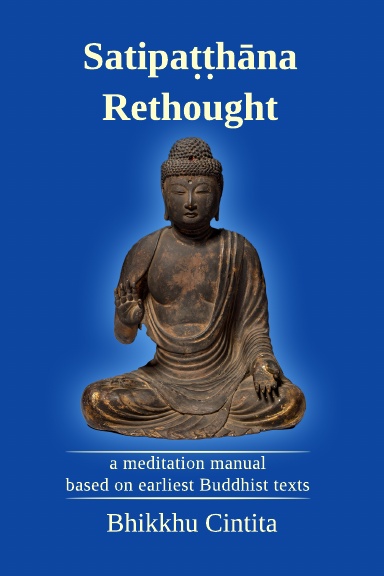
  • Satipaṭṭhāna Rethought: a meditation manual based on earliest Buddhist texts

    Satipaṭṭhāna Rethought: a meditation manual based on earliest Buddhist texts

    Satipaṭṭhāna (often translated as “Foundations of mindfulness”) is the Buddha’s method of wisdom contemplation, best known through the ancient practice tutorial The Satipaṭṭhāna Sutta. It is recognized as the basis of modern vipassanā or insight meditation and of many other modern and historical practices. Unfortunately, the complexities of Buddhist intellectual history have not been kind to this early teaching.

    PDF
    Lulu

  • 1. Living in mindfulness

    This is the first of five videos in the online course “Mindfulness: where Dharma meets practice.” “Living in mindfulness” serves as a general introduction to the Dharma and practice with particular attention to the role of mindfulness.

  • 2. Living in virtue

    This is the second of five videos in the online course “Mindfulness: where Dharma meets practice.” “Living in virtue” explains the fundamental ethical practices that belong to a Buddhist life: precepts, giving, and purity of mind developed through mindful observation of emotional factors.

  • On Buddhist ethics

    On Buddhist ethics. The primary principle of Buddhist ethics is the development and cultivation of virtue as a quality of character. Virtuosity in virtue is a quality of the awakened ones. This is contrasted with modern understandings of ethics, but is arguably a basic human drive and definitive of a meaningful or well-lived life. (February 9, 2024)

  • 3. Living in devotion

    Japan edit.2

    This is the third of five videos in the online course “Mindfulness: where Dharma meets practice.” “Living in devotion” discusses the wider motivational context of Buddhist practice, how we develop it and how we remain mindful of it, in order to uplift and incentivize our practice.

  • 4. Living in wisdom

    This is the fourth of five videos in the online course “Mindfulness: where Dharma meets practice.” “Living in wisdom” takes us from right understanding of Dharma to the intense examination and internalization facilitated through mindful observation of cognition.