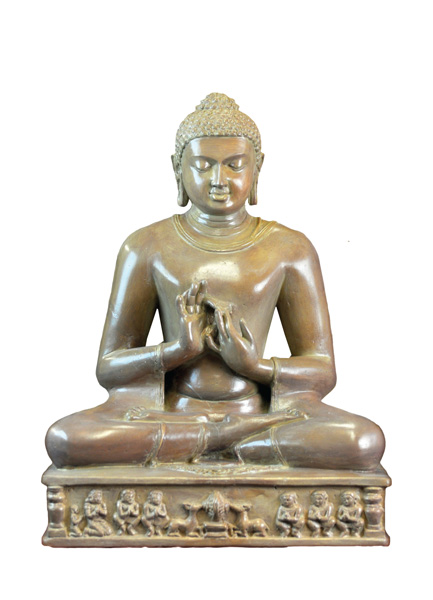
 Uposatha Day, Full Moon, June 16, 2011
Wielding Faith I
We live in a world of overwhelming uncertainty, and at the same time we need to live our lives, set goals, act in the world. There are some things we know, or pretty reliably know, from direct experience, but really not very much. The rest of what we have to go on is this guesswork we call faith. This world is pregnant with possibilities, and indeed of two kinds: First there are all the propositions that might turn out to be true or to be false. How do we choose? Second, as active agents we have a degree of creative control over the world, there are things we can will to be true or false. What do we value? As we all know we can make some really dumb choices on both counts. This is why we must learn the skill of faith.
 One of the first things we can do is extend the range of the known by relying on others, but that requires putting our faith in someone else. We all do this. Faith in others occurs in all areas of human interest. What news sources do we put your faith in? Which friends are reliable sources of information about movies to watch? In the corner of our world of possibilities we have science, concerned at an expert level with expanding the range of the known. Do we have faith in those guys?
Even upon expanding the range of the known in this way, we do not have enough information to act in the world. What is worth doing? We do have basic instinctual drives, for instance for nourishment, procreation, and so on, that are wired into us. I don’t suspect most animals need to think about what are the worthwhile things to do in the world (“Fish gotta swim and birds gotta fly …”), and many people are the essentially the same (“… and I gotta love one man ’til I diiiiee”). But humans can question these motivations on the one hand, and look for higher or more satisfactory motivations on the other. Buddhism does this all over the place. At this level the realm faith becomes an adventure, inviting exploration, pregnant with possibilities.
 So we populate our worlds with values, with what is worthy, or unworthy, of our attention. Scientists value solving mysteries, discovering truth; this is part of their faith and they allow that to inform their life’s activities. Christians value obeying God’s will. Others value sensual pleasures. The U.S. Marine Corps values courage and honor (according to some billboards I’ve seen), whereas the Army seems to value being all that you can be. Many of the Burmese I know who live in America express surprise at American values, “Everyone seems to just care about money.” As we choose values, we are still in the realm of uncertainty but with creative control, however still unable to predict the consequences of acting according to those values, along with the beliefs or working assumptions we’ve acquired. Our values get us into a lot of trouble, and conflict with each other, when we try to manifest them. There is a world of possibilities to explore.
The Buddha took great care to ensure that Buddhist faith is skillful. Faith at the most fundamental level is placed, as we have seen in the Kalama Sutta, in the value welfare and happiness and the avoidance harm and suffering, for all beings. (Buddhism is about virtue to the core.) The rest of faith must support this value. We have seen that this places a strong constraint on faith that protects us from its abuses. It is also important to put our faith in the wise and then have faith in what they seem to know, and he provides criteria for recognizing the wise.
Additionally the Buddha asks us to put as much reason and discernment behind faith as possible, so that faith comes for the most part in little hops rather than in great leaps, to see for yourself, and if your vision is blurry now to keep trying so that you will see in the future. In the Inquirer Sutta (MN 47) he even provides the example of faith in his own enlightenment and walks through what direct evidence the disciple can discern to support this hop of faith. Eventually reason and discernment should replace Buddhist faith entirely as these develop. Although the Buddha accepts that before that point we need to work with working assumptions on faith, he asks us to be clear that we don’t confuse faith with discernment, that we know where we stand. He also accepts that working assumptions have a practical value independent of whether they are actually true or not. In the Incontrovertible Teaching Sutta (MN 60) he explores the value of the working assumption in more detail than we have here.
 If you walk around the monastery where I live in Texas you will find various cottages (kutis) for retreatants, each one named after a Buddhist value. There is Metta (kindness), Karuna (compassion, that is where I dwell), Mudita (joy in the good fortune of others), Uppekha (equanimity), Sila (virtue), Pannya (wisdom), Samadhi (concentration), Sacca (truth), Khema (security), Dana (generosity) and Satipatthana (establishment of mindfulness). These are all personal qualities that are encouraged in practice. We will someday have about fifty cottages, but will not run out of Buddhist values and will probably at some point have a cottage named Saddha (faith).
Faith is on many of the Buddhist lists, such as the Five Faculties and the Five Strengths. Faith is also said to become unshakable when one attains stream-entry. Faith is a condition leading through ease, joy, serenity, and concentration. The opposite of faith, doubt (vicikiccha) is likewise on the lists of Five Hindrances and Ten Fetters. However, according to our discussion so far, faith as a value might seem a bit out of place. First, faith as a general component of human reasoning is as likely, maybe more likely, to be unskillful as skillful; it often gets us in a peck of trouble. Second, including it as a value among values would seem redundant, like including “Obey all rules” as a rule among rules. So why do we value faith?
 Saddha in Buddhism is generally taken in the sense of skillful faith, specifically the Buddhist take on faith. Moreover faith is a personal quality subject to cultivation and development in itself, one that has an energy, an emotive property of its own. I’ve described faith as opening up a world of possibilities for us to explore.
In brief, faith in Buddhism is the explorer’s mindset, with these properties:
Faith is bold. It carries discernment as far as it can, wide open to the possibilities, then makes its decision and plunges forth.
Faith is resolute. It sticks with its decision as if it were certain, unless it discerns a serious blunder.
Faith is secure. It relaxes into its resolution, does not waffle or argue with itself, it is a refuge.
 Doubt, on the other hand, is the home-body’s mindset. It is wimpy, wishy-washy and nervous. It falters in an uncertain world. This is why in Buddhism faith is a virtue and doubt a hidrance. As states of mind faith and doubt are subject to Right Effort, we try to ensure the arising of faith that has not yet arisen and the maintenance of faith that has already arisen. We try to guard against the arising of doubt that has not yet arisen and to remove the doubt that has already arisen. Devotional practices aid us in the effort.
Thanissaro Bhikkhu in his essay “Faith in Awakening” describes what is at stake:
As in science, faith in the Buddha’s Awakening acts like a working hypothesis, but the test of that hypothesis requires an honesty deeper and more radical than anything science requires. You have to commit yourself — every variation of who you feel you are — totally to the test. Only when you take apart all clinging to your inner and outer senses can you prove whether the activity of clinging is what hides the deathless.
The Buddha also spoke (AN 4.34):
Those who have joyous faith in the highest, the highest fruit will be theirs.
In our next and final week I want to take up the psychology of faith in a bit more detail, and in fact to discuss these three properties of being bold, resolute and secure, why these properties are important and how they play out in Buddhist practice.


Leave a Reply