Author: bhikkhu cintita

  • New page: Current Projects

    I’ve added a new content page to this site, Current Projects, that describes projects I and others are working on at the present time. I invite involvement by others in any of these in whatever capacity you my be qualified or find interest.

    Current Projects

    Currently two project are described. Briefly,

    Dependent Coarising

    The goal here is to produce a substantial revision of my book Dependent Coarising (Pali, paṭiccasamuppāda) and republish it, foreseeably by the end of 2026.

    Bhikkhu Cintita, 2021, Dependent Coarising: meaning construction in the twelve links.

    This old edition of the book will continue to be available until the revised edition is released.

    Books

    Culture of Awakening


    This project will result in the enlargement and republication of my book Culture of Awakening: the life and times of the Buddha-Sasana (2014), and will broaden the exploration of the Buddha’s teachings in their sociocultural dimension. Foreseeably the project will be completed by the end of 2027.

    Bhikkhu Cintita, 2014, A Culture of Awakening: the life and times of the Buddha-sasana.

    This old edition will continue to be available, but by the end of 2026 I would recommend requesting an updated draft.

    Books

    The closest precedent to this project might be Trevor Ling’s 1973 book The Buddha: The social-revolutionary potential of Buddhism. This project takes to heart its central thesis that Buddhism does not really make sense until we understand its social dimension. This thesis is likely to raise many readers’ eyebrows, since modern Buddhists typically think of Buddhism as an individual, solitary project, best undertaken by sitting alone at the root of a tree in deep contemplation (in spite of a nod to the principle of the bodhisattva).

  • Folk Buddhism

    We are all physicists, at at least a naïve level, insofar as we must deal with the world of mass and motion, light and liquids, gravity and gyrations. Try asking some folk (in contrast to adept) physicist things like: What keeps the moon and airplanes up but us down? Why is the back of the refrigerator so warm? How can radio waves carry sounds and pictures? What makes water freeze? … and you may receive in return an astonishingly imaginative array of folk understandings that trail off into total misunderstandings, superstition and “old wives’ tales,” among some rather sound guesses. Music, philosophy, art and engineering are other fields in which expert or adept knowledge exists side by side with naïve or folk understandings. Buddhism, because of its sophistication comparable to any of these fields, is no exception, never has been since the earliest days, and never will be. Just as there is a Burmese or Chinese folk Buddhism, there is also modern folk Buddhism, generally unnoticed. In fact, many modern Buddhist teachers teach predominately folk Buddhism (see David McMahan’s The Making of Buddhist Modernism if you need convincing).

    Folk Buddhism is a wilder, less domesticated and more popular understanding of Buddhism than adept Buddhism, an understanding, or rather range of understandings, that manifests in a particular social, cultural or regional context. It is the attempt to harmonize the radical message of adept Buddhism with the conventionality of the prevailing folk culture. Malleability is therefore a prominent property of folk Buddhism. Folk Buddhism includes many elements found also in adept Buddhism but also a hefty admixture of beliefs of non-Buddhist religious, ethical and philosophical traditions, many colorful elements from myth or popular entertainment, and many false understandings of Buddhist teachings.

    It should be understood that, far from being a perverse anomaly, Folk Buddhism plays a necessary role in the history and continuity of Buddhism. First, it overlaps with adept Buddhism. Its defining characteristic is not spuriousness, but its relative popularity among the general Buddhist population. Witness the relative popularity of meditation practice in both Burmese and Western Buddhism. Second, folk Buddhists hold adept Buddhism in high regard and are drawn to approximate it with time. Folk Buddhists are generally aware in outline of the Path as something they might someday pursue. Third, folk Buddhism makes Buddhism comprehensible to some degree for most Buddhists and virtually all non-Buddhists. Particularly as Buddhism enters a new culture, it is Folk Buddhism that softens the clash of cultures and mediates the give and take that can bring these into harmony. It is the oil between piston and cylinder, the wheel between axle and road. It almost certainly provided some of the conditions necessary for Buddhism to become the first religion to go global.

    A frequent Burmese visitor to the monastery at which I used to live in Texas, a laywoman who liked to come on weekends to prepare food for the monks, was up late one night and spotted a monk standing in the sky above one of the new buildings near where a new pagoda was about to begin construction. She called other people hither, who indeed verified the presence of this monk in the sky, but by this time the monk was sitting in meditation posture. It was generally agreed among the witnesses that this monk had teletransported from Burma. A couple of weeks later I heard a retelling of this story by a non-witness to this original event, in which the sky-monk in question was our own founder, who lives in Burma, undoubtedly checking out the new construction site.

    The average Burmese Buddhist householder is devout, and knows maybe a little about meditation, but does not practice it regularly, while a uniquely large number are adept meditators. They know basic teachings of Buddhism largely from Jataka tales (primarily a Children’s literature), but are largely informed by a vibrant Folk Buddhism. The average Burmese Buddhist, at the same time, inhabits a world of tree spirits, miracles and magic, largely of pre-Buddhist origin but often blending in her mind seamlessly with Buddhist practices and doctrine. Tree spirits (nats) can be kind or malicious. Appeasing them has become a common duty of monks, toward which nats have a particular affinity On one occasion, I was cornered into appeasing tree spirits myself, after pointing out, ever skeptical, to a more senior Bumese monk that Texas tree spirits are unlikely to understand Burmese.

    In Burma, many lay people have daily contact with monastics when they offer alms in the morning, rice and a little curry. People have a particular regard for those monks who are accomplished meditators, have impeccable discipline, are recognized scholars or excel in social welfare. Although monks rarely mingle in social gatherings, alms rounds or visits to the monastery on quarter moon days provide the laity an opportunity to learn some Dharma or ask questions. Although all monks are respected as representatives of the Sangha,f individual monks’ acquire reputations as teachers. Moreover, in this electronic age many people listen to recordings of Dharma talks and Paritta chanting at home, featuring their favorite famous sayadaws (teachers), as routinely as Americans listen to popular music.

    In Burma, blessings are routinely sought from monks. As in other Theravada countries, the recitation of any of the Parittas, a standard set of eleven suttas or composites from the suttas, by monks on one’s behalf is widely believed to be efficacious in ensuring one’s welfare. If someone is ill or is about to take a university exam they often request such a recitation as a karmic boost beforehand. This practice has parallels in many religions and other Buddhist traditions, which sometimes, unlike the Burmese, use talismans or amulets to bestow blessings. A revealing study reports that in fact the vast majority of monks in Myanmar, virtually all of whom provide this priestly service routinely, believe such practices have no special power other than to produce self-confidence in the subject. I have often heard monks pointing this very thing out, but folk beliefs persist, as does the recitation of Parittas by the monks on behalf of devotees.

    Part of the Burmese system of veneration of the Buddha and of arahants involves relics as the remains of cremation upon their demise, a practice that the Buddha himself endorsed at some level. In Burma the relics of such exalted beings generally take on the form of crystals which are capable of spontaneously reproducing like bunnies: Left overnight, the next morning a jar of them will have increased in number and mass. A museum has been built in a temple in Burma where a local arahant had lived and died. Pictures in the museum reveal he had very intense eyes, which, it is reported, did not burn during his cremation but were found among the relics. I am not aware that the eyes have multiplied with time.

    Relics, and also consecrated statues of the Buddha, have special powers. Kyaik Tiyo, the golden rock, is a huge boulder, maybe 40 or 50 feet in diameter, perched on top of a sheer cliff, at the very top of a tall mountain in southern Burma, in such a way that it has been just about to roll off, for maybe the last several hundred thousand years or so. However, the folk story is that some of the Buddha’s hairs are contained inside of the rock and that the rock remains in place by the unexplained “power of the Buddha.” Once upon a time, some non-Buddhists tried to push the rock off the cliff in order to undermine people’s trust in the Triple Gem, but they were turned into monkeys. In an inspiring, hopefully not foolhardy, display of faith, there is now a nunnery directly below the rock, exactly at the point of first bounce.

  • The world of experience

    excerpt from the upcoming new edition of Dependent Coarising

    The experience produced by our cognitive architecture is primarily of a world “out there,” an “objective reality” that appears to us to transcend experience, in the sense that it would be there even if we were not here to experience it. In this objective reality all the objects exist that we desire, fear, own or obsess over, and existential, ontological and other views seem reasonable. As part of our experience we almost always take at face value that most of what we experience simply reflects such an objective reality directly. Not only that, but immediate access to this objective outer world is simply there, effortlessly; all we have to do is show up.

    There it is: your plush arm chair, the cat on your lap, the pipe in your mouth, a cup of tea, a snifter of cognac and a dog-eared copy of Buddhist Life/Buddhist Path on your side table.

    Simple reflection on the science of this scenario shows that it cannot be so simple. As you sit in your arm chair, your brain sits in your skull in total darkness and total silence, communicating with whatever is “out there” through raw neural impulses originating in your retina, your eardrum, etc. If the brain in your fathom-long body is the source of your experience, then anything beyond neural sense impulses must be fabricated by the brain (or the emergent mental processes running on your brain architecture). A lot of mental activity goes on between the impingement of neural impulses and your cozy experience, no matter how vivid and immediate your experience seems.

    In fact, we have no direct access to such a reality independent of the filter of human cognition which produces our experience. A fundamental principle to keep in mind is,

    Experiencing things as real is not the same as experiencing real things.

    For all we know, we live in a the computer-generated Matrix®, or in a dream. Maybe what is really right side up is systematically converted to up side down before we experience it.

    The Buddha was perhaps the ultimate skeptic about our ability to know what is really going on “out there.” This would explain the Buddha’s reluctance to answer questions of existence. The Buddha also persistently reminds us of the unreliability of what we experience as reality “out there” when he points out the worldling’s vexing habit of seeing permanence in the impermanent, pleasure in suffering, beauty in the ugly, and self where there is none, a habit that leads to a life of broken promises and pain when things turn out otherwise. It also explains the Buddha’s routine refusal to endorse views. For the Buddha, we have no basis for ever knowing if any view is really true or false in an objective sense:

    There are five things, Bhāradvāja, that may turn out in two different ways here and now. What five? Faith, approval, oral tradition, reasoned cogitation, and reflective acceptance of a view. These five things may turn out in two different ways here and now.

    Now something may be fully accepted out of faith, yet it may be empty, hollow, and false; but something else may not be fully accepted out of faith, yet it may be factual, true, and unmistaken. [as for faith, so for approval, oral tradition, reasoned cogitation, and reflective acceptance of a view] (MN 95 ii170)

    Views, by their very nature are presumptive (maññita), and for the Buddha,

    Presumption is a disease, presumption is a tumor, presumption is a dart. By overcoming all presumptions, bhikkhu, one is called a sage at peace. And the sage at peace is not born, does not age, does not die; he is not shaken and does not yearn. For there is nothing present in him by which he might be born. (MN 140 iii246)

    What we presume are parts of the experiential world (we experience them as true). They are eliminated from experience by the sage at peace, who has learned to experience otherwise

    In his wisdom teachings, the Buddha explicitly limits the word ‘world’ (loka) to refer to the world of experience,

    In this fathom-long living body, along with its percep­tions and thoughts, lies the world, the arising of the world, and the cessation of the world. (AN 4.45)

    Right at the beginning of the Dhammapada we find,

    Mind precedes all phenomena. Mind is their chief; they are all mind-made. (Dhp 1)

    Phenomenology is a field in modern philosophy that began similarly with the primacy of experience, as a challenge to the metaphysical premise of science that there is a real, objective world, that transcends human awareness, but that humans have special access to. Accordingly, the Buddha has been described as a phenomenologist by some modern Buddhist thinkers. Loka seems to refer precisely to the phenomenal world, what the early modern phenomenologists call the life world (Lebenswelt). It is our world of experience.

    In any case, what goes on in some reality that transcends experience is not particularly relevant to practice. Practice occurs squarely in the world as we experience it, or as it appears to us. It is in this world that suffering arises, that our incentive for practice arises, that the factors arise that inform our kammic decisions (of which our practice is made), that we experience the fruits of practice, that we are able to track our progress, that we gain confidence in the Dhamma, and it is in this world that we awaken.

    Unfortunately, Dhamma is rarely taught or understood from this phenomenological perspective. I would caution that without this perspective the Dhamma is commonly misinterpreted, often trivialized, often left obscure.

  • Knowledge and vision

    The final result of the wisdom practices is “knowledge and vision of things as they are” (yathā-bhūta-ñāṇa-dassanā) one step away from full awakening. But what do we mean by “knowledge and vision of things as they are”? This question is asked less frequently than it deserves. Many may assume that it is ineffable, and that we’ll know it when we finally see it. Nonetheless, the early texts do provide substantial clarity about what to expect.

    Consider the following exchange between the wanderer Kokanada of a non-Buddhist sect and the Buddha’s right-hand monk Ānanada,

    K: “How is it, sir? Do you hold the view ‘The world is eternal; this alone is true, anything else is wrong’?”
    Ā: “I don’t hold such a view, friend.”
    K: “Then do you hold the view ‘The world is not eternal; this alone is true, anything else is wrong’?”
    Ā: “I don’t hold such a view, friend.”

    Kokanada then asks further questions in this vein, such as whether the world is finite or infinite, whether the soul and the body are the same or different, and whether or not the Tathāgata exists after death. Each of Kokanada’s questions evokes in the same reply,

    Ā: “I don’t hold such a view, friend.”

    Kokanada seems taken aback at Ānanda’s apparent obliviousness,

    K: “Could it then be that you do not know and see?”

    Ā: “It isn’t the case, friend, that I do not know and see. I know and see.”

    K: “How, friend, should the meaning of this statement be understood?”

    Ā: “‘The world is eternal; this alone is true, anything else is wrong,’ friend, this is a speculative view.”

    … and so on for each of Kokanada’s questions.

    Ā: “To the extent, friend, that there is a speculative view, a basis for views, a foundation for views, obsession with views, the origination of views, and the uprooting of views, I know and see this. When I know and see this, why should I say: ‘I do not know and see.’ I know, friend, I see.” (AN 10.96)

    If there have ever been instances of two people talking right past one another, this is certainly one of them. Notice that Kokanada’s questions were all existential. He was probing for clarity about the Buddhist ontological stance on what was really true of the world “out there.” But we know that the Buddha famously left such questions unanswered. Ānanda’s responses to these questions, on the other hand, were explained epistemically (MN 63, MN 72). He was concerned with how the heck such existential views might get into one’s head, into the world “in here,” in the first place, as speculation then as obsession, and with how we might rid ourselves of such vexing notions.

    The difference between these two perspectives was quite radical for the time. Traditionally the resolution of the human condition had been sought “out there,” through understanding to cosmological forces speculated to be at work “out there,” so that we might control or adapt to them. (We can think of our pursuit of happiness through material means and celebrity as an expression of this at a more immediate level.) For this reason, the answers to existential questions were crucial. For the Buddha, the resolution of the question was to be sought “in here,” in the human capacity or incapacity to apprehend the world properly. The human mind is the origin of our experience, even of our experience of the world “out there.” Therefore, experience and the cognitive architecture that produces experience are the primary themes that run throughout the early wisdom teachings.

  • Comments on Awakening (yesterday’s post)

    Yesterday’s post on awakening left readers with no way to submit a comment because of the way I posted it. By posting what you are reading the normal way, you should be able to offer comments below. Sorry, I’m still learning some of the quirks of this web site.

  • Awakening

    Buddhism is a practice tradition. Central to Buddhist practice is the development of virtue and wisdom. We all know that practice makes perfect. Final awakening is the final perfection of Buddhist practice. One who is awakened is therefore a virtuoso of virtue and a wizard of wisdom.

    In the early texts, we find awakening characterized alternatively as the end of suffering, as the end of attachment, as the end of corruptions, as the end of karma, as the end of consciousness, as the unconditioned, as the deathless, and as nibbāna (nirvana). Moreover, alongside these descriptions in terms of the progressive effect of Buddhist practice in shaping human cognition and character, awakening is also described in cosmological terms as liberation from saṁsāra (literally “faring on”), the end of the cycle of birth and death.

    Awakening as the culmination of Dhamma practice

    Buddhism is a practice tradition through which we progressively acquire the skills of virtue, wisdom, and certain mental faculties supportive of engaged practice and skill acquisition (ardency, “mindfulness,” and “concentration”). Those engaged with making progress on the path are accordingly are said to be ‘in training’ (sekha). It makes sense to find awakening associated with the mastery or perfection of these skills. Indeed, the arahant (the awakened one) is said to be ‘not (no longer) in training’ (asekha). Throughout the many narrative accounts of awakening in the early texts, the following is an oft repeated declaration at the culmination of practice,

    Birth is ended, the holy life fulfilled, the task done. There is nothing further for the sake of this world.

    The functions of most of the various Buddhist practices, as well as awakening itself, are most often framed in terms of loss of what what is problematic (as in the list of ways in which awakening is characterized above), and only rarely in terms of gain of what is beneficial. Awakening is also called the end of the three unskillful roots of greed, aversion, and delusion. The word nibbāna means literally extinguishing, or blowing out, in reference to the fire of personal identity, fueled by attachment, the Pali word for which also means ‘fuel.’

    A common way to track the progressive attainments (stream entry, once-returning, non-returning and arahantship) culminating in complete awakening is in terms of progressive loss of the ten fetters:

    1. Self-existence view,
    2. doubt,
    3. perversion of norms and observances,
    4. sensual desire,
    5. ill will,
    6. desire for material existence,
    7. desire for immaterial existence,
    8. conceit,
    9. restlessness, and1
    0. ignorance.

    Likewise awakening is identified with breaking the causal chain of dependent coarising, each link of which is thereby lost.

    1. Ignorance →
    2. fabrication →
    3, consciousness →
    4. name and form →
    5. sense spheres →
    6. contact →
    7. feeling →
    8. craving →
    9. appropriation →
    10. becoming →
    11. birth →
    12. continued suffering in saṁsāra.

    Buddhist practice perfects the character of the individual practitioner, but its role can best be understood when placed in a social matrix: through practice we become decreasingly self-centered and increasingly pro-social in our behavior and thought, until no self remains to inhibit our concern for the needs of the greater community and the greater world. Nonetheless, awakening in terms of loss fails to encompass what is gained. The paramīs (‘perfections,’ paramītas in Sanskrit), for instance, are prominent values to be acquired and internalized through Buddhist practice, as dispositional factors perfected in an awakened one:

    1. Generosity (dāna),
    2. virtue (sīla),
    3. renunciation (nekkhamma),
    4. wisdom (paññā),
    5. energy (viriya),
    6. patience (khanti),
    7. truthfulness (sacca),
    8. determination (adhiṭṭhāna),
    9. loving-kindness (mettā), and
    10. equanimity (upekkhā).

    The explanation for the two perspectives on awakening might be that pro-social factors are gained of their own accord, once they are no longer inhibited by self-centered factors.

    You may find some of the factors that are lost through practice toward awakening (many of which are found among the links of dependent coarising above) surprising, for these factors seem to be requirements for navigating daily life. For instance, without consciousness and the sense spheres we could scarcely avoid bumping into things as we walk around. The explanation seems to be that, in spite of their value in worldly matters, they are nonetheless problematic from a spiritual perspective. The Buddha describes consciousness, for instance, as a magic show, presenting an illusory world, failing to mention that in the midst of the illusion, we are most the the time not bumping into things. How we manage to maintain advantages of such factors while ridding ourselves of liabilities will be discussed below.

    Common modern misunderstandings about awakening

    It is common in modern Buddhism to attribute awakening solely to wisdom practices, and to dismiss the role of ethical practices. Wisdom practices have to do with apprehension, while ethical practices have to do with behavior. This appears at first glance to find some support in the early texts, in which knowledge and vision of things as they are is generally regarded as the immediate precursor to awakening. Knowledge and vision is attained most immediately through Dhamma investigation (the four satipaṭṭhānas), about which it is said,

    This is the one way, bhikkhus, the path for the purification of beings, for the surmounting of sorrow and lamentation, for the disappearance of pain and grief, for the attainment of the true way, for the realization of nibbāna, namely, the four satipaṭṭhānas.

    Nonetheless, satipaṭṭhāna is a near-final step on a very long path of practice, with many prerequisites. For instance,

    Then, bhikkhu, when your virtue is well purified and your view straight, based upon virtue, established upon virtue, then you should develop the four satipaṭṭhānas in a threefold way.

    By analogy, pushing the garage door button might be the one and only way to arrive at home, but still not the most important step if we have yet to drive across two states, deal with restless children and tank up multiple times before we reach a point where the garage door will actually respond to a thumb’s touch. In short, we become a saint well before we perfect wisdom and attain awakening.

    Drawing on the metaphor of the process of refining gold, the Buddha describes the trajectory of practice as follows,

    There are these gross impurities in a monk intent on heightened mind: misconduct in body, speech, and mind. These the monk—aware, and able by nature—abandons, destroys, dispels, wipes out of exis­tence. When he is rid of them, there remain in him the moderate impurities: thoughts of sensuality, ill will, and harmful­ness. These he abandons, destroys, dispels, wipes out of existence. When he is rid of them there remain in him the fine impurities: thoughts of his caste, thoughts of his home district, thoughts related to not wanting to be de­spised. These he abandons, destroys, dispels, wipes out of existence.

    When he is rid of them, there remain only thoughts of the Dhamma. His composure is neither calm nor refined, it has not yet attained tranquility, or unity, and is kept in place by the fabrication of forceful re­straint. But there comes a time when his mind grows steady inwardly, settles down, grows unified, and concentrated. His composure is calm, and refined, has attained tranquility, and unity, and is no longer kept in place by the fabrication of forceful re­straint. And then whichever of the higher knowledges he turns his mind to know and realize, he can witness them for himself whenever there is an opening. (AN 3.100)

    Refinement proceeds from losing the gross to the fine impurities in virtue of the first paragraph, then to the gain of wisdom in the second paragraph.

    Awakening as liberation from the cycle of birth and death

    This way of conceptualizing awakening takes a more panoramic, cosmological perspective outside the practice experience of the present life. Buddhist cosmology seems to based strongly on Védic and Upaniṣadic cosmology, but also has a few unique features of its own. In any case, it is not systematically developed in the early texts, as it would become in the later Buddhist traditions. Its basis is in multiple realms (human, diety, animal, ghost and hell) of existence distributed over many world systems. We accordingly fare on almost endlessly over and over again moving from one realm to another.

    We’ve been stuck in saṁsāra since beginningless time, and will generally continue to be so indefinitely into the future, at least in the absence of awakening. Buddhist texts regularly describe practice attainments in terms of this cosmological model, and this seems indeed to have begun with the Buddha: meritorious acts tend to produce rebirths in higher realms, demeritorious acts tend to produce rebirths in lower realms. The most striking point in the Buddhist cosmology, and also the point relevant to the current discussion, is that final liberation entails the complete escape from saṁsāra, for an arahant will never again know rebirth.

    It is often pointed out that Buddhist cosmology commonly parallels Buddhist psychology, resulting in alternative explanations for the same things. This has been called the principle of the equivalence of cosmology and psychology. Some scholars have argued that mythic elements of religions in general often stand for an underlying psychology, or for society or culture. Society and culture are even more difficult to apprehend or pinpoint in words than psychology, given their highly symbolic nature. The Buddha was an early pioneer in psychological exposition, with some limited credit to the earlier Upaniṣads. However, he would have spoken in a context in which mythical accounts had considerable currency. As examples of this equivalence of cosmology and psychology, we should observe that each of the realms of existence corresponds to a dominant experiential state within the scope of human psychology. Through the accrual of kammic benefits or deficits, a saint might create a heaven right here in this human realm, while a scoundrel might create a hell.

    My intent is not to demythologize the cosmological models in favor of psychology. However, there are multiple ways to interpret Buddhist cosmology. Let me propose for consideration an interpretation that might potentially explain the relationship of liberation from saṁsāra to the culmination of Dhamma practice. It is reflected in the following dialog. A student once asked Tibetan master Chögyam Trungpa, “If there is no self, what is reborn.” Trungpa answered, “Your neuroses.” Notice, this correlates with the notion that the result of practice is a loss rather than a gain; no mention is made of bring what may have been gained in past practice into the next life. The arahant has lost all “neuroses”; therefore there is nothing left to pass into a next life.

    However, when we view awakening as the result of gaining beneficial qualities, we note that the arahant certainly has gained much that is already making the world a better place: great virtue and great wisdom influence others, either through deed, through example, or through guidance. Why squander that influence on awakening if what is gained thereby fails to carry over to a next life, when it might otherwise continue to benefit the world? The early texts do not answer this. The later Mahāyāna tradition, however, does something clever (and this is one of the defining features of Mahāyāna): it replaces the arahant with the bodhisattva, whose vow is to remain in the cycle of birth and death in order to bring, out of compassion, whatever virtue and wisdom has been gained in this life into the next life and beyond, until all beings are saved from suffering.

    Awakening and the life well-lived

    Progress toward awakening is also experienced personally as an increase in personal well-being. This is the cumulative fruit of our wholesome deeds (kamma). This sense of well-being is of a quite different nature than mundane, sensual pleasure, and is classified by the Buddha as supramundane (lokuttara). For instance, if you do something for someone (e.g., save someone from a burning car, or order another ice cream cone for a clumsy child), and do this purely out of compassion, with no notion of gain for yourself, you are likely to experience a warm, “heart-felt” sensation in the chest, that is quite distinct from, and dwarfs, any mundane pleasure. Your disposition toward virtue has thereby grown. The experience, unlike mundane pleasures, never really goes away. Rather, with a lifetime of similar actions, these experiences will accumulate. As you grow old you will have the sense of having lived a meaningful, happy life, a life worth living, even as you fall short of full awakening. Aristotle seems also to have discovered this dimension of experience, and called it eudaimonia, often translated as ‘flourishing.’

    It is now well understood that emotions drive all of our decisions in life. Mundane emotions have certainly been with us evolutionarily for a long time; your dog or your pet hamster (but probably not your goldfish) has roughly the same mundane lusts and fears, pleasures and pains that you do. The experience of flourishing seems to be a uniquely human adaptation, one that steers us toward realizing our purpose as fully functional human being, dedicated to a greater purpose. Flourishing arises from Buddhist practice, but should not be mistaken for the goal of practice. We practice for the perfection of virtue and wisdom. Flourishing then supervenes to our great satisfaction.

    Between awakening and death

    Having attained awakening in this very life, having reached the end of practice, one is not yet liberated from the cycle of birth and death, for one is still living between the birth and death of this life. What happens in this intermediate period? In fact, the Buddha tells us this,

    What, bhikkhus, is the nibbāna-element with residue left? Here a bhikkhu is an arahant, one whose corruptions are destroyed, the holy life fulfilled, who has done what had to be done, laid down the burden, at­tained the goal, de­stroyed the fetters of being, completely released through final knowledge. However, his five sense faculties remain unimpaired, by which he still experiences what is agree­able, and dis­agreeable, and feels pleasure, and pain. It is the extinction of attachment, aversion, and delusion in him that is called the nibbāna-element with residue left. (Iti 2.17)

    In short, existence is extinguished, but glowing embers remain. Without these embers, perceptions, conceptualizations, thoughts, and consciousness will have totally ceased, leaving the arahant with nothing to do but sit under a tree and drool into their alms bowl, lacking the wherewithal to assemble the fabrications necessary for conducting a conversation, much less for imparting a single sentence of Dhammic wisdom. Certainly this is not how the Buddha spent the last forty-five years of his life. He spent that time teaching Dhamma, so that others might awaken. What gives?

    Here is what I think is going on here: To say that the arahant has overcome ignorance is to say that these fabrications no longer have persuasive power. Although we no longer believe in “I,” nor in “you,” nor in “that other guy,” we do remember what all these concepts used to represent. They are the ghosts of departed friends; we see through them. Houses have not vanished altogether, rather they have become like children’s sandcastles, pretend, and are described in what is now like an adult’s use of children’s language to talk with children.

    Suppose we are watching a movie. We are transported into a fictional John Wayne world, or into some other “reality.” We comprehend that world with its twists and turns of plot, but we are not completely convinced by it, because we know it is fiction; we see though it. But then we become totally immersed in that world. We laugh, sob, empathize with its characters, and are frightened. Then the credits roll by, at which time none of it has really mattered. The fictional world is quite different from the “real world” in this respect: We can enter a theater, cry through a tear-jerker, or be scared witless, come out of the theater, and, returning to reality, say, “I thoroughly enjoyed that movie!”

    We knew the whole time it was not real, that the cravings and attachments that arose therein were simply ghost cravings, and ghost attachments. On the other hand, our attitude is quite different toward the outer world that we still presume is really real, in which we do not enjoy the horrifying tear-jerker in which most of us actually live. The movie is a ghost world to us. The horrifying tear-jerker is a ghost world to the arahant. Since no traces of the residual fuel survive death, the physical death of the arahant is described as nibbāna without residual fuel (anupādisesā nibbāna), or parinibbāna (Sanskrit, parinirvāna, higher nirvana).

  • The jhānas: Dhamma made easy

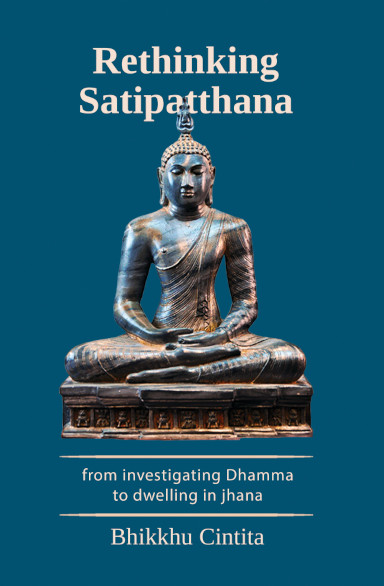
    The following is the final chapter of my recently revised book Rethinking Satipatthana. It can be read independently of the other chapters. It deals with the question of whether investigation of Dhamma can occur in deep jhāna, and concludes not only that it can, but that it is required in order to completely internalize Dhamma.

    Bhikkhu Cintita, 2026, Rethinking Satipaṭṭāna: from investigating Dhamma to dwelling in Jhāna.

    This is a thoroughgoing reevaluation of the early wisdom meditation teachings of the Buddha that lead to “knowledge and vision of things as they are.” It demonstrates the critical role of the integration of samādhi in the investigation of Dhamma.

    PDF
    Lulu

    Many centuries ago, the question of the role of samādhi in satipaṭṭhāna opened up a contentious Dhammic rift that remains with us today. The core question is: “How can the investigation or knowledge of something as complex and wise as Dhamma be experienced in the deep stillness of jhāna?” The title of this chapter suggests that an encouraging answer to this question is forthcoming. However, the almost unanimously accepted answer to this core question among scholars today is: “Investigation of Dhamma can not occur in jhāna!”

    In spite of this consensus, its adherents manage to split themselves further into two camps with regard to whether Dhamma investigation or jhāna is primary in the path to liberation. The following seems to be a rough overview of the membership of the two camps overview.1

    Contemplating Dhamma is primary. Gombrich, Conze, Rahula, Collins, Carrithers, Masefield, Lindtner, Hamilton, and also most modern Vipassanā traditions.

    Typically, Samādhi is thereby regarded as a preparation for contemplation.

    Jhāna is primary. Griffiths, Vetter, Wynne, Bronkhorst, Rhys Davids, Norman, Cousing, Gethin, Anālayo, Sujato, Kuan, Samuel, Brahmāli.

    Often deep jhāna is regarded as the (ofttimes mystical) liberating experience itself, and Dhamma as a kind of secondary, conceptual bi-product. Sometimes contemplating Dhamma is regarded as a preparation for jhāna.

    On the other hand, Shulman challenges two questionable assumptions underlying the presumed incompatibility of Dhamma investigation and jhāna. In his 2014 book Rethinking the Buddha, he argues:

    1. that Dhamma, in the very earliest texts, is not generally abstract philosophy in need of higher reasoning processes, but rather for the most part descriptive of direct experience, and
    2. that repeated Dhamma investigation itself induces a “restructuring” or “internalization” of content conducive to a more spontaneous means of apprehension.

    In chapter five I have taken his first point to heart in showing how each of the Dhamma teachings referred to in the Satipaṭṭhāna Sutta has a nuts-and-bolts interpretation in terms of direct observables. In this final chapter, I will focus on Shulman’s second point. We will learn that internalization is already intrinsic to all human skill acquisition, from learning to walk or drive a car, to weaving or to playing the accordion. In each case, it turns know-what into a progressively more spontaneous, intuitive and non-conceptual know-how, easily, with repeated practice, within the capabilities of the still mind. In fact, we will see how jhāna serves to enable the practice of investigation to reach ever greater refinement as internalization puts it out of the reach of the more deliberate reasoning processes, with remarkable results.

    It should also be appreciated by the end of this chapter that if we equate satipaṭṭhāna investigation with vipassanā, and jhāna with samatha, the Buddha’s few statements about the need to balance these in practice make sense. The Buddha said,

    Again, a bhikkhu developssamathaand vipassanā in conjunction. As he is developing samatha and vipassanā in conjunction, the path is generated. He pursues this path, develops itand cultivates it. As he is pursuing, developing and cultivating this path, the fetters are abandoned and the underlying dispositions are uprooted. (AN 4.170)

    Download full essay

  • Where did these images come from?

    The images used in this site are based on photographs of a collection of twenty four two-foot-high statues that can be found at the Burmese monastery in Austin, TX. If you click on “Credits” in the footer below, you can read about the interesting history behind these images.

  • The miracle of samādhi

    Samādhi occupies a prominent role in the early Buddhist texts. It is the final factor of the noble eightfold path to which the higher achievements of wisdom, or of knowledge and vision of things as they are (yathā-bhūta-ñāṇa-dassana) are attributed. It is a profound state of serenity, differentiated into the four jhānas, through which the mind becomes progressively stilled and centered, various cognitive faculties are silenced, and complete ease and equanimity are attained.

    Etymologically, samādhi is derived from sam ‘together’ + ādhi ‘put,’ and so has to do with gathering or collecting something together. Samādhi is most commonly translated as ‘concentration,’ implying a narrowing or focusing of attention. However, as we will see, concentration is one of two dimensions that characterize samādhi; the other is the progressive “curtailment” of various cognitive faculties as we progress through the jhānas. At every stage samādhi establishes an orderly array of mental faculties, and this (consistent with its etymology) recommends a translation as ‘collectedness’ or ‘composure.’ I will, for the most part, simply leave samādhi and jhāna untranslated to avoid confusion.

    Etymologically, jhāna is the gerund of the verb jhāyati, apparently in use before the Buddha’s time to denote almost any contemplative or meditative activity. The Buddha sometimes uses this term in its common meaning, but alongside the technical sense of the “four jhānas,” which seems to have been novel at the time of his teachings. In its technical sense the Buddha equates the fourfold jhāna with samādhi, such that there is no samādhi independent of the four jhānas in the early texts.

    Unfortunately, samādhi has become a controversial topic within the Theravāda tradition, where much confusion seems to have resulted historically, first from a redefining of samādhi, then from an attempt to reconcile contrasting frameworks that don’t in principle cohere. The debate persists even among the adherents to the authority of the early Buddhist texts, where contrasting evidence is cited for “hard” or “soft” jhānas (respectively difficult and easy-ish to attain), and where there is still no consensus about how Dhammic insight is even possible in jhāna.

    In this chapter, I develop an account of what samādhi is and how it works according to the early Buddhist texts. I will point out some common, but widely neglected, passages concerning the ubiquitousness and spontaneous nature of samādhi, and about the fruits of samādhi. I will also examine some details of how samādhi is claimed to integrate in practice with other factors. I hope thereby to contribute to a fuller illumination of this remarkable multifaceted culminating factor of the noble eightfold path.

    . . .

    How samādhi arises

    . . .

    Samādhi as concentration

    . . .

    The jhānas

    . . .

    The fruits of samādhi

    . . .

    The miracle of samādhi, the pdf (2025)

    I thought the readers of this blog could use a scholarly explanation of what the earliest texts, and therefore presumably the Buddha, have to say about samādhi and jhāna, that is about meditative states. This is a chapter from my recent book Satipaṭṭhāna Rethought.

    pdf

  • Q&A w/BC: Walking for peace

    Celsa: There is a group of monks walking for peace to Washington DC right now. Is this in agreement with Buddhism principles? Is this a Buddhist way to do things?

    NOTE: Let’s back up for a moment to my last post, “Bodhidharma’s Witnesses.” The dialog between Emperor Wu and Master Bodhidharma should read like this:

    Wu: “I have built pagodas and funded monasteries in my kingdom. What merit have I gained?”

    Bodhidharma: “No merit!”

    Wu: “What are the essential principles of Buddhism?”

    Bodhidharma: “Vast emptiness. Nothing holy.”

    Wu: “Who is it who faces me?”

    Bodhidharma: “I don’t know.”

    This dialog was truncated in the email that went out to subscribers (apparently my email manager mismanages quote blocks). Now the post will make sense, if you go back and read it.

    BC (in reply to Celsa):

    I don’t think the Buddha ever mentioned this specific kind of political expression, but let’s look at what the Buddha said about political expression for monastics and for householders, and at currently accepted manners of political expression.

    The Buddha himself seems to have intervened on two occasions to prevent a military invasion, leveraging the high regard the offending king had for him. On the first occasion he succeeded, on the second he failed. In general, the Buddha was not directly politically engaged (unlike Jesus), but had a lot to say about society (see cintita.org > Study&Practice > Society), and the qualities of the ideal ruler (the “wheel-turning king”). One point stands out in this regard: He recommends that a good ruler seek the council of “brahmins and ascetics”). This would include, but not be limited to the Buddhist Sangha of his time, and in any case would have been a far cry more beneficial than modern rulers’ current reliance on corporate lobbyists. We can infer that the Sangha should play an influential role in the ethics of political decision making.

    Walking for peace would be a means for fulfilling that role. Because monastics are so highly venerated in Buddhist cultures, this influence can be huge. Monastics even enjoy a degree of respect in general American culture, and certainly curiosity. Mainstream media tends to ignore the peace movement, but curiosity may sway even them to give the monks some coverage. Let me draw a comparison to the so-called Saffron Revolution in Burma in 2007 against the military government, in which monks emerged en masse to walk the streets chanting suttas about mettā, but were violently suppressed by the military government. There is a movie about this, Burma VJ, that can be found on Youtube (https://www.youtube.com/watch?v=mH6SrlZvdUM). I highly recommend it.

    In Myanmar, and certainly in many other Buddhist countries, there is an expectation that monks will not engage directly in politics. In fact, in Myanmar monks are not permitted to vote. (However, in Sri Lanka there are monks that are members of parliament.) I agree with the Burmese position, as long as it does not exclude making an ethical point, addressed toward policy or behavior rather than particular parties. I think this is what our peace walkers and doing, as I understand it. Simply bearing witness to make an ethical point.

    The problem with partisan politics is that it divides people. A monk should ideally be able to befriend anyone (yes, him included, and even that guy). We are all faulty, and we are all trying to do the best we can with what we’ve been given (really). Some of us happen to break the fault-o-meter. However, if a monk or nun is willing to talk to the person they find most agreeable, but not to the person least agreeable, they’ve lost half of the people they might offer ethical advice to. The least agreeable is the least likely to listen, but also has potentially the most to gain. Mettā practice is about learning to befriend everybody.

    Alongside political engagement is social engagement in providing health services, alleviating poverty, improving infrastructure, education and other things like that. Monastic communities in Asia are commonly so involved. In Myanmar public education is very poor; the best schools are founded and run by monks and nuns, who also tend to be better educated than most. Monks and nuns also run orphanages, appeal for donations to infrastructure projects, and even found hospitals. It should be noted that the scope of these projects has grown through the invaluable model of Christian charity witnessed during the colonial period. Modern “engaged Buddhism” (a term coined by Thich Nhat Hanh) has taken some very creative directions, to my mind very much in accord with ancient Buddhist principles.