Some subscribers (including me) seem not to be receiving blog posts by email from my new site. I’m sending this out as a test. Please excuse the disruption.
Author: bhikkhu cintita
Q&A w/BC: How should Buddhism be repackaged for modern people?
Gerry Trione and I have been engaged in a 1-to-1 email discussion following up on a previous post on the difficulty of promoting Buddhism in modern society. He has put in a lot of thought and reflection based on years of experience. We are trying to organize our thread to put it out on this blog, for those that might be interested in this topic. We agree on the major points.
I am posting this Q&A on the issue of if and in what ways Buddhism might be adapted to fit modern predilections, since I have a well-considered position on this matter, which respectfully differs from Gerry’s. It also gives me an opportunity to explain the title of this site. This is also relevant to the topic of secular Buddhism.
GERRY:
Thanks for your response. I have more comments after more carefully reading your web site, which I enjoyed. Your focus is admirable. While reading much of the English translations of Ven. Hsing Yun’s teachings on “Humanistic Buddhism”, one pithy statement jumped out at me: “Buddhism must change to fit modern times.” In my view, he’s right, and it hasn’t. Your work targeting “Modern Buddhists” with your interpretation of EBT seems to be in concert with Ven. Hsing Yun’s admonition.
BC:
The Buddha gave the Sangha an explicit 10-point mission statement in the Vinaya, its monastic code. One point is to sustain the integrity of the Dhamma (not the word of the Buddha, but the functional integrity so that it will continue to conduce to awakening). Another is to promote the practice of Dhamma in the world. If the second overrides the first, little is accomplished, because what is promoted is a deficient practice. I think that is why the Sangha has traditionally not been very aggressive in promoting Dhamma (proselytizing is almost unknown). My efforts are primarily directed toward the first point for two reasons. The first is that think the Sangha, and non-monastic scholar-practitioners need to do a better job of preserving the integrity of the Dhamma than it has. There are so many misunderstandings. The second is that scholarship is my forte. I am by nature reclusive, and not as charismatic as Joel Osteen.
That said, I am very sensitive to difficulty and necessity of fitting together the Dhamma (as it has been communicated to us by our Asian teachers) with our modern mindset (with its peculiar cultural and intellectual history). They are worlds apart. I’ve had to navigate this gap myself over the last decades. (Look at me now: I am thoroughly modern, trained as a scientist, but living with Burmese monks, who represent a culture almost untouched by modernity.) I use the phrase “early Buddhism for modern Buddhists” in reference to that gap, for which I hope am providing a bridge (or at least a ferry boat) in order that at least a few inspired modern minds can make sense of Dhamma, and modern culture (which Gerry and I both agree is not healthy) may move closer to Buddhist culture.
Luckily the Buddha gave us a Dhamma that is malleable; he seems to have anticipated the need for adaptation to new contexts. As I approach a Dhamma teaching that is obscure to me, I start by asking, “Why would the Buddha teach this?”, not “Does this accord with my modern mindset, or what I think is true?” The Buddha was clearly not interested in philosophical or scientific speculation, and made clear, for instance, in the handful of leaves simile, that he only taught what conduces to awakening. The Dhamma is therefore a complex system in which each part plays its functional role. For example, when I look at rebirth (shown to be perhaps the thorniest teaching for the modern mind) I ask “What is its role?”, not “Can this be scientifically verified?” The Buddha clearly explains its role for us in providing a particular framework in which to practice, never in terms of its objective veracity.
Once I’ve established its role, I look a how this role is implemented “Hmm, a linear process whereby some continuum that is active at the time of physical death, continues after the time of a subsequent birth”). This is where a modern mind might balk. But there are many possibilities for reframing this implementation. First, the implementation might be meant figuratively, or by example. Second, it might be the best rough guess about how this process works given the state of “science” at the Buddha’s time, a guess we might improve on with modern understandingof genetics, cultural transmission, etc. Or, we could simply not care. What is important is that we see the fruits or deficits of our practice projecting themselves far into the future.
It is helpful the realize that the Buddha gave us free license to frame things how we want. He was an extreme skeptic himself, to the extent that he considered all truth claims unreliable. He certainly never endorses blind faith (though Buddhists have certainly had it, but so have modern scientists with regard to their scientific presuppositions). The Dhamma does not consist of things to believe, but rather of “working assumptions.” I describe these as things we should “take seriously, but hold loosely.”
Take Seriously but Hold Loosely (2017)
We take the teachings of Dhamma seriously because each has a practical function that makes a difference in our lives. If we hold Buddha’s teachings loosely, we have license to interpret them in ways that are most meaningful to us.This is how can preserve the integrity of the Dharma without demanding interpretations that will never make sense to us.

We humans can accept working assumptions easily, even if they totally contradict our beliefs. We do it all the time. I talk to animals all the time myself, even bugs, because it puts me into a private framework of friendliness. But I know they have no idea of what I am saying. In fact a unique aspect of being human is that we get to make things up symbolically. All it takes is to apply this formula: “See this physical reality here. Well that counts as X,” where X is whatever we want it to be. We live in a largely made-up symbolic world as a result. This is the only sense in which money, property, national borders, any institution, football, and (perhaps) God is real. We are adept at this mode of thinking. We adopt it when it is valuable in coordinating human affairs, or to give us an efficient perspective for approaching certain tasks. This is
the extent I am willing to adapt early Buddhism for modern Buddhists.GERRY:
However, with all due respect for Fo Guang Shan, which is enormously successful in terms of “active” temples like Chang Mei in Stafford, the problem is it’s all Chinese (or mostly Taiwanese in Stafford), where they teach and promote “Asian Buddhism”, which doesn’t resonate well with Westerners like myself. This is counter productive to my goals for Hong Fa for westerners.
Writing for the Smithsonian in April 2025 on archeological Buddhist discoveries in Nepal, Jeffery Bartholet summarized the Buddhism Dilemma quite well:
Even among believers, the Buddha is a figure who takes on different forms depending on the observer. Among secular Buddhists in the United States, he’s often regarded simply as an enlightened teacher—a person who, through discipline and deep meditation, gained remarkable insights into the human condition and gave instructions for how people can tame and channel their minds to reduce the stress of living. In Asia, where Buddhism is practiced in a bewildering array of different schools and lineages, each with its own traditions and rituals, he’s often a much more magical figure—someone who could levitate and fly long distances, subdue dragons and demons, project duplicates of himself in space, and travel to astral realms.
The “traditional Buddhism” taught in most Buddhist temples we have visited is “archaic” and often based on misinterpretation of the EBT, or a complete misunderstanding of the intent, the result being confusion, and dismissal by “critical thinking” westerners.
BC:
I find it very helpful here to distinguish what I have called “adept Buddhism” and “Folk Buddhism.” Adept Buddhism gets to the core of the Buddha’s teachings, the four noble truths, impermanence, suffering, non-self, the eightfold noble path. It is what I teach, and is certainly quite coherent in early Buddhism, and also in many later traditions. Folk Buddhism blends in beliefs that originate in local cultures, adding a lot of color, but confusing modern people. I never cease to be surprised at the things Burmese Buddhists, for instance, commonly believe; sometimes monastics try to correct these beliefs in terms of the early texts, but to little avail). If we can distinguish what’s adapt and what’s folk (the adepts are likely to know), we can put aside the folk; it doesn’t do modern people much good anyway. Besides, we have our own modern folk Buddhism. I think other fields of adept knowledge also have a folk accompaniment: we certainly have a lively folk science, for instance. Adept Buddhism is what has traditionally been preserved by the monastic Sangha, but in modern circumstances Buddhist scholars, lay teachers, and many very advanced lay practitioners are also prominent. Folk Buddhism is rather free to go wherever folk’s imaginations carry them.
I view folk Buddhism as rather innocuous, as long as it does not challenge to principles of adept Buddhism. The adepts tend to know what is adept and what is folk, and the Buddhist culture tends to move away from the contradictions., and has had many centuries to iron things out. In fact, Buddhist tolerance of sometimes off-the-wall folk beliefs probably enabled Buddhist to become the first world religion in permitting it to travel into foreign cultures. A playful attitude is helpful in the encounter of Asian folk Buddhism. On one occasion I found myself in a position where I was expected to talk to angry tree spirits in Texas, who might not know Burmese or Pali. For me it was all in fun.
What I most worry about is modern cultural baggage. I’ve been talking about ways to adapt an Dhamma to the modern mind, but it is even more important that we change modern culturally defined presuppositions that contradict the Dhamma. After all, we cannot bridge the gap between Dhamma and the modern mind otherwise, so that Dhamma practice can relieve what ails modern culture. It concerns me that Buddhism is so poorly understood by modern teachers of Buddhism. Many teach something as Buddhism that is almost entirely of western origin. We have to reconsider our hyper-individualism, our anti-religious attitudes (even among the religious), our materialism, commercialism and much more. Gerry and I both agree that Buddhist values are almost the opposite of modern cultural values. If Buddhism is to help cure what ails us, we have to challenge our modern cultural baggage.

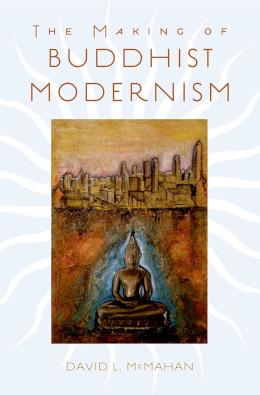
David McMahan, 2008, The Making of Buddhist Modernism, Oxford.
This is a thorough study of the absorption of modern preconceptions into the content of what is taught as Buddhism in modern Buddhism. It method is to trace the sources of individual modern Dhamma teachings, either in some Asian Buddhist tradition, or in some western cultural/religious/intellectual tradition. The results are surprising.
GERRY:
I submit that modern Buddhism needs to focus on the core concepts of EBT, as they relate to the realities of modern life, and in terms which have modern context, and not resort to “blind faith”. Specifically, to teach Buddhism in a way which is Simple, Relevant , and Compelling, we need to strictly avoid any reference to Pali or Sanskrit terms, and their etymology, which is not only confusing and hard to assimilate, but also absolutely unnecessary to the goal, serving as yet another barrier to understanding.
Similarly, with the primary goal, in your words, of cultivating integrity and wisdom, there are many so-called “sacred” Buddhist concepts which are also a barrier and entirely unnecessary, making the teaching counterproductive; the result being to throw the baby out with the bathwater, meaning to discard Buddhism because of extraneous and unrealistic “sacred requirements”, thereby pushing away anyone who has some interest in Buddhism. Its a matter of credibility. Examples of unnecessary barriers include the importance of Karma, merit, re-birth, Realms, devas, killing, vegetarianism, and Nirvana.
BC:
To teach Dhamma without reference to foreign terms would be ideal. I believe that is possible for Chinese, because the technical vocabulary of Dhamma was long ago standardized in the process of translating Indic texts into Chinese in the first millennium (I may be wrong). However, the well-established terminology of Pali has does not translate well into English: a given Pali term may be translated into English in multiple was. For instance Pali samādhi (the meditative state) has been translated as ‘concentration,’ ‘absorbtion,’ ‘composure,’ ‘trance.’ To pinpoint a particular concept precisely we often have to refer to the Pali term, at least alongside the favored English. Given this difficulty, a lot of Pali terms, like samādhi and vipassanā, are entering the English language. Jhāna seems to have no common alternative in the English language.
With regard to those teachings that might be dropped from the Dhammic repertoire, the issue is, Who decides what is or is not necessary? I’m afraid the answer has all too often been modern folk-cultural presuppositions. This is very common among “secular Buddhists.” This is the fastest way to throw the baby out with the bathwater. Let’s look at your examples.
We’ve talked about rebirth: its function is to provide a way of framing practice that projects the continuity of its results far beyond this one life, and makes us responsible for the future. I submit that this continuity is substantial, complex, but can be reframed in many ways (modernity often affords natural understandings that were not available to the Buddha). Simply dismissing the notion as nonsense is not an option, without weakening the Dhamma.
Killing and vegetarianism are meant to go together here, I assume. This gets into the complexities of Buddhist ethics, which will take us far afield. I should point out that vegetarianism is not a significant matter in the early Dhamma. It became very significant in East Asia in the Bodhisatva Precepts, one of which is simply, “Don’t eat meat.”.
I’m not sure what the objection to nirvāna here is. In folk Buddhist traditions Nirvana is often regarded as a kind of divine realm where awakened ones are reborn. There is no such thing in the early Dhamma. The word literally refers to the “extinguishing” of the factors from which our sense of personal identity is fabricated.
Devas (dieties) are mentioned all over the place in the early texts. They are part of the cultural backdrop of the time. However, they are not integral at all (putting aside divine realms of rebirth). For instance, they have no function as objects of worship. In fact sometimes they are treated a comical beings with more bravado than substance. Rhetorically, they underscore the superiority of awakening by comparison.
I daresay, throwing out karma and merit would destroy Buddhism as a practice tradition! Karma (Pali kamma) means intentional action. Practice is therefore kamma. What is often objectional in modern circles is the notion of the “fruits of kamma,” the idea that “I am the heir of my own deeds,” the notion that my actions have significant effect on my future well-being, alongside whatever immediate benefit or harm my deed may produce for others. But consider, we practice for two reasons: Your lawyer or your dentist has a practice that (hopefully) benefits you. That is the consequence for others of their practice. Your neighbor’s kid practices playing the tuba at all hours so that he will become skilled enough to join the marching band, certainly not to entertain you. Skillfulness (maybe even virtuosity if he practices long and wholeheartedly enough) will be the fruit of his practice. I submit that that is (almost) all there is to it. The ultimate fruits of our Buddhist practice are the perfection of the skills of virtue and wisdom. We practice Buddhism with both purposes in mind, but increasingly in advanced practice the fruit becomes primary.
How is this personal well-being? As we develop virtue and wisdom, our personal heightened well-being accumulates, experienced as deep satisfaction with life, as living a meaningful life, a life well-lived life, a spiritually charged life. It is a pervasive contentedness with life. We are all have a sense that this kind of well-being exists, but generally as a promise never delivered, quite a rare experience in modernity. Because it does not have a sensual basis, and is not immediate, it is abstract, hard to pin down. As a result it seems to be framed in imaginative ways in the early texts. The Buddha calls it supra-mundane (lokuttara).
One of the more clumsy ways to frame supramundane experience is as a payback mechanism: if you do some evil deed, then later you’ll get hit by lightning. This reduces supramundance experience to the status of the more easily understood mundane experience. Luckily, such examples are actually very rare in the early texts, and I daresay merely allegorical.
A more skillful, and the most common way to frame this experience of well-being in early Buddhism is as a dwelling place, in particular as a heavenly realm. I think of this as an apt metaphor that captures the idea that we “earn” it over time and that it is a pervasive experience, a kind of psychological condition that is just there, like a gloomy day. Notice that treating it as a psychological condition demythologizes supra-mundane experience. It is noteable that the Buddha does this himself, albeit not commonly: In one instance he describes his nemesis the demon Māra in psychological terms, and elsewhere hell realms in terms of psychological pain.
GERRY:
I once had a nun at Fo Guang Shan tell me that the ~200,000 people killed by the 2004 tsunami in Aceh, Indonesia, were killed because they had bad Karma. I was stunned. Another credibility black eye.
BC:
This is a very common, and hugely unfortunate misunderstanding of kamma in later traditions. It is likely a case of folk Buddhism actually infecting adept Buddhism, it seems particularly in Tibet. It seems to come from not enough loosely holding within the payback framework. It is not beneficial, because it means logically that compassion on the part of others is pointless: the best it can do is postpone the payback. The Buddha explicitly denied this understanding in the Sīvaka Sutts (SN 36.21). Things happen for a variety of natural causes unrelated to kamma. Lightning will strike, whether or not you happen to be standing there.
GERRY:
Merit is another confusing concept. We do good things in life because it benefits others; not for our reward or recognition. Yet “merit” is pushed by many monastics as an essential aspect for achieving the higher realms of rebirth.
BC:
Merit or demerit is at root simply a kind of subjective metric of progress or regress in practice, which is to say the fruit of practice. If you are training for the Olympics or on a diet, you might want to measure your level of effort on a daily basis. It keeps you engaged. Some Burmese actually keep a daily balance sheet with them that they update each time they perform an act of generosity, break a precept, etc. A dieter count calories. The paradox is that the more you seek personal advantage through merit, the less merit you earn. Craving is suffering, and unskillful in Dhammic terms.
GERRY:
Rebirth is an entirely theoretical concept, and one which some question as an authentic part of the Buddha’s teachings. Yet rebirth is what many Buddhists secretly, or overtly, hope for; more cravings. Much like the carrot in Christianity, Salvation, many Buddhists are “expecting” rebirth. Rebirth, in my view, is an erroneous reflection of the Vedic culture at the time of the Buddha’s awakening around 500 BC where the notion of rebirth had been deeply engrained and unquestioned for a 1000 years before the Buddha’s birth.
BC:
My understanding is that the early Vedas have nothing to say about rebirth, and evidence of the concept first shows up in the early Upanashads, maybe 200 years before the Buddha. There it comes in various forms. Interestingly the birth of a son to a father is considered a rebirth in one account. At the time of the Buddha it seems not to have been universally accepted, since the Buddha often debated about it with skeptics. But notably, he never argues that rebirth is true, only that its acceptance as a working assumption is beneficial to practice, for it induces people take responsibility for the future.
GERRY:
Indirectly, following a wholesome life with integrity and wisdom to improve your chances of rebirth, may be positive … ,
BC:
That’s the point. In the Kālama Sutta the Buddha answers the question about when a teaching should be embraced. His answer is very pragmatic: when it is of benefit. This is “taking seriously.” He never gives truth as a criterion, for him truth arguments are unreliable. This is “holding loosely.”
Let me supplement your list of candidates for dropping from the Dhammic repertoire: anything under the rubric of “religiosity.” This includes rights, rituals, institutions, and distinguished roles (priests, monks, etc) and garb (archaic clothing, usually robes). Buddhism has all of this, and has had them since the time of the Buddha. Why are they objectionable? Many secular spheres of modern life have all of these as well: courtrooms, birthday parties, sports events, academic institutions, the military, receiving wine at a high-scale restaurant. Isn’t it peculiar that religiosity is objectionable only when associated with religion? It seems that this particular example of modern cultural baggage arose within religion, with the Protestant Reformation, which rebelled against the excesses of the Catholic Church, and promoted instead the idea of private religion in need of no social trimmings, only individual direct communication with God. This was a religious history in which Buddhism did not participate.
Please reply below to contribute to the discussion.
Q&A w/BC: What are fabrications/formations (sankharas)?
QUESTION, another important one from Celsa:
Studying the Paticca-samuppada- Vibhaṅgasutta, and reading a couple of translations, I have a hard time understanding the concepts of “consciousness”, “fabrications” “contact” and “becoming”. B Sujatto, calls “fabrications”, choices. I find that word clearer, but how do we go from a choice to consciousness? Or better yet, what is considered ‘consciousness’ in this context? Can you give me an example of a real-life process where the development of dependency from one to the next step is shown?
ANSWER
The answer to your question is easier than you might suspect. Let me begin with an example per your request: if you see two round spots on a larger round surface maybe with a parallel line below, you see a face. The word sankhāra means literally ‘put together,’ and that’s exactly what you are doing in this case. Sankhara might also be translated as ‘conceptualization.’ We build up (fabricate) the world as we experience it through conceptualizations, layer upon layer. And our experience of the world is consciousness (notice, for the Buddha consciousness is something we make, not something that we simply show up for). Think of sankharas as the bricks out of which consciousness is built. Each brick is a small conceptualization, a putting together with other bricks to fabricate a larger whole. That’s it!
Why does Sujato translate sankharas as choices? We fabricate not only our perception of the world (consciousness), but also our plans for action in the world. They are built up conceptually before we physically act. For the Buddha, there is little difference: they are conceptual fabrications. We think of our plans for action as the result of many choices, but actually our perceptions of the world are also choices. We can perceive otherwise, and if we look very carefully at the way we perceive, we see that it is full of biases, particularly biases that reflect our personal interests. We can choose otherwise (which is what the Dhamma is all about). A self-centered person perceives the world differently than a selfless person, they have a different form of consciousness.
Now, kamma means ‘action’ in Pali. The Buddha refined this to mean ‘intentional action,’ which is action made on the basis of choice (rather than by accident, for instance). The Buddha then extended this beyond bodily and verbal actions, to mental actions as well. That is, by planning to do something we are already producing kamma. So he refined the meaning of kamma further to mean simply ‘intention,’ which is ‘choice.’ But if our perceptions are intentional as well, then they are instances of kamma. The upshot seems to be that sankhara = kamma. Though I am not aware that the Buddha equated them in this way, the words are used pretty much interchangeably. Kamma is more common in the domain of ethics, and sankhara in the domain of wisdom. But we talk about sankharas of body, speech and mind, as we do for kamma.
An important aspect of kamma or sankhara is that they become habituated into dispositions, that is, we gain habit patterns in our conceptualizations or choices, and we each have a unique sets of dispositions as a result. In fact acquiring skills is all about improving dispositions, and our entire Buddhist practice is about developing wholesome dispositions. Both kamma and sankhara can refer to particular conceptual fabrications performed right now, or to the dispositions that underlie those choices. We talk about ‘old kamma’ vs. ‘new kamma.’
The transition from sankharas to consciousness in dependent coarising has been interpreted in two ways. The first is just as I have explained. The second is that it describes the process of rebirth. Our dispositions define who we are individually (including where we are in our practice). On the second interpretation, at death our dispositions from the previous life are all bundled up into a special kind of consciousness, that travels–zap– to the mother’s womb at conception. The second is consistent with the account of sakharas given here, but not with the general account of consciousness in the early texts. There consciousness is always a momentary event, a flash of fabrication. The choice between the first and second interpretation effects how the subsequent links are interpreted: name and form, the sense spheres, and contact.
— After hearing my answer Celsa added, “So, consciousness is making sense of the reality as we are able to perceive it, conceptualize it and interact with, right? That’s why is so unique for every person. As stupid it may be, one very simple thing that had me reflect on this has been why I like to have cleanliness and order, and other people don’t seem to see the need for them.”
You’ve got it. I started out as one of the other kind of persons, but the effect of wholesome Buddhist practice on my kammic dispositions has made me more like you.
By the way, there is now a handy submission for at my new site: https://cintita.org/blog/ . However, the post will still show up on my old site, and in your mailbox.
Q&A w/BC: Is Theravada Buddhism less developed than Mahayana Buddhism?
QUESTION from Claudia: What is the key difference(s) between Theravada and Mahayana traditions? Why is Theravada called the lesser vehicle? Someone said recently that Theravada school was less developed than the Mahayana because it did not go to advanced states of mind-developing.
ANSWER from BC: The Buddhist world is generally divided into two major schools, the Mahayana (great vehicle), and the Hinayana (small vehicle). These terms originated with the rise of the Mahayana to distinguish them from the other school, and it has become widely considered impolite to call someone “Hinayana.” But I’ll use the terms here. Roughly 65% of Buddhists today are affiliated with Mahayana. The rest belong to the Theravada school to which I belong.
The Mahayana was an innovative movement that grew in India in the first millennium. Before that time Buddhism had differentiated into many geographically and (as a result) somewhat doctrinally dispersed sects, which with time blended back together. Of the early sects only Theravada has kept its identity, certainly because of its early isolation in Sri Lanka, from whence it spread into SE Asia. Traditionally the doctrinally distinct Mahayana is considered to have developed from the early Mahasanghika sect in eastern India. It may have had more than a single point of origin, but Mahayana became over the centuries a pan-Buddhist movement. Within any sect, region, or monastery you might have found some Mahayanists and some Hinayanists living together and getting along happily, as pilgrims from China were surprised to find. Mahayana was even influential in the Theravada sect at one time but later died out.
Mahayana was the innovator, and emphasized three main things that distinguished it from the older Hinayana: (1) the status of the Buddha as not as a normal human, but as a kind of cosmic being, something along the Jesus model. (2) The higher ideal by which instead of awakening to escape the cycle of rebirth, it is more praiseworthy to forego awakening in order to be reborn with all of the virtue and compassion that will have come with high practice attainments. Why squander all that virtue on awakening, when you can use it to help make the world a better place in future lifetimes? A Bodhisattva is someone who follows this path. This is why the Dalai Lama has been reborn fourteen traceable times. (3) The idea of emptiness, that nothing in the world exists from its own side, but only through human conceptualization.
I think (1) reflects the general need of people to embellish. It’s pretty much harmless, and may encourage wholeheartedness in Buddhist practice. (2) is actually present and respected in Theravada, apparently as a remnant of the early Mahayana influence on Theravada. I think it is beautiful way to frame one’s own Buddhist practice, even for those who disbelieve in rebirth. (3) is a very significant factor in wisdom practice, and insight meditation. The Buddha taught emptiness, but predicted that it would be the first of his teachings to be forgotten. The Mahayana emphasis may be a revival of this teaching, but it is not taught in Mahayana quite the way the Buddha taught it.
There are other doctrinal divides in current Buddhism aside from Mahayana-Hinayana. Mahayana has many subschools with doctrinal differences, and some schools that might be considered Dhamma-lite. Tibetans consider themselves to be Mahayanists, but adhere also to what they consider to be an even higher teaching: Vajrayana, influenced historically by Hindu Tantra in Kashmir. I do not know enough about Tibetan Buddhism to assess the strengths and weaknesses of the Vajrayana enhancement, but this might be the source of the “advanced states of mind development” that Claudia’s interlocutor mentioned. Alternatively, she might be like many practitioners who regard whatever school they belong to as “the best.”
I should add a word for those who are dismayed that Buddhists don’t always agree on Dhamma. First, the core purpose of Dhamma is found throughout the Buddhist world: practice aimed at developing human character in its twin aspects of virtue and wisdom through behavioral and contemplative training aided by deep control of mental faculties, aimed at awakening. Second, the Buddha anticipated variation and innovation: he defined the Dhamma not as what he personally taught, but as that which achieves that purpose.
Two interesting follow-up questions would be: (1) Is Theravada really Hinayana? (2) Was the Buddha a Hinayanist or a Mahayanist?
Please reply to keep the conversation going with relevant knowledge, insights or follow questions. Or pose a new question be emailing BC directly at bhikkhu.cintita@gmail.com.
Announcement: we’re moving soon
As part of the revitalization of this site, we’ve been remodeling it. We will soon be active at https://cintita.org/ , possibly within a week. The subscriber list and blog submissions will be moved, hopefully without any disruptions. It’ll be real artsy. You can visit it now; just don’t trip over anything or lean against any wet paint.
Q&A w/BC: Is it useless to try to fix the world’s problems?
Question from Celsa
Because this world and our life is ‘suffering’, there is no hope that the suffering will go away, and it’s useless to try to fix the world’s problems. Of course, the obvious solution would be that every person becomes virtuous and behaves in a moral way, so suffering can decrease. This is not feasible at a mass level, so maybe humanity is hopeless? and there is no way out, except individually? Why is it so hard to surrender desire, doubt, anger, etc. Aren’t the 5 hindrances our very inherent makeup? And if one eliminates them, one ceases to exist? Isn’t Desire the very motive of existence, keeping us eating and reproducing? Does Buddhism say that human life is absurd?
Response from BC
Celsa, I’m sorry to hear so much despair, and I know most people feel this way at this stage in history (or any other stage). Let me try to put the role of Buddhism in all this into perspective to show how Buddhist practice helps make the world a better place and the individual more fulfilled.
Let’s start with the issue of our inherent makeup. You’ve probably heard the following little story.
An old Cherokee is teaching his grandson about life. “A fight is going on inside me,” he said to the boy. “It is a terrible fight and it is between two wolves. One wolf is evil – he is anger, envy, sorrow, regret, greed, arrogance, self-pity, guilt, resentment, inferiority, lies, false pride, superiority, and ego. The other is good – he is joy, peace, love, hope, serenity, humility, kindness, benevolence, empathy, generosity, truth, compassion, and faith. The same fight is going on inside you – and inside every other person, too.”
The grandson thought about it for a minute and then asked his grandfather, “Which wolf will win?”
The old Cherokee simply replied, “The one you feed.”
This really says that we have two incompatible inherent makeups; this is the human dilemma. The Buddha never spoke in these terms, but notice that the qualities of the two wolves correspond almost precisely to what to Buddha regards as unskillful/unwholesome kamma, and skillful/wholesome kamma respectfully, so I’ll run with it. In fact, the Buddha has a lot to say about the psychological differences between the two wolves. Dependent coarising is an apt description of how the evil wolf’s mind works. (I have a bit of trouble picturing a good wolf. Maybe a highly domesticated collie like Lassie counts as a wolf.)
It seems like the evil wolves are getting plenty to eat these days, certainly among public figures and the powerful. Our individualistic, “Greed is good” culture favors evil wolves (not all cultures do). However most religious traditions, if they have not been corrupted, favor good wolves. Buddhism unambiguously favors feeding the good wolf. For the Buddha that is the one inherent human makeup that counts, and that must be developed and cultivated.
Most people think when the evil wolf is in charge it is good for “me,” but bad for others, when the good wolf is in change it is good for others, but bad for “me,” so they try to balance the two: “If I give to them, there is less for ‘me.’ Mostly I care about ‘my’ happiness, but I am not indifferent to theirs.” They feed both wolves, maybe the evil wolf a bit more.
For the Buddha, this balance makes no sense at all, for a well-fed good wolf is always far far happier than a well-fed evil wolf. The reason is that each wolf experiences a different kind of happiness: for the evil wolf happiness is mundane, based on sense pleasures, fleeting and unreliable. For the good wolf it is supramundane, is based on contributing to greater things including others, just accumulates, and leads to a fulfilling, meaningful life well lived. Only the good wolf can be fulfilled spiritually. This is the fruit of good kamma, that many in our hyper-individualistic culture fail to recognize.
How does Buddhist practice therefore make the world a better place?
The adept Buddhist brings ceaseless benefit to those around him or her, though compassionate action, though cooperation in group pursuits, through harmonizing with them, through example and teaching. This is our inherent nature, the one worth developing and cultivating, the one concerned with something greater than the individual self, in that it includes others.
It may be frustrating that the world overall does not seem to improve, but that is just “all or nothing” thinking. Helping a few others is huge in itself. Contributing the to the frustration is that we commonly do not see the far-reaching consequences of our influence, but they there. (I can think of various people whom I barely knew who have no idea of the influence they had on my life, like the odd Polish man in a suit and carrying a briefcase that I picked up hitchhiking in Corte Madera, California over fifty years ago, with whom I had a conversation about languages, and who recommended a book for me to read, before I dropped him off.) It is best to practice in small communities of like-minded people, where we can actually see the world getting a bit better, at least in one place, and where we are working together with others to accomplish this. Community was essential in the Buddha’s thinking.
But even if the world does not become a better place, or we fail to see it, we individually will live much more fulfilling, meaningful lives for having dedicated our practice to something greater than ourselves, to living as good wolves according to the standards of Dhamma.
In summary, yes Buddhism does say that human life is absurd. But Buddhism knows how to make it sane, just not for everybody all at once.
Q&A w/BC: How do we repackage Buddhism to make it simple, relevant and compelling for young people?
QUESTION from Gerry Trione:
Bhante, As you probably know, there are about 700 million Buddhists around the world, most of whom are in Asia. There are an estimated 3-4 million in the US, but most of whom are Asian, leaving only about 600,000 “westerner” Buddhists; far less than 1% of the population. I know from personal experience that Buddhism is essentially unknown or misunderstood with Americans. Moreover, the prospect of US as a fertile ground for religious Buddhism is becoming more tenuous as young people are taught in school and social media that there is no “god” and anyone who follows a religion is a loser. The result of turning away from religion is the loss of moral and ethical guidelines on how to live a wholesome life. This is why we have such a high rate of drug and alcohol use, and psychological problems. Over 60 million people in the US have psychological problems, and over 50 million have drug addictions. And, its getting worse.
The question is: Why is Buddhism, the proven best means to end mental suffering, so hard for young people to grasp?
ANSWER from BC
Gerry, Thanks for this important question. I agree with you: the modern world needs Buddhism, because Buddhism is almost the opposite of what ails modern culture: its hyper-individualism, its consumerism, its commercialism, its secularism, and so. But exactly this this is what makes Buddhism difficult to grasp for modern people. Buddhism is not an easy-answer guide to life, except in some of its regional, primarily devotional “folk” manifestations, which are simply going to seem strange to westerners.
Partly as a way to popularize Buddhism, many modern teachers westernize or pare down Buddhism. I daresay that much of what is taught as Buddhism by western teachers is not of Asian origin at all, but is a continuation of currents of western thought that can be traced through the early Protestant Reformation, through Romanticism, American Transcendentalism, psychoanalysis, and probably through the beatnik and hippy countercultures. Buddhism is being significantly co-opted by modern culture, rendering it unable to squarely oppose those aspects of modernism that are most vexing. David McMahan’s book, the Making of Buddhist Modernism, offers a fascinating discussion of this issue.
Of course, modern people are always going to see Buddhism through a modern lens. The challenge is to do this without distorting the Buddha’s original intent. East Asians certainly do not conceptualize Buddhism the way Indians did, yet the managed to preserve the functionality of early Buddhism well. Much of my own efforts center around presenting “Early Buddhist for Modern Buddhists” (which I’ve made the name of this web site) without distorting the intention of the earliest sources.
I don’t have a clear answer on how best to promote Buddhism in the west. I’m doing my best. The commercial culture seems to overrun everything. The number of monks in Thailand, for instance, has fallen by 50% in 20 years, apparently because of the growing influence of modernity. Taiwan, on the other hand, continues to sustain very strong Buddhist and Taoist traditions in spite of its modernity. I’d like to know how they do it. I doubt that we will manage a sweeping Buddhist movement, say, in the USA. What we might accomplish is small communities here and there that are dedicated to living sanely according to the Dhammic principles, much as the artifacts of civilization were preserved in the monasteries of the Middle Ages.
MORE DISCUSSION from Gerry
The answer is the primary message of Buddhism, to end suffering, is not being communicated to the masses. It is obscured and eclipsed by a larger focus on the more mystical concepts of rebirth, merit, realms, devas, and the supernatural. The elegance of Buddhism from my perspective, having studied psychology in undergrad, is the close resemblance to psychology of the 4 Noble Truths. Namely, suffering, or “psychic irritants” exist; we know the causes (Three Poisons); Suffering can be cured; and, the cure is known (8 Fold Path, Precepts, etc.). This is classical psychology with “psychoanalysis” and “Psychotherapy”.
What young people ask themselves is: “What’s in it for me?”. The answer is “Happiness”; the end of suffering. But, young people I know don’t think they’re “suffering”. They think that anger, hate, resentment, jealousy, envy, worry, fear, cravings, addiction, anxiety, and depression is “normal”!!! In short, Buddhism needs to be repackaged to appeal to these younger people in a form which is Simple, Relevant, and Compelling.
RESPONSE by BC
I agree with your most of your points, and along with you am particularly alarmed at what young people experience as life.
You are right: Buddhism, at least the early Buddhism taught by the Buddha, is psychological through and through. I am a retired cognitive scientist and I am simply in awe the the Buddha’s understanding of the human mind. I’m discovering that early Dhamma matches up with modern cognitive research well. However, I don’t agree Dhamma bears a close relationship to psychotherapy (although a lot of psychotherapists are Buddhists). The goals are different. Freud described psychotherapy as curing psychological abnormalities that cause individual suffering, and added something like, “so that sufferers can return the common level of suffering that we all share.” Buddhism is concerned with curing the common level of suffering that we all share. But even that goal is incidental to its main goal: to improve and eventually perfect the human character in its dual aspects of virtue and wisdom. I think of the suffering of young people in modern society, and of almost everyone else, not so much as an abnormality of individual psychology, as of the break-down of the society in they live.
As for the “larger focus on the more mystical concepts of rebirth, merit, realms, devas, and the supernatural,” many teachers explicitly exclude such teachings, particularly the secularists. As for preserving the integrity of early Dhamma, I’ve concluded that devas, realms and much of the supernatural (like acquiring the ability to jump up and touch the sun) are dispensable, but fun. Rebirth and merit are critically important. Merit (or the fruits of kamma) is simply the effects of wholesome practice on our character, and can be largely explained cognitively. Rebirth gives us an important way of framing our long-term practice. It’s not necessary to believe that it is actually true as described, only that we accept it as a working assumption. We do this all the time anyway: money is not true, it is a social construct that everyone accepts as a working assumption, and thereby serves an important social function.
Please REPLY if you would like to continue this conversation on a multifaceted topic that perhaps all readers have a stake in. I would like to encourage such discussions in order to revive this web site, to which I have given insufficient attention in the last years. Submit a question

Satipaṭṭhāna Rethought: a meditation manual based on earliest Buddhist texts
Satipaṭṭhāna (often translated as “Foundations of mindfulness”) is the Buddha’s method of wisdom contemplation, best known through the ancient practice tutorial The Satipaṭṭhāna Sutta. It is recognized as the basis of modern vipassanā or insight meditation and of many other modern and historical practices. Unfortunately, the complexities of Buddhist intellectual history have not been kind to this early teaching.

1. Living in mindfulness
This is the first of five videos in the online course “Mindfulness: where Dharma meets practice.” “Living in mindfulness” serves as a general introduction to the Dharma and practice with particular attention to the role of mindfulness.
2. Living in virtue
This is the second of five videos in the online course “Mindfulness: where Dharma meets practice.” “Living in virtue” explains the fundamental ethical practices that belong to a Buddhist life: precepts, giving, and purity of mind developed through mindful observation of emotional factors.