Gerry Trione and I have been engaged in a 1-to-1 email discussion following up on a previous post on the difficulty of promoting Buddhism in modern society. He has put in a lot of thought and reflection based on years of experience. We are trying to organize our thread to put it out on this blog, for those that might be interested in this topic. We agree on the major points.
I am posting this Q&A on the issue of if and in what ways Buddhism might be adapted to fit modern predilections, since I have a well-considered position on this matter, which respectfully differs from Gerry’s. It also gives me an opportunity to explain the title of this site. This is also relevant to the topic of secular Buddhism.
GERRY:
Thanks for your response. I have more comments after more carefully reading your web site, which I enjoyed. Your focus is admirable. While reading much of the English translations of Ven. Hsing Yun’s teachings on “Humanistic Buddhism”, one pithy statement jumped out at me: “Buddhism must change to fit modern times.” In my view, he’s right, and it hasn’t. Your work targeting “Modern Buddhists” with your interpretation of EBT seems to be in concert with Ven. Hsing Yun’s admonition.
BC:
The Buddha gave the Sangha an explicit 10-point mission statement in the Vinaya, its monastic code. One point is to sustain the integrity of the Dhamma (not the word of the Buddha, but the functional integrity so that it will continue to conduce to awakening). Another is to promote the practice of Dhamma in the world. If the second overrides the first, little is accomplished, because what is promoted is a deficient practice. I think that is why the Sangha has traditionally not been very aggressive in promoting Dhamma (proselytizing is almost unknown). My efforts are primarily directed toward the first point for two reasons. The first is that think the Sangha, and non-monastic scholar-practitioners need to do a better job of preserving the integrity of the Dhamma than it has. There are so many misunderstandings. The second is that scholarship is my forte. I am by nature reclusive, and not as charismatic as Joel Osteen.
That said, I am very sensitive to difficulty and necessity of fitting together the Dhamma (as it has been communicated to us by our Asian teachers) with our modern mindset (with its peculiar cultural and intellectual history). They are worlds apart. I’ve had to navigate this gap myself over the last decades. (Look at me now: I am thoroughly modern, trained as a scientist, but living with Burmese monks, who represent a culture almost untouched by modernity.) I use the phrase “early Buddhism for modern Buddhists” in reference to that gap, for which I hope am providing a bridge (or at least a ferry boat) in order that at least a few inspired modern minds can make sense of Dhamma, and modern culture (which Gerry and I both agree is not healthy) may move closer to Buddhist culture.
Luckily the Buddha gave us a Dhamma that is malleable; he seems to have anticipated the need for adaptation to new contexts. As I approach a Dhamma teaching that is obscure to me, I start by asking, “Why would the Buddha teach this?”, not “Does this accord with my modern mindset, or what I think is true?” The Buddha was clearly not interested in philosophical or scientific speculation, and made clear, for instance, in the handful of leaves simile, that he only taught what conduces to awakening. The Dhamma is therefore a complex system in which each part plays its functional role. For example, when I look at rebirth (shown to be perhaps the thorniest teaching for the modern mind) I ask “What is its role?”, not “Can this be scientifically verified?” The Buddha clearly explains its role for us in providing a particular framework in which to practice, never in terms of its objective veracity.
Once I’ve established its role, I look a how this role is implemented “Hmm, a linear process whereby some continuum that is active at the time of physical death, continues after the time of a subsequent birth”). This is where a modern mind might balk. But there are many possibilities for reframing this implementation. First, the implementation might be meant figuratively, or by example. Second, it might be the best rough guess about how this process works given the state of “science” at the Buddha’s time, a guess we might improve on with modern understandingof genetics, cultural transmission, etc. Or, we could simply not care. What is important is that we see the fruits or deficits of our practice projecting themselves far into the future.
It is helpful the realize that the Buddha gave us free license to frame things how we want. He was an extreme skeptic himself, to the extent that he considered all truth claims unreliable. He certainly never endorses blind faith (though Buddhists have certainly had it, but so have modern scientists with regard to their scientific presuppositions). The Dhamma does not consist of things to believe, but rather of “working assumptions.” I describe these as things we should “take seriously, but hold loosely.”
Take Seriously but Hold Loosely (2017)
We take the teachings of Dhamma seriously because each has a practical function that makes a difference in our lives. If we hold Buddha’s teachings loosely, we have license to interpret them in ways that are most meaningful to us.This is how can preserve the integrity of the Dharma without demanding interpretations that will never make sense to us.

We humans can accept working assumptions easily, even if they totally contradict our beliefs. We do it all the time. I talk to animals all the time myself, even bugs, because it puts me into a private framework of friendliness. But I know they have no idea of what I am saying. In fact a unique aspect of being human is that we get to make things up symbolically. All it takes is to apply this formula: “See this physical reality here. Well that counts as X,” where X is whatever we want it to be. We live in a largely made-up symbolic world as a result. This is the only sense in which money, property, national borders, any institution, football, and (perhaps) God is real. We are adept at this mode of thinking. We adopt it when it is valuable in coordinating human affairs, or to give us an efficient perspective for approaching certain tasks. This is
the extent I am willing to adapt early Buddhism for modern Buddhists.
GERRY:
However, with all due respect for Fo Guang Shan, which is enormously successful in terms of “active” temples like Chang Mei in Stafford, the problem is it’s all Chinese (or mostly Taiwanese in Stafford), where they teach and promote “Asian Buddhism”, which doesn’t resonate well with Westerners like myself. This is counter productive to my goals for Hong Fa for westerners.
Writing for the Smithsonian in April 2025 on archeological Buddhist discoveries in Nepal, Jeffery Bartholet summarized the Buddhism Dilemma quite well:
Even among believers, the Buddha is a figure who takes on different forms depending on the observer. Among secular Buddhists in the United States, he’s often regarded simply as an enlightened teacher—a person who, through discipline and deep meditation, gained remarkable insights into the human condition and gave instructions for how people can tame and channel their minds to reduce the stress of living. In Asia, where Buddhism is practiced in a bewildering array of different schools and lineages, each with its own traditions and rituals, he’s often a much more magical figure—someone who could levitate and fly long distances, subdue dragons and demons, project duplicates of himself in space, and travel to astral realms.
The “traditional Buddhism” taught in most Buddhist temples we have visited is “archaic” and often based on misinterpretation of the EBT, or a complete misunderstanding of the intent, the result being confusion, and dismissal by “critical thinking” westerners.
BC:
I find it very helpful here to distinguish what I have called “adept Buddhism” and “Folk Buddhism.” Adept Buddhism gets to the core of the Buddha’s teachings, the four noble truths, impermanence, suffering, non-self, the eightfold noble path. It is what I teach, and is certainly quite coherent in early Buddhism, and also in many later traditions. Folk Buddhism blends in beliefs that originate in local cultures, adding a lot of color, but confusing modern people. I never cease to be surprised at the things Burmese Buddhists, for instance, commonly believe; sometimes monastics try to correct these beliefs in terms of the early texts, but to little avail). If we can distinguish what’s adapt and what’s folk (the adepts are likely to know), we can put aside the folk; it doesn’t do modern people much good anyway. Besides, we have our own modern folk Buddhism. I think other fields of adept knowledge also have a folk accompaniment: we certainly have a lively folk science, for instance. Adept Buddhism is what has traditionally been preserved by the monastic Sangha, but in modern circumstances Buddhist scholars, lay teachers, and many very advanced lay practitioners are also prominent. Folk Buddhism is rather free to go wherever folk’s imaginations carry them.
I view folk Buddhism as rather innocuous, as long as it does not challenge to principles of adept Buddhism. The adepts tend to know what is adept and what is folk, and the Buddhist culture tends to move away from the contradictions., and has had many centuries to iron things out. In fact, Buddhist tolerance of sometimes off-the-wall folk beliefs probably enabled Buddhist to become the first world religion in permitting it to travel into foreign cultures. A playful attitude is helpful in the encounter of Asian folk Buddhism. On one occasion I found myself in a position where I was expected to talk to angry tree spirits in Texas, who might not know Burmese or Pali. For me it was all in fun.
What I most worry about is modern cultural baggage. I’ve been talking about ways to adapt an Dhamma to the modern mind, but it is even more important that we change modern culturally defined presuppositions that contradict the Dhamma. After all, we cannot bridge the gap between Dhamma and the modern mind otherwise, so that Dhamma practice can relieve what ails modern culture. It concerns me that Buddhism is so poorly understood by modern teachers of Buddhism. Many teach something as Buddhism that is almost entirely of western origin. We have to reconsider our hyper-individualism, our anti-religious attitudes (even among the religious), our materialism, commercialism and much more. Gerry and I both agree that Buddhist values are almost the opposite of modern cultural values. If Buddhism is to help cure what ails us, we have to challenge our modern cultural baggage.
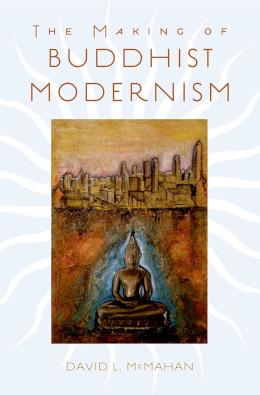
David McMahan, 2008, The Making of Buddhist Modernism, Oxford.
This is a thorough study of the absorption of modern preconceptions into the content of what is taught as Buddhism in modern Buddhism. It method is to trace the sources of individual modern Dhamma teachings, either in some Asian Buddhist tradition, or in some western cultural/religious/intellectual tradition. The results are surprising.
GERRY:
I submit that modern Buddhism needs to focus on the core concepts of EBT, as they relate to the realities of modern life, and in terms which have modern context, and not resort to “blind faith”. Specifically, to teach Buddhism in a way which is Simple, Relevant , and Compelling, we need to strictly avoid any reference to Pali or Sanskrit terms, and their etymology, which is not only confusing and hard to assimilate, but also absolutely unnecessary to the goal, serving as yet another barrier to understanding.
Similarly, with the primary goal, in your words, of cultivating integrity and wisdom, there are many so-called “sacred” Buddhist concepts which are also a barrier and entirely unnecessary, making the teaching counterproductive; the result being to throw the baby out with the bathwater, meaning to discard Buddhism because of extraneous and unrealistic “sacred requirements”, thereby pushing away anyone who has some interest in Buddhism. Its a matter of credibility. Examples of unnecessary barriers include the importance of Karma, merit, re-birth, Realms, devas, killing, vegetarianism, and Nirvana.
BC:
To teach Dhamma without reference to foreign terms would be ideal. I believe that is possible for Chinese, because the technical vocabulary of Dhamma was long ago standardized in the process of translating Indic texts into Chinese in the first millennium (I may be wrong). However, the well-established terminology of Pali has does not translate well into English: a given Pali term may be translated into English in multiple was. For instance Pali samādhi (the meditative state) has been translated as ‘concentration,’ ‘absorbtion,’ ‘composure,’ ‘trance.’ To pinpoint a particular concept precisely we often have to refer to the Pali term, at least alongside the favored English. Given this difficulty, a lot of Pali terms, like samādhi and vipassanā, are entering the English language. Jhāna seems to have no common alternative in the English language.
With regard to those teachings that might be dropped from the Dhammic repertoire, the issue is, Who decides what is or is not necessary? I’m afraid the answer has all too often been modern folk-cultural presuppositions. This is very common among “secular Buddhists.” This is the fastest way to throw the baby out with the bathwater. Let’s look at your examples.
We’ve talked about rebirth: its function is to provide a way of framing practice that projects the continuity of its results far beyond this one life, and makes us responsible for the future. I submit that this continuity is substantial, complex, but can be reframed in many ways (modernity often affords natural understandings that were not available to the Buddha). Simply dismissing the notion as nonsense is not an option, without weakening the Dhamma.
Killing and vegetarianism are meant to go together here, I assume. This gets into the complexities of Buddhist ethics, which will take us far afield. I should point out that vegetarianism is not a significant matter in the early Dhamma. It became very significant in East Asia in the Bodhisatva Precepts, one of which is simply, “Don’t eat meat.”.
I’m not sure what the objection to nirvāna here is. In folk Buddhist traditions Nirvana is often regarded as a kind of divine realm where awakened ones are reborn. There is no such thing in the early Dhamma. The word literally refers to the “extinguishing” of the factors from which our sense of personal identity is fabricated.
Devas (dieties) are mentioned all over the place in the early texts. They are part of the cultural backdrop of the time. However, they are not integral at all (putting aside divine realms of rebirth). For instance, they have no function as objects of worship. In fact sometimes they are treated a comical beings with more bravado than substance. Rhetorically, they underscore the superiority of awakening by comparison.
I daresay, throwing out karma and merit would destroy Buddhism as a practice tradition! Karma (Pali kamma) means intentional action. Practice is therefore kamma. What is often objectional in modern circles is the notion of the “fruits of kamma,” the idea that “I am the heir of my own deeds,” the notion that my actions have significant effect on my future well-being, alongside whatever immediate benefit or harm my deed may produce for others. But consider, we practice for two reasons: Your lawyer or your dentist has a practice that (hopefully) benefits you. That is the consequence for others of their practice. Your neighbor’s kid practices playing the tuba at all hours so that he will become skilled enough to join the marching band, certainly not to entertain you. Skillfulness (maybe even virtuosity if he practices long and wholeheartedly enough) will be the fruit of his practice. I submit that that is (almost) all there is to it. The ultimate fruits of our Buddhist practice are the perfection of the skills of virtue and wisdom. We practice Buddhism with both purposes in mind, but increasingly in advanced practice the fruit becomes primary.
How is this personal well-being? As we develop virtue and wisdom, our personal heightened well-being accumulates, experienced as deep satisfaction with life, as living a meaningful life, a life well-lived life, a spiritually charged life. It is a pervasive contentedness with life. We are all have a sense that this kind of well-being exists, but generally as a promise never delivered, quite a rare experience in modernity. Because it does not have a sensual basis, and is not immediate, it is abstract, hard to pin down. As a result it seems to be framed in imaginative ways in the early texts. The Buddha calls it supra-mundane (lokuttara).
One of the more clumsy ways to frame supramundane experience is as a payback mechanism: if you do some evil deed, then later you’ll get hit by lightning. This reduces supramundance experience to the status of the more easily understood mundane experience. Luckily, such examples are actually very rare in the early texts, and I daresay merely allegorical.
A more skillful, and the most common way to frame this experience of well-being in early Buddhism is as a dwelling place, in particular as a heavenly realm. I think of this as an apt metaphor that captures the idea that we “earn” it over time and that it is a pervasive experience, a kind of psychological condition that is just there, like a gloomy day. Notice that treating it as a psychological condition demythologizes supra-mundane experience. It is noteable that the Buddha does this himself, albeit not commonly: In one instance he describes his nemesis the demon Māra in psychological terms, and elsewhere hell realms in terms of psychological pain.
GERRY:
I once had a nun at Fo Guang Shan tell me that the ~200,000 people killed by the 2004 tsunami in Aceh, Indonesia, were killed because they had bad Karma. I was stunned. Another credibility black eye.
BC:
This is a very common, and hugely unfortunate misunderstanding of kamma in later traditions. It is likely a case of folk Buddhism actually infecting adept Buddhism, it seems particularly in Tibet. It seems to come from not enough loosely holding within the payback framework. It is not beneficial, because it means logically that compassion on the part of others is pointless: the best it can do is postpone the payback. The Buddha explicitly denied this understanding in the Sīvaka Sutts (SN 36.21). Things happen for a variety of natural causes unrelated to kamma. Lightning will strike, whether or not you happen to be standing there.
GERRY:
Merit is another confusing concept. We do good things in life because it benefits others; not for our reward or recognition. Yet “merit” is pushed by many monastics as an essential aspect for achieving the higher realms of rebirth.
BC:
Merit or demerit is at root simply a kind of subjective metric of progress or regress in practice, which is to say the fruit of practice. If you are training for the Olympics or on a diet, you might want to measure your level of effort on a daily basis. It keeps you engaged. Some Burmese actually keep a daily balance sheet with them that they update each time they perform an act of generosity, break a precept, etc. A dieter count calories. The paradox is that the more you seek personal advantage through merit, the less merit you earn. Craving is suffering, and unskillful in Dhammic terms.
GERRY:
Rebirth is an entirely theoretical concept, and one which some question as an authentic part of the Buddha’s teachings. Yet rebirth is what many Buddhists secretly, or overtly, hope for; more cravings. Much like the carrot in Christianity, Salvation, many Buddhists are “expecting” rebirth. Rebirth, in my view, is an erroneous reflection of the Vedic culture at the time of the Buddha’s awakening around 500 BC where the notion of rebirth had been deeply engrained and unquestioned for a 1000 years before the Buddha’s birth.
BC:
My understanding is that the early Vedas have nothing to say about rebirth, and evidence of the concept first shows up in the early Upanashads, maybe 200 years before the Buddha. There it comes in various forms. Interestingly the birth of a son to a father is considered a rebirth in one account. At the time of the Buddha it seems not to have been universally accepted, since the Buddha often debated about it with skeptics. But notably, he never argues that rebirth is true, only that its acceptance as a working assumption is beneficial to practice, for it induces people take responsibility for the future.
GERRY:
Indirectly, following a wholesome life with integrity and wisdom to improve your chances of rebirth, may be positive … ,
BC:
That’s the point. In the Kālama Sutta the Buddha answers the question about when a teaching should be embraced. His answer is very pragmatic: when it is of benefit. This is “taking seriously.” He never gives truth as a criterion, for him truth arguments are unreliable. This is “holding loosely.”
Let me supplement your list of candidates for dropping from the Dhammic repertoire: anything under the rubric of “religiosity.” This includes rights, rituals, institutions, and distinguished roles (priests, monks, etc) and garb (archaic clothing, usually robes). Buddhism has all of this, and has had them since the time of the Buddha. Why are they objectionable? Many secular spheres of modern life have all of these as well: courtrooms, birthday parties, sports events, academic institutions, the military, receiving wine at a high-scale restaurant. Isn’t it peculiar that religiosity is objectionable only when associated with religion? It seems that this particular example of modern cultural baggage arose within religion, with the Protestant Reformation, which rebelled against the excesses of the Catholic Church, and promoted instead the idea of private religion in need of no social trimmings, only individual direct communication with God. This was a religious history in which Buddhism did not participate.


Leave a Reply