Author: bhikkhu cintita

  • Bodhidharma’s Witnesses

    It is commonly known that Buddhism seldom proselytizes, but its practice of “reverse proselytizing” is not so widely appreciated. Here is the idea:

    Bodhidharma was a mythical or half-mythical monk who lived in the fifth to sixth century. He is known for bringing Chan Buddhism from Central Asia to China. Fierce in appearance and demeanor, he is said to have had red hair and beard. Upon learning of Bodhidharma’s appearance in his kingdom, Emperor Wu, a great promoter of Buddhism in China, summoned the venerable to his court. Their conversation went something like this.

    Wu: “I have built pagodas and funded monasteries in my kingdom. What merit have I gained?”

    Bodhidharma: “No merit!”

    Wu: “What are the essential principles of Buddhism?”

    Bodhidharma: “Vast emptiness. Nothing holy.”

    Wu: “Who is it who faces me?”

    Bodhidharma: “I don’t know.”

    Bodhidharma had challenged Emperor Wu’s tightly held preconceptions. Years ago I considered getting a group together and walking door to door carrying Bodhidharma’s message. We would call ourselves “Bodhidharma’s Witnesses.” After all, his attitude seems to have had some success in China, producing a thriving Chan movement that spread from China to Korea, to Japan (where ‘Chan’ was mispronounced as ‘Zen’) and to Vietnam, and that is alive in many more lands to this day.

    In the forests and mountains of ancient China, if a young man was intent on leaving home to join the Chan monastic community, he would approach a monastery, knock on the gate, and request permission to enter. However, he would routinely be denied admittance, rather being told either that they could see that he not worthy of admittance, or that the monastery was already fully occupied. He should go home.

    Determined, the young man would sit cross-legged at the monastery gate in meditation position and endure the challenging wait for the monks within to change their mind. The monks meanwhile would insult the foolish aspirant and throw rotten vegetables at him. But the young man would persist for as long as it took. Fortunately, an empathetic cook would come out once a day and offer food and water. This would go on for days, until the monks within were convinced of the young man’s conviction. They would then relent, shave his head, give him monastic garb and floor space on which to meditate and sleep.

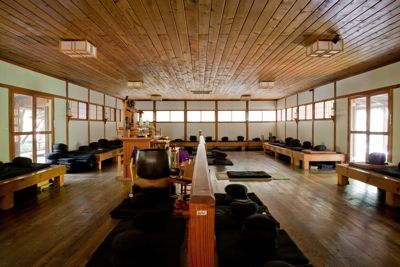
    This challenging tradition continues to this day, but is often formalized. In Japan, the process is called tangaryo. In January 2002, I arrived for a three-month practice period at Tassajara Zen Mountain Monastery deep in the cold coastal mountain range of California, inland from Monterey. Any monk (men and women are both called ‘monks’ at Tassajara) who arrives for a first practice period at Tassajara must undergo tangaryo. At Tassajara tangaryo consistently lasts five days and nights, the aspirant sits in the zendo, receives meals in the zendo, but is given a real bed elsewhere to sleep on from 9:00 at night to 3:50 the next morning. Otherwise the aspiring monk has to be on their allocated cushion (standing also allowed as long as they are standing on their cushion), facing the wall, except to use the restroom, never bathing or shaving. Meanwhile other, established monks come and go freely into and out of the zendo, to sit zazen, to perform services, to learn the chants and how to ring bells and to clean the zendo, as if the tangaryans were not there. These others did so a little too cheerfully for my taste. There is generally a small group of tangaryans at the beginning of any practice period. There were about fifteen of us in January 2002, the women sitting on one side of the zendo, the men on the other.

    meditation hall at Tassajara

    Tangaryo is perhaps the most challenging thing I have ever done on purpose. It was impossible to actually sit zazen in the strictest sense the whole time; apparently nobody ever does. I would start off OK for a few hours, then would have to relax and think about something, remember favorite songs, daydream. When my mind would wander too far beyond control, I would induce some rigor into my practice to bring it back:

    “If you find that your mind has drifted away from the daydream, just let go gently of whatever distraction has arisen, and return to the natural course of the daydream.”

    Later I would return to actual zazen for a couple of more hours, then try to recall my most interesting distraction thus far. With the meal that was brought to my cushion I would drink as much liquid as I could so that I would have to go to the restroom more often, and then drink as much water as I could on the way back to the zendo. On my way back to my seat, I would furtively glance at the women tangaryans facing the wall in their baggy robes, the greatest external thrill I could squeeze out of the day, except for lunch. The women seemed much stiller to me than the men I was sitting next to, certainly than myself.

    Finally, just short of one hundred and twenty hours of this, a disembodied voice manifested in each of our little worlds, congratulated us, asked us to walk up the hill to the hot springs, bathe, to put on clean robes and to join the practice period as full-fledged participants. All fifteen of us had successfully met the challenge, and sat it out. I would learn of would-be monks of the past who had given up and gone home in a huff and with a sigh. “No practice period for you.”

    The tangaryo monks were additionally given an early morning duty for the remainder of our first practice period that we were to take turns performing: We were to light all of the kerosene lamps that illuminate the many paths monks use in the predawn hours, most especially to get to the zendo before four thirty zazen. This arduous task entailed getting up at 2:50 to fumble around with wicks and matches, a miner’s lamp strapped to the head, trying to protect feeble flames from the wiles of the wind.

    Why would anyone want to discourage practice in this way, to reverse the easy entry into practice that proselytizing might have achieved, and to deny practice for those deemed “not worthy”? Come to think of it, denial for the unworthy is common in many walks of life. College admission often requires worthy SAT or GRE scores. Fraternity admission requires enduring some kind of hazing process to establish one’s worth. It’s a cinch that joining a street gang, especially the worst of the worst like the Sharks or the Jets, requires proving one’s worth by performing a ghastly misdeed, such as stealing a police officer’s badge or getting an ill-advised tattoo.

    So, why not let anyone who can navigate the mountainside-hugging road to Tassajara stay there and practice, anyone who can find an apartment near campus attend classes in Ethnographic Research Methods and such, and any kid in the neighborhood join the local gang? I think the answer is that requiring aspirants to make that challenging initial investment promotes excellence. Having made that investment the aspirant will not forget their commitment, nor doubt their ability to fulfill that commitment. Moreover, they will also have joined a community of aspirants who can say the same thing—like-minded, mutually inspiring and mutually supportive individuals. Together they have created an environment in which practice can thrive in excellence if not in numbers. But as an excellent community they will inspire new aspirants to make that same initial investment.

  • Sunday Zoom Dhamma Talks

    I have just added the following to the Events page. Please join us when you can. It is short notice, but I am giving a talk tomorrow (Sunday, December 28, 2025, 10:30 CST) on the Seven Awakening Factors.

    Sunday Jade Temple Dhamma Talks

    click on the banner for more info
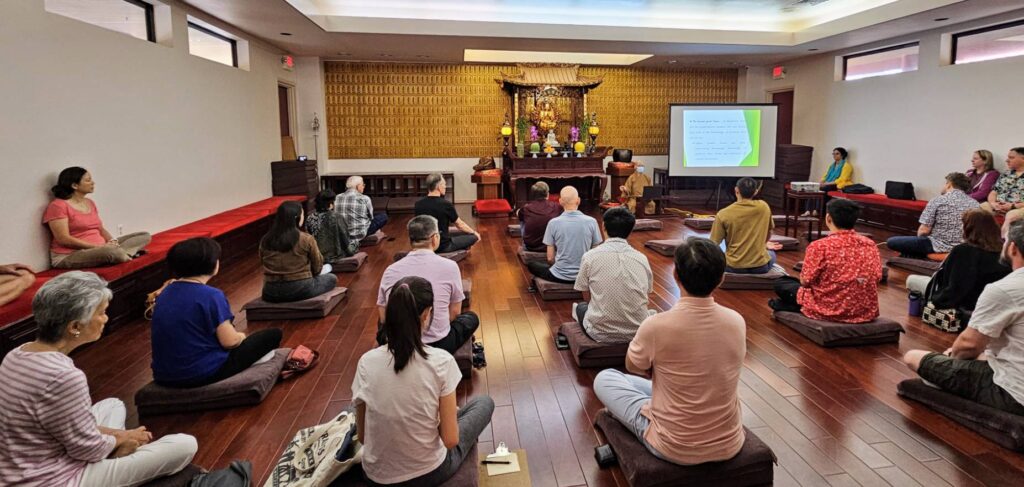
    Kwan Yin Hall, Jade Buddha Temple, Houston, TX

    BC offers occasional talks via Zoom for the Sunday morning program in the Kwan Yin Hall at Jade Buddha Temple in Houston, TX. Each Sunday there is a guided meditation at 10 am Central (Chicago) Time, followed by a short Dhamma Talk at 10:30 am, offered either in person or via Zoom on the big screen. BC is currently scheduled to speak on the following Sundays (subject to change).

    • December 28, 2025
    • January 11, 2026
    • February 8, 2026
    • March 8, 2026
    • April 12, 2026
    • May 10, 2026
    • June 14, 2026
    • July 12, 2026
    • August 9, 2026
    • September 13, 2026
    • October 11, 2026
    • November 8, 2026
    • December 13, 2026

    Click on the current date for the Zoom link. It should be available a day or so before the respective Sunday program.

  • Q&A w/BC: Happiness not suffering

    Bruce:

    Buddhism sounds negative and depressing, because it deals with suffering. And I think a lot of people are turned off with anything dealing with the word suffering. Instead, I’m starting to say that Buddhism deals with happiness – the other side of the coin.

    Sounds strange, but I’m serious.

    My new 4 noble truths:

    There is happiness
    Happiness is caused by the lack of craving
    When you get rid of craving, you reach nibbana.
    To get to nibbana, follow the 8th fold path

    My new Ti-lakkhana:

    Everything is transient
    without a permanent self
    and subject to happiness

    BC:

    Bruce, I’m afraid I’m not with you on this, but I see what you are after.

    Suppose you wake up with a severe pain in the lower right side of your belly, and it doesn’t go away. The rational thing to do would be to go see a doctor. However, they are all negative and depressing, and only want to talk about your suffering, where it comes from, and how to cure it. That is a big turn off, so you go to a party instead, where everything is about happiness. The next morning you wake up with a hangover, and your belly hurts even worse.

    The Buddha is sometimes called the Great Physician. Buddhism starts with suffering, because that is where people are at, but happily the Buddha has diagnosed suffering, and told us how to cure it. That is hardly negative and depressing. People already know suffering; it is prominent in virtually everyone’s life, whereas happiness is generally no more than a vague promise that is rarely fulfilled.

    Unfortunately we live in a culture that is in denial of suffering and in pursuit of happiness. This works neither to lessen the suffering that is there in any case, nor to improve or lead to happiness. Look at how we hide away sickness, crippling illness, aging and even death. Look at how consumer products are advertised with models clearly blissing out at a spiritual level for having found the perfect shampoo, snack or networking solution. There is a strong trend toward marketing Buddhism alongside other traditions in this way.

    Nonetheless, there is much in Buddhist practice that is quite pleasurable, and advanced practitioners do bliss out as suffering recedes. But happiness is the quiet contentment of a meaningful life well-lived that supervenes on practice. It will be elusive as long as we are focused on pursuing it.

    There is another dimension to this: It is not advisable to mess with the Buddha. The Buddha’s Dhamma is a complex integrated system in which each teaching has its place. The whole thing is a guide for practice, how we live our lives, much as a cookbook is a guide for cooking. If we choose to reform one teaching, it is not likely work properly with the other teachings, like substituting sugar for salt. Let’s take the four noble truths as an example:

    (1) the truth of suffering,
    (2) the truth of the origin of suffering,
    (3) the truth of the cessation of suffering, and
    (4) the truth of the way to the cessation of suffering.

    It is often pointed out that this follows what a physician does:

    (1) is the symptom,
    (2) is the diagnosis,
    (3) is the prognosis, and
    (4) is the treatment.

    Since Dhamma is a guide to practice, the Buddha also tells us how to practice with each of these four truths:

    (1) is to be understood.
    (2) is to be eliminated.
    (3) is to be realized.
    (4) is to be pursued.

    Now, if we substitute happiness for suffering, the whole practice becomes something quite different. The extensive wisdom teachings of the Buddha help us understand suffering. The teaching of dependent coarising even provides an elaborate psychology of suffering for us to understand. The Buddha does not provide anything like an equivalent account for happiness. In short, there is very little left in the four noble truths in the way of guidance for practice if we substitute happiness for suffering.

  • Q&A w/BC: Moments of insight

    Anne:

    Can you describe in writing one of your most powerful experiences during meditation?

    BC:

    There is a tendency for modern practitioners to seek after dramatic, unanticipated, immediately life-altering experiences, to which they can attribute either awakening itself, a glimpse of awakening, or a less defined but nonetheless “mystical” experience. Some practitioners are obsessed with achieving such experiences. That might be what you are expecting me to have had, Anne. Seeking such experiences is craving, and certainly detrimental to practice. Accordingly, I try to discourage attributing too much importance to the wonder of such experiences. Though they will occur, the Buddha seems to have had little no or interest in the drama of such experiences, while giving attention to the growing sense of well-being that comes with successful practice to surpass mundane pleasure. We do not practice in order to have dramatic experiences, we practice in order to develop wisdom (as a support for virtue). In the process, however, we do come to see the world in radically different ways. Sometimes we cannot help but be astonished by what we see.

    The experiences I’m referring to are sudden moments of insight associated with wisdom contemplation, in which something that was previously unclear becomes clear. Within the early Buddhist context, they occur particularly in Dhamma investigation (satipaṭṭhāna, vipassanā) within a meditative state (jhāna or samādhi). My book Rethinking Satipaṭṭhāna describes the mechanics of this practice, including what I am about to relate. Outside of the Buddhist context, insight experiences can also arise spontaneously, I suspect especially in children, where they can be disorienting and frightening in the absence of any preparation. In any case, they come suddenly, like a spark but occasionally like a lightning strike. They seem to bubble up from the unconscious mind, then make us want to shout, “Aha!” “Aha” experiences also come with with a conviction, almost a certainty, that one has seen into some deep truth.

    However, the insight experience is typically at best poorly explained in conceptual terms. It is a product of intuition. Concepts generally do not do justice to the experience itself. Tejaniya Sayadaw, a Burmese meditation teacher, gives an example of an insight he once had as a meditation student. The best he could describe it conceptually was, “You can smell only with the nose.” Excited, he told other monks about this great insight, but they all laughed at him. He finally went to his teacher, who acknowledged the depth of this insight, but advised, “When you have an insight, don’t tell the other monks about it. They will think you are crazy.”

    Common broad themes in these experiences are impermanence, non-self, the falling away of the distinction between subjective and objective experience, the nature and depth of suffering, and the mental constructedness of what we presume to be an independent reality“ out there.” The Buddha takes great pains to prime us for insights into such realms through his various Dhamma teachings. Being bound to language, he does this in conceptual terms. Many teachers and scholars accordingly take these conceptual teachings as philosophy, valuable in themselves. In fact, the Buddha’s concern seems to be limited to inducing the practitioner to be able to experience these teachings directly and non-conceptually. He expresses this achievement as “dwelling, having touched X with the body.” We do this through contemplation (in jhāna!) and discovering what the Buddha is talking about in our own experience, making it our own. Aha!

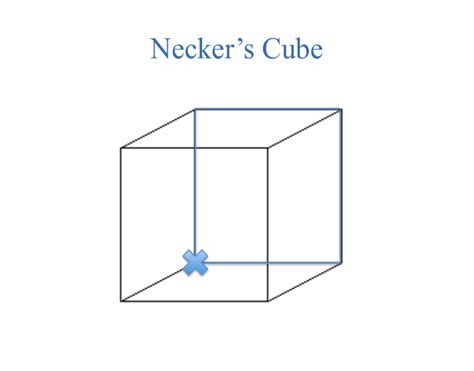
    The closest simple and readily available analogy I’ve found in the mundane world is “Magic Eye” images, 2D patterns that when stared at suddenly (aha) reveal content that appears in 3D. I recommend that beginning practitioners play around with these (I’ve acquired a couple of books of such images for both our Austin and Minnesota libraries). A similar, even simpler effect is found in staring at a Neker’s cube:

    Is the marked corner the closest to you, or the furthest from you? Once the mind has snapped into one interpretation, most people have difficulty snapping into the alternative interpretation. Discovering the alternative is then bound to produce an “aha” experience. One would think that the more firmly the mind is fixed on one interpretation, the more dramatic the discovery of the other will be. One might furthermore even conclude that the more open-minded one is, the more astonishing their insight experiences will be, if and when they eventually do occur.

    One of my favorite wisdom practices is contemplation of the five aggregates, a teaching that leads to insight into the inseparability of mind from the objective, independent world “out there.” Effectively, it teaches the constructedness of reality. (Modern quantum physics seems to have become a precisely focused continuation of this exercise, beginning with the split beam experiment.) Once over twenty years ago I was sitting zazen many hours each day at Tassajara Zen Mountain Monastery in the California coastal mountains, where I lived for almost a year and a half. One is unlikely to learn the five aggregates in Zen, since one is given only vague ideas of what to look for in meditation, most importantly “emptiness” and “non-duality,” with little explanation. Zen takes pride in being a tradition “beyond words and letters,” which in my experience seems to have the effect that insights are few and far between, but it is a whopper if and when one happens to occur.

    I must have had a very fixed idea at this time about the reality of an objective, independent world “out there,” for on this occasion something seemed to snap. I left the meditation hall and felt the world had shifted. I looked up at the tall mountains all around and saw clearly that I was in them and they were in me. There was no separation. I took a walk up the hill up to Suzuki Roshi’s burial sight and spent some time dwelling there in what I had touched. Then suddenly, after about 4 or 5 hours, I snapped back, and couldn’t recover my new interpretation of the world, only a vivid memory of it. I knew I should label the experience “non-duality,” but the label seemed meaningless in view the depth of the experience itself. It was only years later, when I was grounded in the Buddha’s teachings, that I could understand the various experiential facets of this little drama, and even begin explain it conceptually, to the satisfaction of philosophers, but inadequately from the perspective of practitioners. If I had started with the Buddha’s more detailed teachings, I think the drama would have been distributed over many smaller moments of insight.

  • Q&A w/BC: The virtuous vegetarian

    Gerry:

    Killing is another good example of a wrong interpretation of the Buddha’s teachings and intention, as well as strict vegetarianism. The rational “intent” of “no killing” (of sentient beings) as an important precept is to reinforce the wholesome concept of always “doing the right thing”, and to avoid being intentionally “cruel” to living creatures. While this sounds good, the reality is man and other “animals” have to kill to eat and survive. Big animals eat smaller animals, big fish eat smaller fish, birds eat almost anything, from fish to rodents, and pet cats. Killing and dying are “normal” aspects of life. Every living creature eventually dies, sometimes from unpleasant effects of old age, injury, or disease. Killing for food was and is perfectly natural and necessary.  In the Buddha’s time, he was influenced by many wars and needless killing. Moreover, there was, and still is, ritualistic killing in India; mass animal sacrifices to the “gods”. These issues shaped the precept of “no killing”.

    An example of the clear intent and practical need for the precept is found in western culture, particularly in Texas, where sport killing is big business, where “deer season”, and “Dove season”, pheasant and turkey hunts, quail hunts, and the “Safari Club” are viewed as imperatives.  Sport fishing is the same. This mindset is of course exploited by manufacturers as a billion dollar market for guns, ammo, clothing, boats, 4 wheel drive “super trucks”, and expensive taxidermy where some more wealthy “big game hunters” have trophy rooms with hundreds of thousands of dollars in stuffed animals; all for ego. And, as an integral part of this fantasy, heavy alcohol drinking is considered essential.

    It seems logical that a critical thinker like the Buddha, saw this type of killing as “sinful”, or promoting an unwholesome view of life, and therefore the first on his list of Precepts to follow for a better life.  Not killing to live. If this logic for a misinterpretation of “no killing” weren’t enough, the Dali Lama, the Spiritual Leader of Tibetan Buddhism, and realistically the “face” of modern Buddhism in general, eats meat!!!!  (Not something they broadcast).

    Killing to eat, or killing “pests” like mosquitoes, or ants, is practical and logical, just like killing a form of bacteria. It is not detrimental to finding the enlightenment of integrity and wisdom. If we are to spread Buddhism to “westerners” we need to repackage its purpose, and the specific practice to transform our distorted minds.

    BC:

    I’m going to say that the dilemma of not killing is common to all precepts, commandments, or ethical rules. There is no way for any ethical system to provide a fool-proof guide to telling what is right or wrong in all circumstances. This is true of Buddhist precepts as well. But let me first clear up just what the Buddha said about eating meat.

    There is no across-the-board requirement or even recommendation of vegetarianism in early Buddhism. The first of the five standard precepts prohibits attack or killing of “breathing things,” which a butcher (or worker in a slaughterhouse), hunter or fisherman would certainly violate regularly. However, many people eat meat without ever killing. Even though doing so is implicated in killing by others, it is not explicitly prohibited in the early texts. However, a general prohibition against eating meat is observed in East Asia. It is listed among the “Bodhisattva Precepts” in the Brahmajala Sutra. Although this text has a Sanskrit name, scholars have determined it is actually of Chinese origin. Modern Zen centers in America are invariably, at least in my experience, vegetarian.

    The Buddha was, nonetheless, sensitive to implication in killing, rather than killing itself, in a couple of contexts. He significantly restricted meat consumption for the Sangha, whose diet depended on what food was offered to them by householders. Here two principles came into conflict: On the one hand, monks and nuns are expected to accept graciously whatever is offered (effectively, beggars should not be choosers). On the other, he apparently seems to have felt that monks and nuns should not be implicated in killing by consuming meat. He therefore established a compromise: A monk or nun can in general accept and consume meat if it is offered, for instance, from what the family is eating at home in any case. However, they cannot accept or consume meat if they have any reason to suspect that the meat was killed explicitly in order to feed monks or nuns. This is a rule in the Vinaya, the monastic code.

    When I was in Myanmar in 2009, shortly before my ordination, I traveled with my teacher (Ashin Ariyadhamma, abbot of our monastery in Austin, TX) throughout Myanmar, staying primarily in monasteries. At each monastery we visited, U Ariya introduced me to the abbot, and I offered the three traditional bows at his feet. Each time U Ariya would explain in Burmese that I was priest in a Mahayana tradition, but was about to ordain as a Theravada bhikkhu. In every single case the local abbot offered me some advice, generally based on his misunderstanding of some aspect of Mahayana that he felt I needed to rid myself of. But on one occasion I was surprised that the abbot offered the following advice,

    “Don’t eat meat!”

    Already a vegetarian, and aware of the typical Theravada provision about accepting whatever is offered, I chose to play devil’s advocate, “What if a layperson offers it to me, shouldn’t I accept it graciously?”

    “If a layperson offered you a glass of whiskey, would you drink it?”

    “No.”

    “Don’t eat meat!”

    Parenthetically, on another occasion we visited a very prominent 94-year old abbot. In his case, upon hearing U Ariya’s explanation of my desire to change traditions, rather than offering advice, he looked very confused, then said to me in perfect English,

    “Mahayana is perfectly good Buddhism.”

    Another example in which behavior falling short of killing is restricted applies to householders as part of right livelihood. A wrong livelihood is one that is not conducive to practice. One’s livelihood compels one to repeat actions over and over, that therefore have a huge influence on upholding or making progress in practice. The significance of mere implication in others’ breaking certain precepts is thereby magnified. Accordingly, the Buddha characterized professions like manufacture of weapons, raising animals for consumption, human trafficking, and involvement in the alcohol industry as wrong livelihoods.

    Garry, your points concerning the necessity and naturalness of meat consumption are well taken, as well as the important distinction between killing for food and killing for sport. I’ll even add a couple of points: There would be no Buddhism in a vegetarian Tibet. Plant-based agriculture is too meager to sustain the human population. Animals domesticated for food production have thrived historically throughout the world: chickens and cattle abound, because people eat them. However, the animals raised today on factory farms are often subject to far more cruelty that the victims of hunting for sport.

    But let’s zoom out to get an idea of the bigger picture. The ethical questions you note with respect to meat are, I think, in the nature of virtually all precepts to one degree or another. This goes for Buddhist precepts, Christian commandments, civic laws, etc. In my intro to Buddhism (BLBP) I call precepts “rigid and porous.” They are rigid in that they fail to acknowledge exceptions, or the kinds of circumstances you note, in which they become counterproductive, harmful, or non-negotiable. They are porous in that they fail to cover all the circumstances that could use a bit of ethical attention. Precepts constitute a kind of shotgun, hit-or-miss approach to ethics. If they are made less rigid (adding a clause such as, “… unless greater harm results”), people will become very creative in imagining greater harm when they simply find the precept personally inconvenient. If they are made less porous, they become so numerous that no one will remember all of them.

    The value of precepts is to offer simple rules thumb that apply relatively reliably to a wide swath of ethically charged circumstances, in which ethical choices might otherwise be overlooked or require more deliberation than available time. They produce benefit, but are not a reliable calculus that tells us what to do in every circumstance.

    Notably, there are two words for precepts in Pali. One is sīlāni, which simply means ‘behaviors.’ The other is more interesting: sikkhapada, which means ‘training step.’ We follow the precepts partly because most of the time they provide beneficial results, but primarily we use precepts to train multple levels of ethical sensibilities. In Buddhist practice, a precept gives us an opportunity to consider our own motives and needs, the consequences of our alternative choices (especially for others), how alternative actions might make us feel (glowing with compassion, remorseful for what we’ve done?). We thereby learn to engage in our ethical choices more conscienciously.

    Just a couple of days ago I was in a store chatting about the weather with a friendly cashier. She said that she had gone pheasant hunting with her dad earlier that sunny day. I asked if she knew how to prepare pheasant for eating, and was surprised to hear that she didn’t even know if they were going to eat the ones they had bagged. If she had the precept about killing firmly in her mind, she would have raised questions that in fact not not occurred to her. Likewise, an ethically equipped person who wants to rid their house of pests is less likely to undertake extreme measures, like destroying an entire ant colony, and more likely to find clever ways of eliminating the problem, such as finding and plugging the entrance by which ants find their way into the house with a bit of putty. Like other matters of Dhamma, we take precepts seriously, but hold them loosely.

    For the Buddha, every action (kamma) we undertake, every choice we make, has a potential ethical value. Ethics is an art, something we train in until our choices becomes second nature, internalized to the extent that we find ourselves making beneficial and satisfying ethical choices spontaneously and intuitively, without recourse to rules, or even thought. For the Buddha, ethics already has a firm basis in human psychology: what is skillful (kusala) or unskillful (akusala) is defined in these terms. Advanced practice is centered around perfecting this art by putting it to use in our lives under the guidance of Dhamma. “Training steps” are simple Dhammic nuggets of wisdom that provide some direction in many situations that tend to cause thorny problems. Other things we must pay close attention to are how the consequences of our choices play out, what intentions (personal motivations) underlie our choices, how our choices or its consequences make us feel (good? remorseful? cringy?). Ultimately we must also take up wisdom practices in order to discover how our habituated but faulty ways of framing the world (for instance as revolving around a fixed self) affects our behavioral choices. All of these factors become integrated as we advance in practice and become a beacon of virtue.

    In the modern world, excellence is an important concept. We produce virtuoso musicians, excellent actors and athletes, brilliant scientists, martial artists, navy seals, snipers, perfect empoyees that know how to compete in the neoliberal marketplace. The contribution of mindfulness has even played an important role in achieving excellence seemingly across the board. However, modern society provides few opportunities to achieve excellence in virtue. This is where Buddhism has its greatest potential.

  • Remembering Sue Hamilton (1950–2016)

    I just came across this article by Jayavara Attwood that removed much of the mystery in my mind surrounding a remarkable scholar of early Buddhism, who has had enormous influence on my own understanding and scholarship concerning the early teachings of the Buddha. I was saddened to learn (nine years late) that she is no longer with us.

    Scholarship in early Buddhism dwells for the most part within the larger field of Theravada scholarship. This is because the Theravada tradition has—far better than any other tradition—kept the early texts alive, along with the Pali language in which they were transmitted to Ceylon not long after the time of the Buddha. (The Theravada tradition also supplements the Pali Canon by texts of later compilation, most notably the Commentaries including the highly regarded Visuddhimagga.) I myself have been largely disappointed with modern Theravada scholarship for its reluctance to challenge much of the orthodoxy that the tradition has accumulated but left unquestioned for many centuries, even when modern scholars seem to make little sense of those orthodox understandings. (Modern Mahayana, and perhaps especially Tibetan scholarship, in contrast, seem to enjoy more liberty, and to be more productive of insight in their respective fields.)

    My two favorite scholars of early Buddhism are exceptions to the self-imposed limitations in their field. On encountering each in my reading and pondering over the years, I remember having the same reaction to each, “By golly, he’s got it!” or in the other case, “By golly, she’s got it!” Each cracked open issues that I had been trying to wrap my head around for years, in such an explanatory way that I knew they had to be right. However, both scholars remain relatively obscure in their field. The first is the late Sri-Lankan scholar-monk Kaṭukurunde Ñāṇananda. The second is the late Oxford scholar Sue Hamilton. If you go to cintita.org, you will find the page on book resources in the menu bar. Scroll down to “Dhamma scholarship,” and you will find three books by the venerable, followed by Dr. Hamilton’s most important work.

    The reason Sue Hamilton was long a mystery to me was that her active work was limited to a few years around the turn of this century. She was a flash in the pan, then disappeared from the scene. Moreover, there has been virtually no subsequent mention of her in scholarly circles. Attwood provides an account of the choices she had made in her life at that time to end her career. Attwood was the only scholar I was aware of who had expressed admiration for her work (though he points out that her teacher, the very well known Richard Gombrich, had become a strong advocate; I had missed that).

    Hamilton advocated an epistemic understanding of the early Buddhist texts. As Attwood puts it, “Hamilton showed that experience was central to Buddhist teaching and ‘reality’ was not.” As she put it, “If we want to understand anything about ourselves at all, then, it is with our khandhas—our experiencing apparatus—that we need to start.” This idea now pervades my own understanding. In fact I’ve reached the conclusion that until one understands this fundamental point, one will remain hopelessly confused in one’s intellectual understanding of Dhamma. Time and again I’ve seen scholars try to explain some Dhamma teaching or another, then give up for having failed to appreciate what boils down to a simple point. Hamilton’s work is not an easy read—it is scholarship intended for Buddhist scholars—but for anyone wishing to develop a deep understanding of Dhamma, I would recommend it as essential reading.

    BC

  • Q&A w/BC How do we promote Buddhism without corrupting the Dhamma?

    This is a continuing discussion between Gerry Trione and BC.

    Gerry

    Bhante-

    Your insight and perspective on these issues is very helpful for “bridging the gap”. I hope this on-line discussion stimulates others to ponder these issues.

    The underlying question seems to be: “How do we remove the many barriers to promoting Buddhism to westerners without corrupting the Dhamma”?

    BC

    Right.

    GERRY

    My goal is to “simplify” the core concepts into a “Buddhism package” that attracts those most likely to benefit, with the expectation that once convinced of its efficacy, they will want to dig deeper into the more complex issues.

    This implies that Buddhism is not for everyone.

    Like “triage”, there are those who are “too far gone” to adopt Buddhism for various reasons, like being deeply into materialism, huge egos, serious addictions, lifetime devotion to a particular religion, or committed criminals. This category would also include younger, immature people who are consumed with fantasy (video games).

    The second category who are not likely targets is those people who are already “awakened” and content with their lives, already “Buddhists” in many respects. They practice the precepts unknowingly, as well as the 6 perfections and 8 Fold Path. These are genuinely good people with integrity and wisdom.

    The primary target, therefore, is people who have good intentions, but are stuck in cultural habits which contribute to a constant undercurrent of “suffering”, in the form of anger, hate, resentment, cravings, fear, addictions, anxiety and depression, and don’t know what to do about it. They may have tried various “cures”, including “religion”, but nothing has worked. They want help.

    Accordingly, I suspect our “target group” is relatively small compared to the others, so I don’t expect a ground swell of interest.

    BC

    I would agree.

    GERRY

    For comparison, the Jewish faith is certainly a radical departure from the “norm” of Christianity in the US which 62%, or about 203 million, and Jewish followers are estimated to be 2.5%, or 8 million (westerner Buddhists are roughly 600,000).

    From personal experience, Judaism is a generally closely knit group who are disciplined, and actively engaged in their practice which has remarkable results of achievement.

    For example, 14% of physicians are Jewish, and 29% of psychiatrists are Jewish. This disproportionate representation suggest a highly disciplined mind set.

    I see no reason why a similar demographic couldn’t include Buddhists.

    BC

    Judaism is certainly a robust culture. Another fact: 25% of all Nobel Prize winners have been Jewish! I don’t understand its ability to survive so successfully as such a small minority in so many lands without being absorbed, even as it has become significantly atheistic. I remember reading that the Dalai Lama was trying to understand the reason for its success in this regard, seein the progressive weakening of Buddhism among the dispersed Tibetan population in India

    GERRY

    You covered a lot of ground, so I’ll try to respond to the more thorny issues.

    You said: Luckily the Buddha gave us a Dhamma that is malleable; he seems to have anticipated the need for adaptation to new contexts.

    This is at the heart of my focus: To preserve the Dhamma, but repackage the core concepts in terms of their importance or priority leading to awakening.

    BC

    We agree on this, though I think explaining the core concepts in ways modern people understand is effective. What needs to be explained is how each teaching fulfills what function. I think the Dhamma can accommodate the modern mindset in this way about 10%. The other 90% requires overcoming modern cultural baggage that conflicts with Dhamma, such as our hyper-individualism.

    GERRY

    Let’s examine some of the specific discussion points in question:

    -Rebirth. As you point out, this is perhaps the thorniest issue, and the reason it is a major barrier is “credibility”; its focus and speculative nature undermines the credibility of the essential “core concepts”.

    When I use the word “rebirth”, I’m including the notion of an afterlife (hence my reference to Vedic beliefs in 1,500 BC), which, not surprisingly, has long been the focus of most of the largest world religions.

    My view is this is disingenuous since there is no evidence of an afterlife in any religion, other than conjecture, “hearsay”, and wishful thinking.

    BC

    I think objective evidence of its veracity is a moot point. There is no objective evidence that money exists, yet it serves its function, or football, or God. Moreover, “wishful thinking” is not part of Dhamma, though it may be a common part of folk Buddhism.

    GERRY

    As someone with an active interest in “Dark Energy”, and Quantum Fields, I suspect there is some sort of “Universal Energy” throughout the universe which “could be” some manifestation of “God”, or Brahma, etc (the Spinoza view). (Scientists are still struggling after many years with the “Unified Theory”, or the “Theory of everything”, but haven’t yet been able to explain “gravity”!).

    But, to revert back to the Buddha’s skepticism, “Why speculate?”, it’s not relevant to improving our daily lives.

    BC

    Exactly my point.

    GERRY

    Yes, “rebirth/afterlife” provides a “symbolic goal” to encourage our practice to be better people, but does the “deception” justify the goal? My view is no. Better to view rebirth or an afterlife as “maybe”, rather than make it the primary focus, which is the Asian approach.

    BC

    Why speculate? Rebirth is “deceptive” in the sense that money or football are deceptive. Guarding against this is the point of my advice to “take seriously, but hold loosely.” The important question in understanding Dhamma is “Why did the Buddha teach this?”, not “Is it true?”.

    GERRY

    There are plenty of incentives to practice Buddhist core concepts without the “carrot” of rebirth or an afterlife.

    BC

    For the Buddha, rebirth is not a carrot. Quite the opposite. Though that framing does allow provide also the framing for the long-term well-being that comes with progress through practice in terms of rebirth in a heavenly realm. (Why would the Buddha teach that?)

    GERRY

    Specifically, a life with inner peace, contentment, satisfaction, tranquility, and an absence of stress, restlessness, fear, worry, anger, hate, cravings, anxiety, and depression is a goal which I suspect would appeal to everyone.

    What happens when we die is “unknown”, if we are to be intellectually honest. I don’t think “removing” rebirth from teaching the Dhamma is in any way damaging. On the contrary, it is likely to entice people to consider Buddhism.

    BC

    I would suggest you need to be darn sure about that before removing anything. It would be difficult to put it back later. An opinion is not enough basis. Personally, I’ve come regard (after many years of your persuasion) that removing rebirth is damaging, and yet I cannot claim I “believe” in rebirth. The Buddha described why we need rebirth, but he never argued in terms of its truth. He was not interested in speculation.

    By the way, I would regard a fixed belief in rebirth as equally damaging. I know a monk who says that if he did not believe in rebirth, he would not be a monk. If someone proved (presumably scientifically) that rebirth is not real, he would disrobe. That is to put the basis of his whole spiritual life on a very shaky basis.

    About whether to remove certain teachings, my methodology in my scholarly work in interpreting Dhamma is never to reject anything. If a teaching does not make sense to my modern, western brain, I always assume that I need to look harder to see what it means. Of course I acknowledge that some teachings actually might be off base, and that some might be later additions that post-date the Buddha. But this methodology avoids cherry-picking to justify a particular understanding, forces me into a very deep analysis of many topics I might otherwise dismiss, and makes it almost impossible for me to throw the baby out with the bathwater. We need to be careful.

    GERRY

    Regarding “Karma”, and “merit”, they are linked in Asian Buddhism to rebirth and realms, which is essentially the same unnecessary “barrier”.

    To simplify, my view is karma is basically causality, in the sense that our intent and actions have consequences. Do good things, and good things are likely to happen, for others, not intentionally for ourselves.

    BC

    This is not what karma means, nor what the fruits of karma mean. These together are meant to be the primary basis of practice. Karma is practice, the fruits of karma are the progress we make toward awakening as a result of practice. We play the guitar in order to entertain people (consequence), but also to get better at playing the guitar (fruit, which is also a good thing to happen to us).

    GERRY

    Likewise, “merit” is not something we should record in a ledger. We do it because it is the “right thing to do”, and not to keep score for some personal gain.

    BC

    Why not? Merit is the quality of practice in terms of its contribution to developing and cultivating virtue and wisdom. These are not personal gains (the self drops out as we progress), they make the world a better place. The ledger serves to pace one’s practice.

    GERRY

    Better to focus on the clear benefits of the core concepts like the precepts, 8 fold path, 6 perfections, 5 skandhas, 5 hindrances, and notions of impermanence, non-self, mindfulness, and meditation.

    And lastly, depending on who you believe, “Nirvana” is a state of mind of “liberation” from negative thoughts and emotions, and fully enlightened with virtue and wisdom “in this life”. All other interpretations are speculative.

    Let’s think of ways to attract more people to Buddhism for its vast benefits rather than try to preserve questionable Dhamma beliefs.

    BC

    Again, Dhamma is not about beliefs. There are no Dhamma beliefs, at least not in early Buddhism. It is all working assumptions and pointers to what one can see for oneself. I should think that thinking in this way is a cultural bias that comes from later Christianity, perhaps the most belief-based religion (though some would argue against that). The Buddha refused to speculate.

    One of the remarkable things about the Dhamma is that the Buddha has anticipated debates such as this. I wrote the following essay eight years ago on what the Buddha says about faith, belief, truth, view, and skepticism. It’s a bit long but worth the read, if I say so myself, for readers who would like to go more deeply into this topic. Nobody seems to think as clearly about such matters as the Buddha.

    Take Seriously but Hold Loosely (2017)

    We take the teachings of Dhamma seriously because each has a practical function that makes a difference in our lives. If we hold Buddha’s teachings loosely, we have license to interpret them in ways that are most meaningful to us.This is how can preserve the integrity of the Dharma without demanding interpretations that will never make sense to us.

    GERRY

    Let’s not “sacrifice progress for perfection”.

    BC

    Let’s not sacrifice Dhamma for speculation.

    GERRY

    Metta,
  • Q&A w/BC What would you do?

    Colleen Kastenek has has an interesting Q, but rather than adding an A, it is appropriate that I let you readers do that. Please comment below with your answers, and I will summarize the results.

    Colleen

    Just throwing this out there, and I hope a lot of people respond because I am curious: If a Buddhist monk or nun knocked on your door and asked for a few minutes of your time to explain Buddhism, what would you do?

  • This is a test

    Some subscribers (including me) seem not to be receiving blog posts by email from my new site. I’m sending this out as a test. Please excuse the disruption.

  • Q&A w/BC: How should Buddhism be repackaged for modern people?

    Gerry Trione and I have been engaged in a 1-to-1 email discussion following up on a previous post on the difficulty of promoting Buddhism in modern society. He has put in a lot of thought and reflection based on years of experience. We are trying to organize our thread to put it out on this blog, for those that might be interested in this topic. We agree on the major points.

    I am posting this Q&A on the issue of if and in what ways Buddhism might be adapted to fit modern predilections, since I have a well-considered position on this matter, which respectfully differs from Gerry’s. It also gives me an opportunity to explain the title of this site. This is also relevant to the topic of secular Buddhism.

    GERRY:

    Thanks for your response.  I have more comments after more carefully reading your web site, which I enjoyed. Your focus is admirable. While reading much of the English translations of Ven. Hsing Yun’s teachings on “Humanistic Buddhism”, one pithy statement jumped out at me:  “Buddhism must change to fit modern times.”  In my view, he’s right, and it hasn’t. Your work targeting “Modern Buddhists” with your interpretation of EBT seems to be in concert with Ven. Hsing Yun’s admonition.

    BC:

    The Buddha gave the Sangha an explicit 10-point mission statement in the Vinaya, its monastic code. One point is to sustain the integrity of the Dhamma (not the word of the Buddha, but the functional integrity so that it will continue to conduce to awakening). Another is to promote the practice of Dhamma in the world. If the second overrides the first, little is accomplished, because what is promoted is a deficient practice. I think that is why the Sangha has traditionally not been very aggressive in promoting Dhamma (proselytizing is almost unknown). My efforts are primarily directed toward the first point for two reasons. The first is that think the Sangha, and non-monastic scholar-practitioners need to do a better job of preserving the integrity of the Dhamma than it has. There are so many misunderstandings. The second is that scholarship is my forte. I am by nature reclusive, and not as charismatic as Joel Osteen.

    That said, I am very sensitive to difficulty and necessity of fitting together the Dhamma (as it has been communicated to us by our Asian teachers) with our modern mindset (with its peculiar cultural and intellectual history). They are worlds apart. I’ve had to navigate this gap myself over the last decades. (Look at me now: I am thoroughly modern, trained as a scientist, but living with Burmese monks, who represent a culture almost untouched by modernity.) I use the phrase “early Buddhism for modern Buddhists” in reference to that gap, for which I hope am providing a bridge (or at least a ferry boat) in order that at least a few inspired modern minds can make sense of Dhamma, and modern culture (which Gerry and I both agree is not healthy) may move closer to Buddhist culture.

    Luckily the Buddha gave us a Dhamma that is malleable; he seems to have anticipated the need for adaptation to new contexts. As I approach a Dhamma teaching that is obscure to me, I start by asking, “Why would the Buddha teach this?”, not “Does this accord with my modern mindset, or what I think is true?” The Buddha was clearly not interested in philosophical or scientific speculation, and made clear, for instance, in the handful of leaves simile, that he only taught what conduces to awakening. The Dhamma is therefore a complex system in which each part plays its functional role. For example, when I look at rebirth (shown to be perhaps the thorniest teaching for the modern mind) I ask “What is its role?”, not “Can this be scientifically verified?” The Buddha clearly explains its role for us in providing a particular framework in which to practice, never in terms of its objective veracity.

    Once I’ve established its role, I look a how this role is implemented “Hmm, a linear process whereby some continuum that is active at the time of physical death, continues after the time of a subsequent birth”). This is where a modern mind might balk. But there are many possibilities for reframing this implementation. First, the implementation might be meant figuratively, or by example. Second, it might be the best rough guess about how this process works given the state of “science” at the Buddha’s time, a guess we might improve on with modern understandingof genetics, cultural transmission, etc. Or, we could simply not care. What is important is that we see the fruits or deficits of our practice projecting themselves far into the future.

    It is helpful the realize that the Buddha gave us free license to frame things how we want. He was an extreme skeptic himself, to the extent that he considered all truth claims unreliable. He certainly never endorses blind faith (though Buddhists have certainly had it, but so have modern scientists with regard to their scientific presuppositions). The Dhamma does not consist of things to believe, but rather of “working assumptions.” I describe these as things we should “take seriously, but hold loosely.”

    Take Seriously but Hold Loosely (2017)

    We take the teachings of Dhamma seriously because each has a practical function that makes a difference in our lives. If we hold Buddha’s teachings loosely, we have license to interpret them in ways that are most meaningful to us.This is how can preserve the integrity of the Dharma without demanding interpretations that will never make sense to us.


    We humans can accept working assumptions easily, even if they totally contradict our beliefs. We do it all the time. I talk to animals all the time myself, even bugs, because it puts me into a private framework of friendliness. But I know they have no idea of what I am saying. In fact a unique aspect of being human is that we get to make things up symbolically. All it takes is to apply this formula: “See this physical reality here. Well that counts as X,” where X is whatever we want it to be. We live in a largely made-up symbolic world as a result. This is the only sense in which money, property, national borders, any institution, football, and (perhaps) God is real. We are adept at this mode of thinking. We adopt it when it is valuable in coordinating human affairs, or to give us an efficient perspective for approaching certain tasks. This is
    the extent I am willing to adapt early Buddhism for modern Buddhists.

    GERRY:

    However, with all due respect for Fo Guang Shan, which is enormously successful in terms of “active” temples like Chang Mei in Stafford, the problem is it’s all Chinese (or mostly Taiwanese in Stafford), where they teach and promote “Asian Buddhism”, which doesn’t resonate well with Westerners like myself.  This is counter productive to my goals for Hong Fa for westerners.

    Writing for the Smithsonian in April 2025 on archeological Buddhist discoveries in Nepal, Jeffery Bartholet summarized the Buddhism Dilemma quite well:

    Even among believers, the Buddha is a figure who takes on different forms depending on the observer. Among secular Buddhists in the United States, he’s often regarded simply as an enlightened teacher—a person who, through discipline and deep meditation, gained remarkable insights into the human condition and gave instructions for how people can tame and channel their minds to reduce the stress of living. In Asia, where Buddhism is practiced in a bewildering array of different schools and lineages, each with its own traditions and rituals, he’s often a much more magical figure—someone who could levitate and fly long distances, subdue dragons and demons, project duplicates of himself in space, and travel to astral realms. 

    The “traditional Buddhism” taught in most Buddhist temples we have visited is “archaic” and often based on misinterpretation of the EBT, or a complete misunderstanding of the intent, the result being confusion, and dismissal by “critical thinking” westerners.

    BC:

    I find it very helpful here to distinguish what I have called “adept Buddhism” and “Folk Buddhism.” Adept Buddhism gets to the core of the Buddha’s teachings, the four noble truths, impermanence, suffering, non-self, the eightfold noble path. It is what I teach, and is certainly quite coherent in early Buddhism, and also in many later traditions. Folk Buddhism blends in beliefs that originate in local cultures, adding a lot of color, but confusing modern people. I never cease to be surprised at the things Burmese Buddhists, for instance, commonly believe; sometimes monastics try to correct these beliefs in terms of the early texts, but to little avail). If we can distinguish what’s adapt and what’s folk (the adepts are likely to know), we can put aside the folk; it doesn’t do modern people much good anyway. Besides, we have our own modern folk Buddhism. I think other fields of adept knowledge also have a folk accompaniment: we certainly have a lively folk science, for instance. Adept Buddhism is what has traditionally been preserved by the monastic Sangha, but in modern circumstances Buddhist scholars, lay teachers, and many very advanced lay practitioners are also prominent. Folk Buddhism is rather free to go wherever folk’s imaginations carry them.

    I view folk Buddhism as rather innocuous, as long as it does not challenge to principles of adept Buddhism. The adepts tend to know what is adept and what is folk, and the Buddhist culture tends to move away from the contradictions., and has had many centuries to iron things out. In fact, Buddhist tolerance of sometimes off-the-wall folk beliefs probably enabled Buddhist to become the first world religion in permitting it to travel into foreign cultures. A playful attitude is helpful in the encounter of Asian folk Buddhism. On one occasion I found myself in a position where I was expected to talk to angry tree spirits in Texas, who might not know Burmese or Pali. For me it was all in fun.

    What I most worry about is modern cultural baggage. I’ve been talking about ways to adapt an Dhamma to the modern mind, but it is even more important that we change modern culturally defined presuppositions that contradict the Dhamma. After all, we cannot bridge the gap between Dhamma and the modern mind otherwise, so that Dhamma practice can relieve what ails modern culture. It concerns me that Buddhism is so poorly understood by modern teachers of Buddhism. Many teach something as Buddhism that is almost entirely of western origin. We have to reconsider our hyper-individualism, our anti-religious attitudes (even among the religious), our materialism, commercialism and much more. Gerry and I both agree that Buddhist values are almost the opposite of modern cultural values. If Buddhism is to help cure what ails us, we have to challenge our modern cultural baggage.

    David McMahan, 2008, The Making of Buddhist Modernism, Oxford.

    This is a thorough study of the absorption of modern preconceptions into the content of what is taught as Buddhism in modern Buddhism. It method is to trace the sources of individual modern Dhamma teachings, either in some Asian Buddhist tradition, or in some western cultural/religious/intellectual tradition. The results are surprising.

    GERRY:

    I submit that modern Buddhism needs to focus on the core concepts of EBT, as they relate to the realities of modern life, and in terms which have modern context, and not resort to “blind faith”. Specifically, to teach Buddhism in a way which is Simple, Relevant , and Compelling, we need to strictly avoid any reference to Pali or Sanskrit terms, and their etymology, which is not only confusing and hard to assimilate, but also absolutely unnecessary to the goal,  serving as yet another barrier to understanding.

    Similarly, with the primary goal, in your words, of cultivating integrity and wisdom, there are many so-called “sacred” Buddhist concepts which are also a barrier and entirely unnecessary, making the teaching counterproductive; the result being to throw the baby out with the bathwater, meaning to discard Buddhism because of extraneous and unrealistic “sacred requirements”, thereby pushing away anyone who has some interest in Buddhism. Its a matter of credibility. Examples of unnecessary barriers include the importance of Karma, merit, re-birth, Realms, devas, killing, vegetarianism, and Nirvana. 

    BC:

    To teach Dhamma without reference to foreign terms would be ideal. I believe that is possible for Chinese, because the technical vocabulary of Dhamma was long ago standardized in the process of translating Indic texts into Chinese in the first millennium (I may be wrong). However, the well-established terminology of Pali has does not translate well into English: a given Pali term may be translated into English in multiple was. For instance Pali samādhi (the meditative state) has been translated as ‘concentration,’ ‘absorbtion,’ ‘composure,’ ‘trance.’ To pinpoint a particular concept precisely we often have to refer to the Pali term, at least alongside the favored English. Given this difficulty, a lot of Pali terms, like samādhi and vipassanā, are entering the English language. Jhāna seems to have no common alternative in the English language.

    With regard to those teachings that might be dropped from the Dhammic repertoire, the issue is, Who decides what is or is not necessary? I’m afraid the answer has all too often been modern folk-cultural presuppositions. This is very common among “secular Buddhists.” This is the fastest way to throw the baby out with the bathwater. Let’s look at your examples.

    We’ve talked about rebirth: its function is to provide a way of framing practice that projects the continuity of its results far beyond this one life, and makes us responsible for the future. I submit that this continuity is substantial, complex, but can be reframed in many ways (modernity often affords natural understandings that were not available to the Buddha). Simply dismissing the notion as nonsense is not an option, without weakening the Dhamma.

    Killing and vegetarianism are meant to go together here, I assume. This gets into the complexities of Buddhist ethics, which will take us far afield. I should point out that vegetarianism is not a significant matter in the early Dhamma. It became very significant in East Asia in the Bodhisatva Precepts, one of which is simply, “Don’t eat meat.”.

    I’m not sure what the objection to nirvāna here is. In folk Buddhist traditions Nirvana is often regarded as a kind of divine realm where awakened ones are reborn. There is no such thing in the early Dhamma. The word literally refers to the “extinguishing” of the factors from which our sense of personal identity is fabricated.

    Devas (dieties) are mentioned all over the place in the early texts. They are part of the cultural backdrop of the time. However, they are not integral at all (putting aside divine realms of rebirth). For instance, they have no function as objects of worship. In fact sometimes they are treated a comical beings with more bravado than substance. Rhetorically, they underscore the superiority of awakening by comparison.

    I daresay, throwing out karma and merit would destroy Buddhism as a practice tradition! Karma (Pali kamma) means intentional action. Practice is therefore kamma. What is often objectional in modern circles is the notion of the “fruits of kamma,” the idea that “I am the heir of my own deeds,” the notion that my actions have significant effect on my future well-being, alongside whatever immediate benefit or harm my deed may produce for others. But consider, we practice for two reasons: Your lawyer or your dentist has a practice that (hopefully) benefits you. That is the consequence for others of their practice. Your neighbor’s kid practices playing the tuba at all hours so that he will become skilled enough to join the marching band, certainly not to entertain you. Skillfulness (maybe even virtuosity if he practices long and wholeheartedly enough) will be the fruit of his practice. I submit that that is (almost) all there is to it. The ultimate fruits of our Buddhist practice are the perfection of the skills of virtue and wisdom. We practice Buddhism with both purposes in mind, but increasingly in advanced practice the fruit becomes primary.

    How is this personal well-being? As we develop virtue and wisdom, our personal heightened well-being accumulates, experienced as deep satisfaction with life, as living a meaningful life, a life well-lived life, a spiritually charged life. It is a pervasive contentedness with life. We are all have a sense that this kind of well-being exists, but generally as a promise never delivered, quite a rare experience in modernity. Because it does not have a sensual basis, and is not immediate, it is abstract, hard to pin down. As a result it seems to be framed in imaginative ways in the early texts. The Buddha calls it supra-mundane (lokuttara).

    One of the more clumsy ways to frame supramundane experience is as a payback mechanism: if you do some evil deed, then later you’ll get hit by lightning. This reduces supramundance experience to the status of the more easily understood mundane experience. Luckily, such examples are actually very rare in the early texts, and I daresay merely allegorical.

    A more skillful, and the most common way to frame this experience of well-being in early Buddhism is as a dwelling place, in particular as a heavenly realm. I think of this as an apt metaphor that captures the idea that we “earn” it over time and that it is a pervasive experience, a kind of psychological condition that is just there, like a gloomy day. Notice that treating it as a psychological condition demythologizes supra-mundane experience. It is noteable that the Buddha does this himself, albeit not commonly: In one instance he describes his nemesis the demon Māra in psychological terms, and elsewhere hell realms in terms of psychological pain.

    GERRY:

    I once had a nun at Fo Guang Shan tell me that the ~200,000 people killed by the 2004 tsunami in Aceh, Indonesia, were killed because they had bad Karma.  I was stunned. Another credibility black eye.

    BC:

    This is a very common, and hugely unfortunate misunderstanding of kamma in later traditions. It is likely a case of folk Buddhism actually infecting adept Buddhism, it seems particularly in Tibet. It seems to come from not enough loosely holding within the payback framework. It is not beneficial, because it means logically that compassion on the part of others is pointless: the best it can do is postpone the payback. The Buddha explicitly denied this understanding in the Sīvaka Sutts (SN 36.21). Things happen for a variety of natural causes unrelated to kamma. Lightning will strike, whether or not you happen to be standing there.

    GERRY:

    Merit is another confusing concept.  We do good things in life because it benefits others; not for our reward or recognition. Yet “merit” is pushed by many monastics as an essential aspect for achieving the higher realms of rebirth.

    BC:

    Merit or demerit is at root simply a kind of subjective metric of progress or regress in practice, which is to say the fruit of practice. If you are training for the Olympics or on a diet, you might want to measure your level of effort on a daily basis. It keeps you engaged. Some Burmese actually keep a daily balance sheet with them that they update each time they perform an act of generosity, break a precept, etc. A dieter count calories. The paradox is that the more you seek personal advantage through merit, the less merit you earn. Craving is suffering, and unskillful in Dhammic terms.

    GERRY:

    Rebirth is an entirely theoretical concept, and one which some question as an authentic part of the Buddha’s teachings. Yet rebirth is what many Buddhists secretly, or overtly, hope for; more cravings. Much like the carrot in Christianity, Salvation, many Buddhists are “expecting” rebirth. Rebirth, in my view, is an erroneous reflection of the Vedic culture at the time of the Buddha’s awakening around 500 BC where the notion of rebirth had been deeply engrained and unquestioned for a 1000 years before the Buddha’s birth.

    BC:

    My understanding is that the early Vedas have nothing to say about rebirth, and evidence of the concept first shows up in the early Upanashads, maybe 200 years before the Buddha. There it comes in various forms. Interestingly the birth of a son to a father is considered a rebirth in one account. At the time of the Buddha it seems not to have been universally accepted, since the Buddha often debated about it with skeptics. But notably, he never argues that rebirth is true, only that its acceptance as a working assumption is beneficial to practice, for it induces people take responsibility for the future.

    GERRY:

    Indirectly, following a wholesome life with integrity and wisdom to improve your chances of rebirth, may be positive … ,

    BC:

    That’s the point. In the Kālama Sutta the Buddha answers the question about when a teaching should be embraced. His answer is very pragmatic: when it is of benefit. This is “taking seriously.” He never gives truth as a criterion, for him truth arguments are unreliable. This is “holding loosely.”

    Let me supplement your list of candidates for dropping from the Dhammic repertoire: anything under the rubric of “religiosity.” This includes rights, rituals, institutions, and distinguished roles (priests, monks, etc) and garb (archaic clothing, usually robes). Buddhism has all of this, and has had them since the time of the Buddha. Why are they objectionable? Many secular spheres of modern life have all of these as well: courtrooms, birthday parties, sports events, academic institutions, the military, receiving wine at a high-scale restaurant. Isn’t it peculiar that religiosity is objectionable only when associated with religion? It seems that this particular example of modern cultural baggage arose within religion, with the Protestant Reformation, which rebelled against the excesses of the Catholic Church, and promoted instead the idea of private religion in need of no social trimmings, only individual direct communication with God. This was a religious history in which Buddhism did not participate.

    Please reply below to contribute to the discussion.