It is commonly known that Buddhism seldom proselytizes, but its practice of “reverse proselytizing” is not so widely appreciated. Here is the idea:
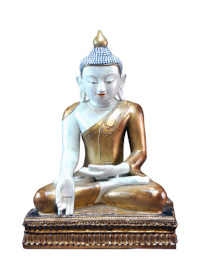
Bodhidharma was a mythical or half-mythical monk who lived in the fifth to sixth century. He is known for bringing Chan Buddhism from Central Asia to China. Fierce in appearance and demeanor, he is said to have had red hair and beard. Upon learning of Bodhidharma’s appearance in his kingdom, Emperor Wu, a great promoter of Buddhism in China, summoned the venerable to his court. Their conversation went something like this.
Wu: “I have built pagodas and funded monasteries in my kingdom. What merit have I gained?”
Bodhidharma: “No merit!”
Wu: “What are the essential principles of Buddhism?”
Bodhidharma: “Vast emptiness. Nothing holy.”
Wu: “Who is it who faces me?”
Bodhidharma: “I don’t know.”
Bodhidharma had challenged Emperor Wu’s tightly held preconceptions. Years ago I considered getting a group together and walking door to door carrying Bodhidharma’s message. We would call ourselves “Bodhidharma’s Witnesses.” After all, his attitude seems to have had some success in China, producing a thriving Chan movement that spread from China to Korea, to Japan (where ‘Chan’ was mispronounced as ‘Zen’) and to Vietnam, and that is alive in many more lands to this day.
In the forests and mountains of ancient China, if a young man was intent on leaving home to join the Chan monastic community, he would approach a monastery, knock on the gate, and request permission to enter. However, he would routinely be denied admittance, rather being told either that they could see that he not worthy of admittance, or that the monastery was already fully occupied. He should go home.
Determined, the young man would sit cross-legged at the monastery gate in meditation position and endure the challenging wait for the monks within to change their mind. The monks meanwhile would insult the foolish aspirant and throw rotten vegetables at him. But the young man would persist for as long as it took. Fortunately, an empathetic cook would come out once a day and offer food and water. This would go on for days, until the monks within were convinced of the young man’s conviction. They would then relent, shave his head, give him monastic garb and floor space on which to meditate and sleep.
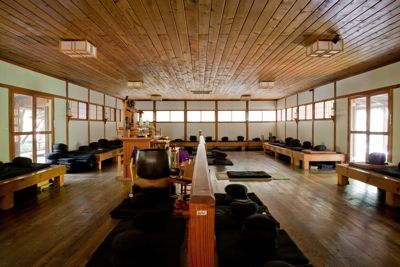
This challenging tradition continues to this day, but is often formalized. In Japan, the process is called tangaryo. In January 2002, I arrived for a three-month practice period at Tassajara Zen Mountain Monastery deep in the cold coastal mountain range of California, inland from Monterey. Any monk (men and women are both called ‘monks’ at Tassajara) who arrives for a first practice period at Tassajara must undergo tangaryo. At Tassajara tangaryo consistently lasts five days and nights, the aspirant sits in the zendo, receives meals in the zendo, but is given a real bed elsewhere to sleep on from 9:00 at night to 3:50 the next morning. Otherwise the aspiring monk has to be on their allocated cushion (standing also allowed as long as they are standing on their cushion), facing the wall, except to use the restroom, never bathing or shaving. Meanwhile other, established monks come and go freely into and out of the zendo, to sit zazen, to perform services, to learn the chants and how to ring bells and to clean the zendo, as if the tangaryans were not there. These others did so a little too cheerfully for my taste. There is generally a small group of tangaryans at the beginning of any practice period. There were about fifteen of us in January 2002, the women sitting on one side of the zendo, the men on the other.
Tangaryo is perhaps the most challenging thing I have ever done on purpose. It was impossible to actually sit zazen in the strictest sense the whole time; apparently nobody ever does. I would start off OK for a few hours, then would have to relax and think about something, remember favorite songs, daydream. When my mind would wander too far beyond control, I would induce some rigor into my practice to bring it back:
“If you find that your mind has drifted away from the daydream, just let go gently of whatever distraction has arisen, and return to the natural course of the daydream.”
Later I would return to actual zazen for a couple of more hours, then try to recall my most interesting distraction thus far. With the meal that was brought to my cushion I would drink as much liquid as I could so that I would have to go to the restroom more often, and then drink as much water as I could on the way back to the zendo. On my way back to my seat, I would furtively glance at the women tangaryans facing the wall in their baggy robes, the greatest external thrill I could squeeze out of the day, except for lunch. The women seemed much stiller to me than the men I was sitting next to, certainly than myself.
Finally, just short of one hundred and twenty hours of this, a disembodied voice manifested in each of our little worlds, congratulated us, asked us to walk up the hill to the hot springs, bathe, to put on clean robes and to join the practice period as full-fledged participants. All fifteen of us had successfully met the challenge, and sat it out. I would learn of would-be monks of the past who had given up and gone home in a huff and with a sigh. “No practice period for you.”
The tangaryo monks were additionally given an early morning duty for the remainder of our first practice period that we were to take turns performing: We were to light all of the kerosene lamps that illuminate the many paths monks use in the predawn hours, most especially to get to the zendo before four thirty zazen. This arduous task entailed getting up at 2:50 to fumble around with wicks and matches, a miner’s lamp strapped to the head, trying to protect feeble flames from the wiles of the wind.
Why would anyone want to discourage practice in this way, to reverse the easy entry into practice that proselytizing might have achieved, and to deny practice for those deemed “not worthy”? Come to think of it, denial for the unworthy is common in many walks of life. College admission often requires worthy SAT or GRE scores. Fraternity admission requires enduring some kind of hazing process to establish one’s worth. It’s a cinch that joining a street gang, especially the worst of the worst like the Sharks or the Jets, requires proving one’s worth by performing a ghastly misdeed, such as stealing a police officer’s badge or getting an ill-advised tattoo.
So, why not let anyone who can navigate the mountainside-hugging road to Tassajara stay there and practice, anyone who can find an apartment near campus attend classes in Ethnographic Research Methods and such, and any kid in the neighborhood join the local gang? I think the answer is that requiring aspirants to make that challenging initial investment promotes excellence. Having made that investment the aspirant will not forget their commitment, nor doubt their ability to fulfill that commitment. Moreover, they will also have joined a community of aspirants who can say the same thing—like-minded, mutually inspiring and mutually supportive individuals. Together they have created an environment in which practice can thrive in excellence if not in numbers. But as an excellent community they will inspire new aspirants to make that same initial investment.


Leave a Reply