The following is the final chapter of my recently revised book Rethinking Satipatthana. It can be read independently of the other chapters. It deals with the question of whether investigation of Dhamma can occur in deep jhāna, and concludes not only that it can, but that it is required in order to completely internalize Dhamma.
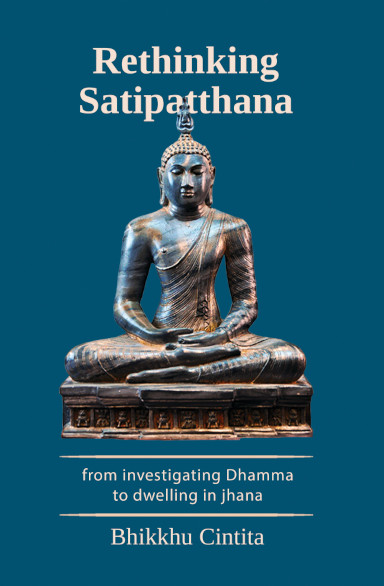
Bhikkhu Cintita, 2026, Rethinking Satipaṭṭāna: from investigating Dhamma to dwelling in Jhāna.
This is a thoroughgoing reevaluation of the early wisdom meditation teachings of the Buddha that lead to “knowledge and vision of things as they are.” It demonstrates the critical role of the integration of samādhi in the investigation of Dhamma.

| 
|
Many centuries ago, the question of the role of samādhi in satipaṭṭhāna opened up a contentious Dhammic rift that remains with us today. The core question is: “How can the investigation or knowledge of something as complex and wise as Dhamma be experienced in the deep stillness of jhāna?” The title of this chapter suggests that an encouraging answer to this question is forthcoming. However, the almost unanimously accepted answer to this core question among scholars today is: “Investigation of Dhamma can not occur in jhāna!”
In spite of this consensus, its adherents manage to split themselves further into two camps with regard to whether Dhamma investigation or jhāna is primary in the path to liberation. The following seems to be a rough overview of the membership of the two camps overview.1
Contemplating Dhamma is primary. Gombrich, Conze, Rahula, Collins, Carrithers, Masefield, Lindtner, Hamilton, and also most modern Vipassanā traditions.
Typically, Samādhi is thereby regarded as a preparation for contemplation.
Jhāna is primary. Griffiths, Vetter, Wynne, Bronkhorst, Rhys Davids, Norman, Cousing, Gethin, Anālayo, Sujato, Kuan, Samuel, Brahmāli.
Often deep jhāna is regarded as the (ofttimes mystical) liberating experience itself, and Dhamma as a kind of secondary, conceptual bi-product. Sometimes contemplating Dhamma is regarded as a preparation for jhāna.
On the other hand, Shulman challenges two questionable assumptions underlying the presumed incompatibility of Dhamma investigation and jhāna. In his 2014 book Rethinking the Buddha, he argues:
- that Dhamma, in the very earliest texts, is not generally abstract philosophy in need of higher reasoning processes, but rather for the most part descriptive of direct experience, and
- that repeated Dhamma investigation itself induces a “restructuring” or “internalization” of content conducive to a more spontaneous means of apprehension.
In chapter five I have taken his first point to heart in showing how each of the Dhamma teachings referred to in the Satipaṭṭhāna Sutta has a nuts-and-bolts interpretation in terms of direct observables. In this final chapter, I will focus on Shulman’s second point. We will learn that internalization is already intrinsic to all human skill acquisition, from learning to walk or drive a car, to weaving or to playing the accordion. In each case, it turns know-what into a progressively more spontaneous, intuitive and non-conceptual know-how, easily, with repeated practice, within the capabilities of the still mind. In fact, we will see how jhāna serves to enable the practice of investigation to reach ever greater refinement as internalization puts it out of the reach of the more deliberate reasoning processes, with remarkable results.
It should also be appreciated by the end of this chapter that if we equate satipaṭṭhāna investigation with vipassanā, and jhāna with samatha, the Buddha’s few statements about the need to balance these in practice make sense. The Buddha said,
Again, a bhikkhu developssamathaand vipassanā in conjunction. As he is developing samatha and vipassanā in conjunction, the path is generated. He pursues this path, develops itand cultivates it. As he is pursuing, developing and cultivating this path, the fetters are abandoned and the underlying dispositions are uprooted. (AN 4.170)


Leave a Reply